
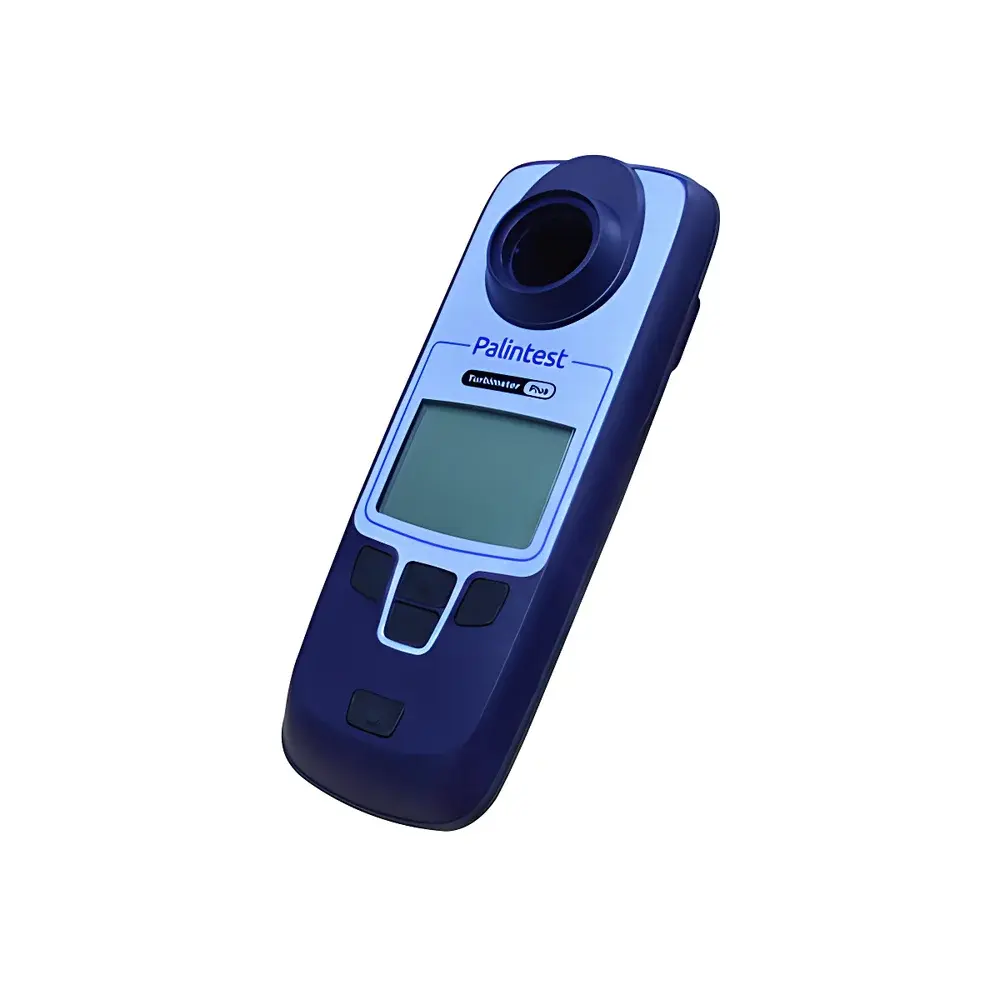
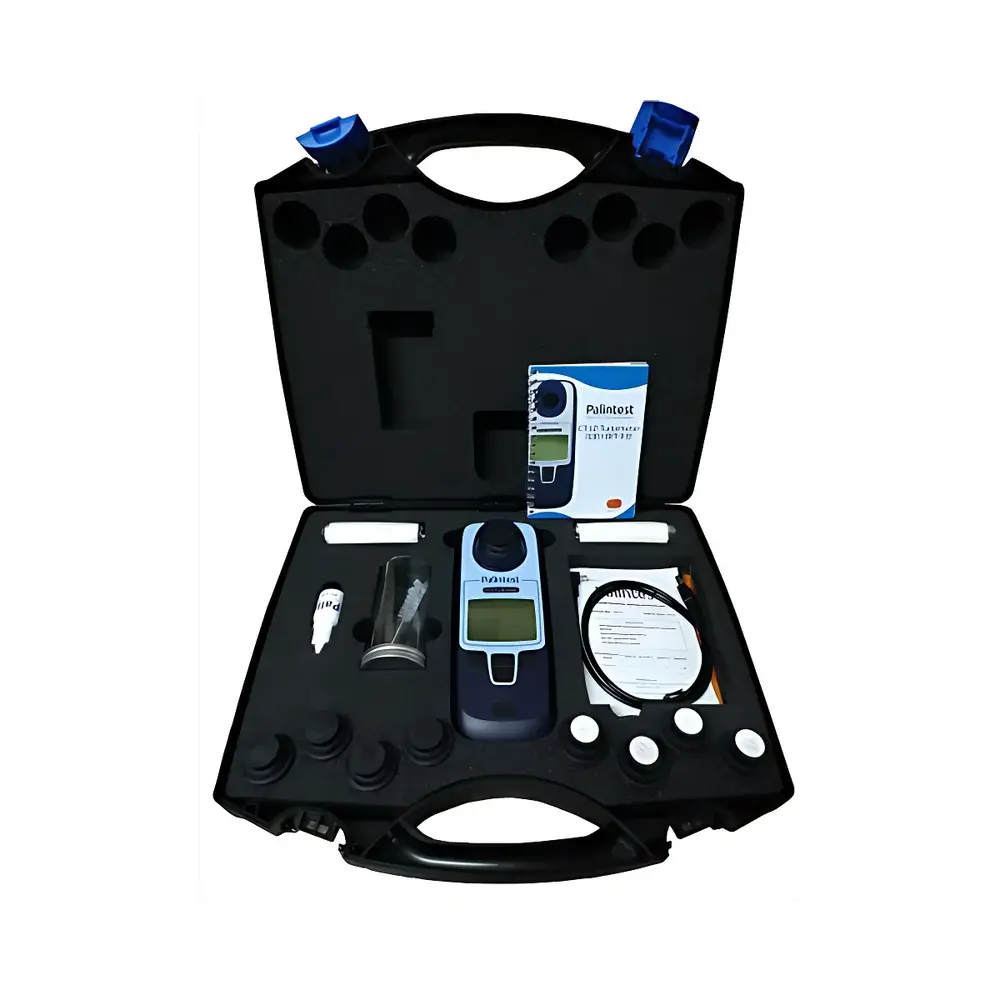
Palintest CT12 Portable Digital Turbidimeter
| Brand | Palintest |
|---|---|
| Origin | United Kingdom |
| Model | CT12 |
| Type | Portable |
| Optical System | QuadoptiX™ dual-source 860 nm LED with dual silicon photodiode detection |
| Compliance | ISO 7027 |
| Measurement Range | 0.01–1050 NTU |
| Accuracy | ±2% of reading |
| Resolution | 0.01 NTU (≤9.99 NTU), 0.1 NTU (10–99.9 NTU), 1% of reading (>100 NTU) |
| Repeatability | ±1% |
| Power Supply | 2 × AA batteries (≈10,000 measurements) or USB bus power |
| Operating Environment | 0–50 °C, ≤90% RH |
| Dimensions | 82 × 225 × 50 mm |
| Weight | 340 g |
| Ingress Protection | IP67 |
| Measurement Modes | Single, Average, Continuous, TSS estimation |
| Data Storage | Internal logging for measurements and calibration records |
Overview
The Palintest CT12 Portable Digital Turbidimeter is a microprocessor-controlled optical instrument engineered for field-deployable, high-fidelity turbidity measurement in compliance with ISO 7027:2016. It employs the proprietary QuadoptiX™ optical architecture—a dual-beam, dual-detector configuration utilizing two precisely matched 860 nm near-infrared LEDs and two calibrated silicon photodiodes. This design eliminates interference from sample coloration, stray light, and source intensity fluctuations by enabling real-time differential signal compensation. Unlike single-beam systems vulnerable to lamp aging or cuvette imperfections, the CT12 delivers stable, traceable performance across its full 0.01–1050 NTU range—spanning raw surface water, clarified potable supplies, wastewater effluents, and process streams. Its adherence to ISO 7027 ensures metrological equivalence with laboratory-grade benchtop turbidimeters, making it suitable for regulatory reporting, routine surveillance, and emergency response where portability and standard-compliant data integrity are non-negotiable.
Key Features
- QuadoptiX™ dual-source/dual-detector optical system for enhanced immunity to chromatic interference and photometric drift
- ISO 7027:2016 certified measurement protocol with NIST-traceable calibration verification capability
- IP67-rated enclosure—fully dust-tight and submersible to 1 m for 30 minutes—enabling operation in harsh outdoor, industrial, or flood-affected environments
- Low-power architecture: 2 × AA alkaline batteries support up to 10,000 measurements; auto-power-off and battery-level indicator ensure operational continuity
- Integrated TSS estimation algorithm correlated to turbidity readings using empirically validated conversion factors (user-configurable slope/offset)
- Three measurement modes: single-shot (instant readout), multi-point average (up to 10 samples), and continuous monitoring (real-time trend capture)
- On-device storage of ≥500 measurement records plus full calibration history—including date/time stamp, standard used, and operator ID field
Sample Compatibility & Compliance
The CT12 accepts standard 25 mm round glass or polycarbonate sample cells (e.g., Palintest PT 555 tubes), accommodating both low-turbidity drinking water (<1 NTU) and highly scattering wastewater matrices (up to 1050 NTU). Its 860 nm NIR excitation minimizes absorption artifacts from yellow-colored dissolved organic matter (e.g., humic substances), ensuring fidelity in natural water analysis. The instrument meets ISO 7027 requirements for spectral bandwidth (<60 nm FWHM), detector angular acceptance (90° ±2.5°), and stray light rejection (<0.001% at 1000 NTU). It supports GLP-compliant workflows via timestamped audit trails, user-accessible calibration logs, and password-protected configuration settings—facilitating FDA 21 CFR Part 11 readiness when paired with Palintest’s optional PC software suite.
Software & Data Management
Raw and averaged turbidity values, TSS estimates, calibration events, and environmental metadata (temperature, operator ID) are stored internally with ISO 8601 timestamps. Data export is supported via USB-C interface to Windows/macOS platforms using Palintest DataLink v3.x software—enabling CSV/Excel export, statistical summary generation (mean, SD, CV%), and graphical trend visualization. The firmware includes configurable data retention policies and optional encryption for sensitive field deployments. All calibration certificates and factory verification reports are digitally embedded and retrievable within the device UI, eliminating paper-based record dependency.
Applications
- Drinking water safety monitoring: compliance verification per WHO Guidelines and national standards (e.g., US EPA Method 180.1, UK DWI Regs)
- Wastewater treatment plant operations: influent/effluent QC, clarifier performance assessment, and sludge blanket depth correlation
- Environmental field surveys: river/lake sediment load tracking, stormwater runoff characterization, and post-remediation validation
- Industrial process control: cooling tower water clarity, pharmaceutical rinse water verification, and food/beverage filtration integrity checks
- Public health emergency response: rapid on-site assessment during boil-water advisories or infrastructure failure events
FAQ
Does the CT12 require annual recalibration by an accredited lab?
No—field recalibration using Palintest-certified Formazin or AMCO AEPA standards is sufficient for routine use. However, annual verification against primary reference standards is recommended for GLP/GMP environments.
Can the TSS estimation be customized for site-specific correlations?
Yes—the slope and intercept of the turbidity-to-TSS regression can be user-defined and saved per application profile.
Is USB power delivery compatible with all USB-A and USB-C hosts?
The CT12 accepts 5 V DC ±5% from any compliant USB 2.0 host or power bank; no driver installation is required.
How does the IP67 rating impact long-term reliability in humid tropical climates?
Sealed O-rings, conformal-coated PCBs, and corrosion-resistant stainless steel fasteners ensure sustained performance at 90% RH and 50°C ambient—validated over 12-month accelerated aging tests.
Are measurement units limited to NTU, or can other scales (FNU, FAU) be selected?
The instrument reports exclusively in NTU per ISO 7027; FNU is numerically equivalent under this standard and requires no unit conversion.





