
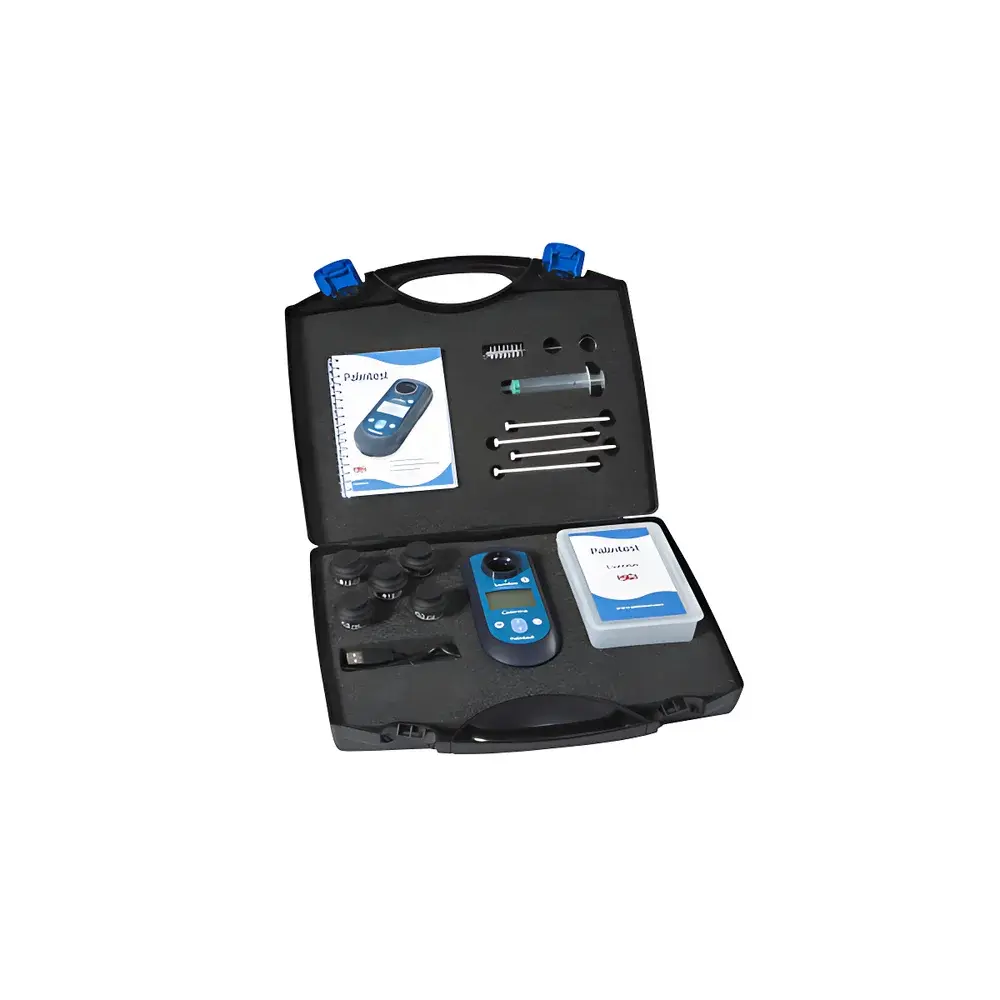
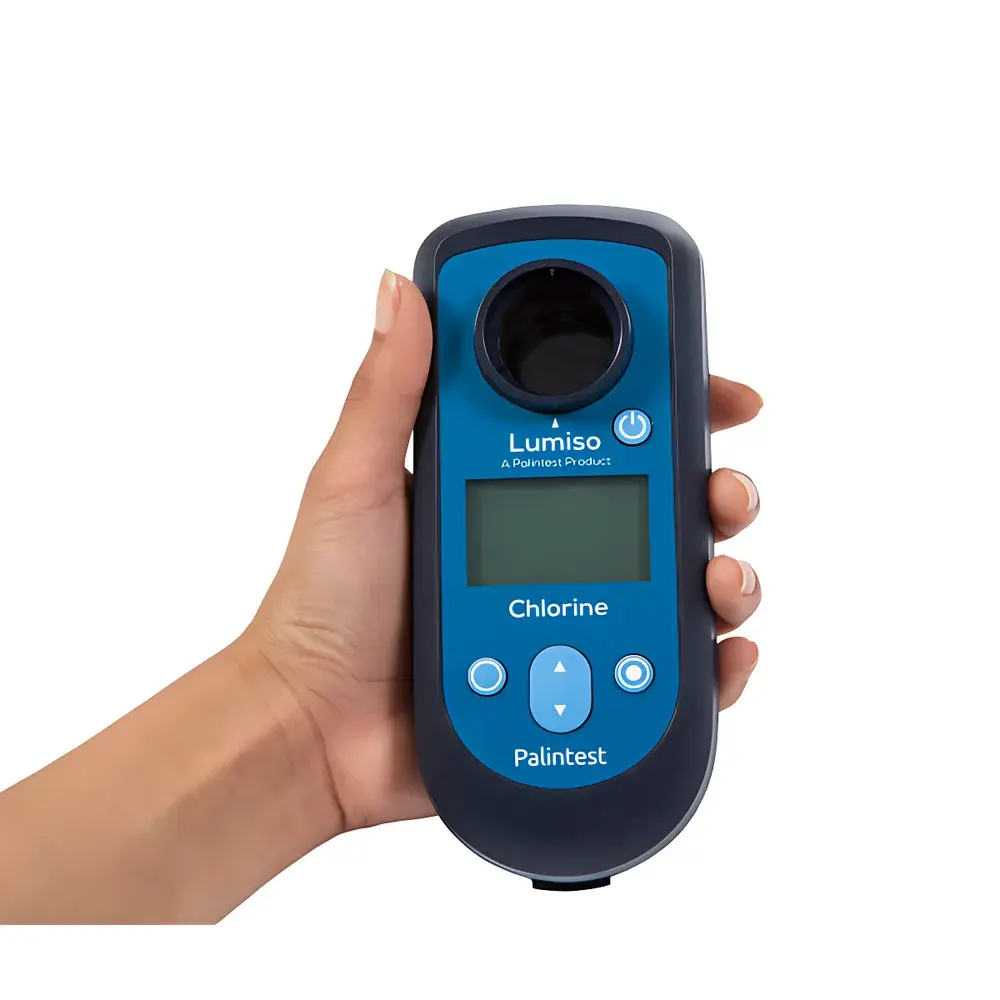
Palintest Lumiso Chlorine Residual Analyzer
| Brand | Palintest |
|---|---|
| Origin | United Kingdom |
| Model | Lumiso Chlorine |
| Instrument Type | Portable Photometer |
| Measurement Principle | DPD Colorimetric Method (ASTM D1253, ISO 7393-2) |
| Measured Parameter | Free and Total Residual Chlorine |
| Wavelength | 530 nm |
| Optical Accuracy | ±1% T |
| Detection Range | Free/Total Cl₂: 0.01–5.00 mg/L (0.01 mg/L resolution) |
| High-Range Total Cl₂ | 1–250 mg/L (0.01 mg/L resolution) |
| Display | 226 × 138 pixel backlit LCD with icon-based UI |
| Data Storage | 50 test records (including parameter, date, time, operator ID) |
| Connectivity | USB port + QR-code-enabled memory retrieval |
| Enclosure Rating | IP67 |
| Power Supply | 3 × AA batteries |
| Dimensions | 163 × 70 × 45 mm |
| Weight | 275 g |
| Calibration Verification | Integrated absorbance check using certified reference filters |
| Compliance | Designed for GLP-compliant field and laboratory use |
Overview
The Palintest Lumiso Chlorine Residual Analyzer is a handheld, field-deployable photometer engineered for rapid, reliable quantification of free and total residual chlorine in drinking water, wastewater effluent, swimming pools, cooling towers, and disinfection validation systems. It implements the standardized N,N-diethyl-p-phenylenediamine (DPD) colorimetric method—first developed by Palintest scientists in the 1950s and now codified in ASTM D1253 and ISO 7393-2. The instrument employs a fixed-wavelength optical path centered at 530 nm, optimized for maximum sensitivity and linearity across low-concentration chlorine ranges critical for regulatory compliance (e.g., WHO Guidelines for Drinking-water Quality, US EPA Method 334.0). Its solid-state LED light source, precision aperture optics, and temperature-compensated photodetector ensure high reproducibility (<2% RSD) under variable ambient conditions. Unlike benchtop spectrophotometers, the Lumiso eliminates wavelength selection complexity while maintaining metrological rigor through factory-calibrated optical alignment and built-in photometric verification.
Key Features
- IP67-rated enclosure for full protection against dust ingress and immersion up to 1 m for 30 minutes—validated for continuous operation in humid, outdoor, or industrial environments.
- Dual-range measurement capability: high-sensitivity mode (0.01–5.00 mg/L) for potable water compliance; extended range (1–250 mg/L) for chlorination process monitoring and shock dosing verification.
- Integrated calibration verification using traceable absorbance reference filters—enabling on-site optical performance checks without external standards or lab recalibration.
- Backlit graphical LCD (226 × 138 pixels) with intuitive icon-driven interface supporting multilingual prompts (English, Spanish, French, German, Chinese); no software installation required.
- On-device data management: stores 50 complete test records with timestamp, operator ID, parameter name, and result—each record assigned a unique QR code for instant export via smartphone scan.
- USB-C interface (compatible with standard USB-A cables) for direct PC connection, enabling batch data download into Excel or LIMS-compatible CSV formats.
Sample Compatibility & Compliance
The Lumiso Chlorine analyzer accepts standard 25 mm round glass or plastic cuvettes conforming to ISO 10666 and ASTM E275. It is compatible with Palintest’s certified DPD reagent tablets (e.g., Chlorine 1, Chlorine 2, and Chlorine 3), as well as third-party DPD kits meeting APHA Standard Methods 4500-Cl G specifications. All measurements adhere to internationally recognized protocols for residual oxidant determination, supporting compliance with EU Drinking Water Directive (2020/2184), US Safe Drinking Water Act (SDWA) monitoring requirements, and WHO chlorine residual targets (0.2–4.0 mg/L free Cl₂ in distribution systems). The device’s firmware and data architecture support ALCOA+ principles (Attributable, Legible, Contemporaneous, Original, Accurate), facilitating integration into GLP and GMP workflows where electronic record integrity is mandated per FDA 21 CFR Part 11.
Software & Data Management
No proprietary software is required for basic operation. However, Palintest provides optional desktop utilities (Lumiso Connect v2.1) for advanced data aggregation, report generation (PDF/CSV), and audit-log export—including operator login history and calibration event timestamps. Each stored measurement includes embedded metadata: test ID, location tag (manually entered), environmental temperature (measured via internal sensor), and photometric stability index. QR-coded records comply with ISO/IEC 18004 for error-corrected data encoding, ensuring fidelity during cross-platform sharing (email, cloud storage, LIMS ingestion). All data exports are timestamped and digitally signed to meet ISO/IEC 17025 clause 7.7.1 requirements for result authenticity.
Applications
- Field verification of chlorine residuals at water treatment plant outlets and distribution system sampling points.
- Routine monitoring of recreational water quality in municipal pools, spas, and aquatic centers per CDC Model Aquatic Health Code (MAHC).
- Validation of disinfection efficacy in food processing rinse water and pharmaceutical clean-in-place (CIP) cycles.
- Emergency response testing following natural disasters or infrastructure failures where rapid, battery-powered analysis is essential.
- Educational use in environmental science laboratories for teaching standardized colorimetric methodology and QA/QC practices.
FAQ
Does the Lumiso Chlorine require annual factory recalibration?
No—its optical path is sealed and factory-aligned for lifetime stability. Users perform routine verification using included absorbance filters; only if verification fails should service be requested.
Can it measure combined chlorine separately from free chlorine?
Yes—by sequential addition of DPD Reagents 1 and 3 per ISO 7393-2 protocol, enabling calculation of monochloramine and dichloramine contributions.
Is the device compatible with LIMS integration?
Yes—via USB export of structured CSV files containing all metadata fields required for automated ingestion into major LIMS platforms (e.g., LabWare, Thermo Fisher SampleManager).
What is the shelf life of the DPD reagents used with this instrument?
Palintest DPD tablets retain full potency for 24 months when stored unopened at ≤25°C and <60% RH; desiccant integrity must be verified prior to use.
How does IP67 rating impact real-world usability in wastewater plants?
It enables uninterrupted operation during rain, high-humidity pump stations, or accidental submersion—eliminating downtime from moisture-related sensor drift or display failure.
Related Products







