
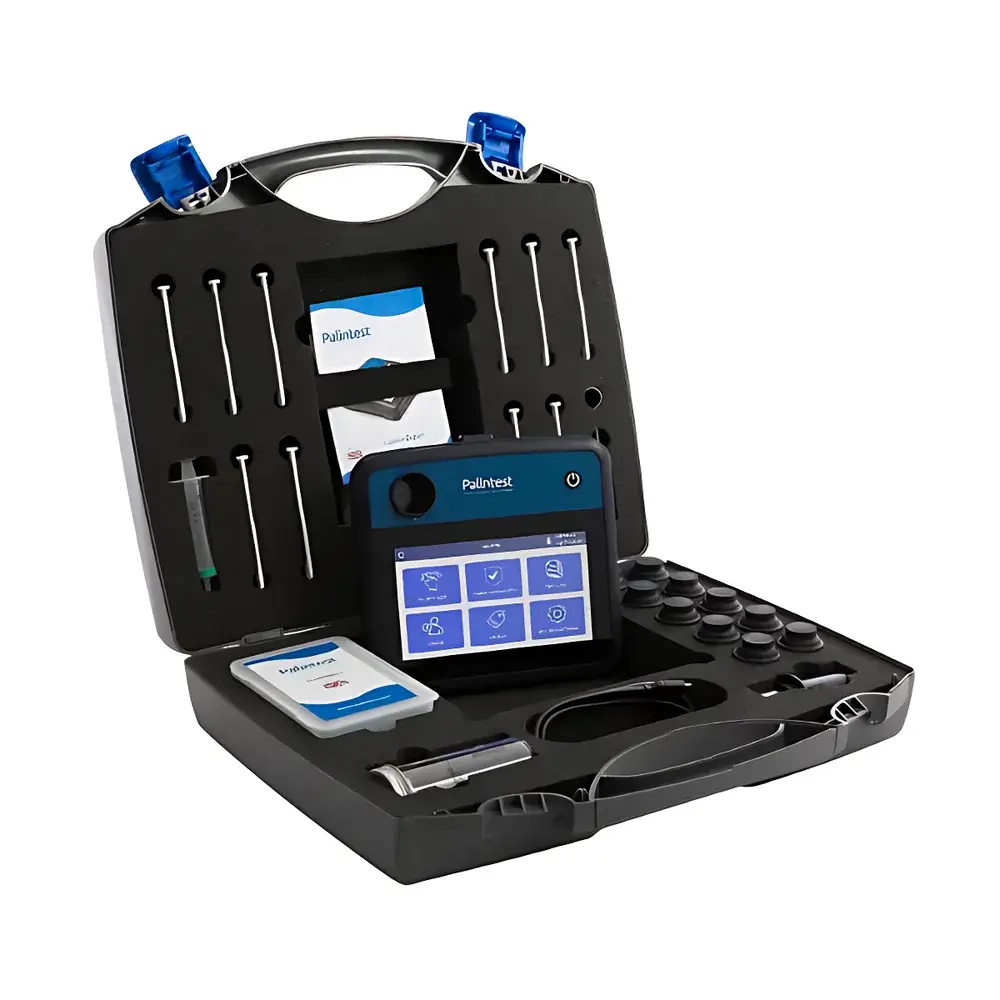
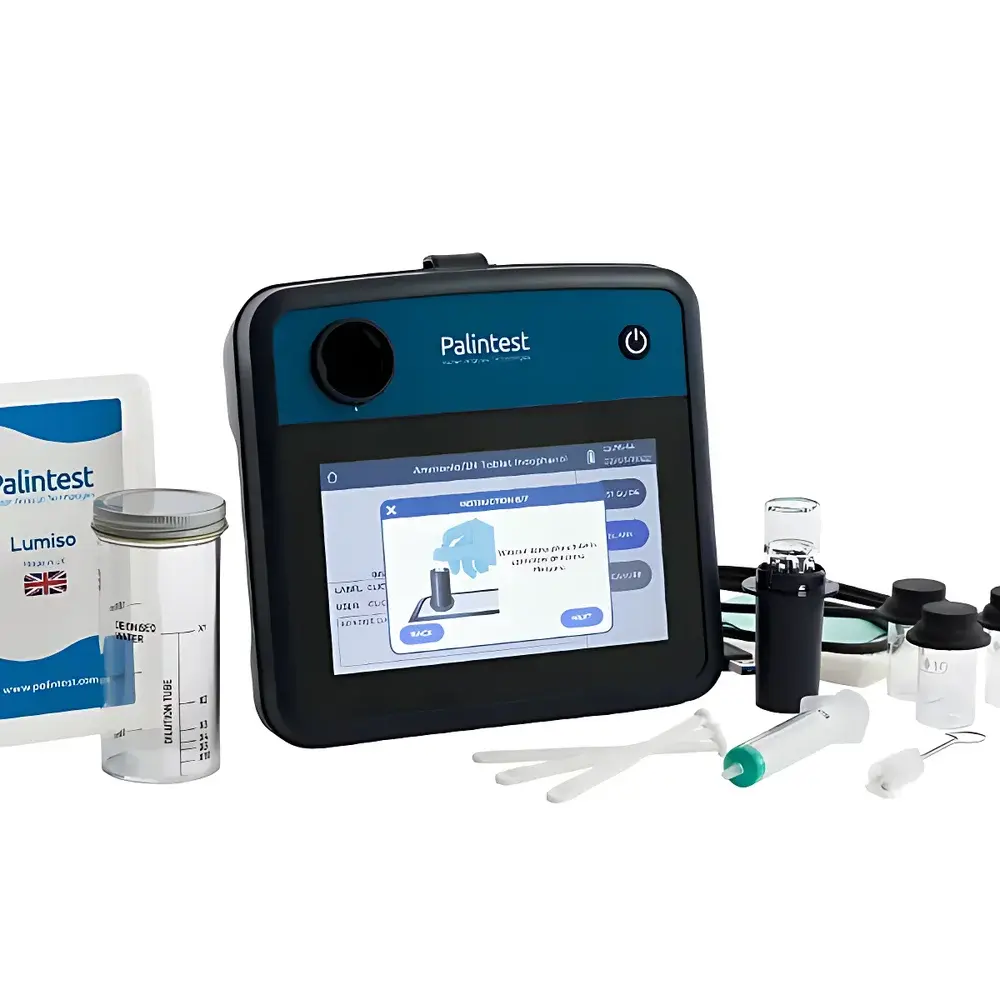
Palintest Lumiso Expert Multi-Parameter Photometer
| Brand | Palintest |
|---|---|
| Origin | United Kingdom |
| Model | Lumiso Expert |
| Instrument Type | Portable / Handheld Photometric Water Quality Analyzer |
| Detection Parameters | Free Chlorine, Total Chlorine, Chloramines, Chlorine Dioxide, COD (5–20,000 mg/L), Ammonia-N (0.01–100 mg/L), Nitrate-N, Nitrite-N, Phosphate (LR/HR), Total Phosphorus, Total Nitrogen, Hardness (Calcium & Total), Alkalinity (Methyl Orange & Phenolphthalein), pH, Turbidity (1–1000 NTU), Iron (LR/MR/HR), Manganese (LR/HR), Zinc, Copper, Fluoride, Chloride (0.5–50,000 mg/L), Silica (LR/HR), Sulfate, Cyanuric Acid, Ozone, Bromine, Hydrogen Peroxide (LR/HR), Sulfite, Cyanide, Urea, Color (5–500 HU), Hexavalent Chromium, Nickel, Molybdate, Aluminum, Sulfide |
| Compliance | Designed for ASTM D1253, ISO 7890-2, ISO 8467, ISO 15704, USP <643>, EN ISO 11923, and EPA-approved colorimetric methods |
| Reagent Format | Pre-measured solid reagents (50–250 tests per vial) and liquid reagents (25 tests per vial) |
| Optical System | Dual-beam LED photometry with temperature-stabilized optics and automatic wavelength selection (420–850 nm) |
| Display | 5.0″ full-color capacitive touchscreen (IP67-rated front panel) |
| Data Management | Onboard storage for ≥10,000 results with GLP-compliant audit trail, time/date stamp, operator ID, and method versioning |
| Environmental Rating | IP67 ingress protection (dust-tight, submersible to 1 m for 30 min) |
| Power | Rechargeable Li-ion battery (≥16 h typical operation), USB-C charging |
Overview
The Palintest Lumiso Expert is a high-precision, portable multi-parameter photometer engineered for field-deployable and laboratory-grade water quality analysis. As the successor to the widely adopted Palintest 7500 series, the Lumiso Expert integrates a next-generation dual-beam optical architecture with thermally stabilized LEDs and a broad-spectrum photodetector array (420–850 nm), enabling accurate, interference-resistant absorbance measurements across over 100 analytes. Its core methodology adheres to internationally recognized colorimetric standards—including ASTM D1253 (chlorine), ISO 8467 (COD), ISO 15704 (ammonia), and EN ISO 11923 (phosphate)—ensuring regulatory alignment for environmental monitoring, drinking water compliance, wastewater treatment, and industrial process control. Unlike benchtop spectrophotometers requiring extensive sample preparation, the Lumiso Expert delivers laboratory-equivalent reproducibility in a handheld form factor—validated by independent inter-laboratory studies showing ≤3% RSD across key parameters under field conditions.
Key Features
- Dual-beam LED photometry with real-time reference channel correction, minimizing drift from ambient light, temperature fluctuation, or lamp aging
- Full-color 5.0″ capacitive touchscreen interface with glove-compatible responsiveness and contextual graphical guidance for every test step
- IP67-rated enclosure: fully sealed against dust and immersion up to 1 meter for 30 minutes—certified per IEC 60529 for harsh outdoor, plant-floor, or emergency response use
- Mercury-free COD digestion protocols compliant with ISO 8467 and EPA Method 410.4, available in four dynamic ranges (5–150, 10–1000, 50–2000, 500–20000 mg/L) using pre-dosed solid reagents
- Integrated method library with >120 pre-programmed assays—including DPD-based chlorine speciation, salicylate/nessler ammonia variants, ascorbic acid phosphate, and catalytic manganese oxidation—each with embedded calibration curves and QC checks
- Rechargeable lithium-ion battery supporting ≥16 hours of continuous operation; USB-C fast-charging compatible with standard power banks and vehicle adapters
Sample Compatibility & Compliance
The Lumiso Expert accepts standard 10 mm, 16 mm, and 20 mm round glass or plastic cuvettes (e.g., Palintest PT 555), accommodating both low-volume field samples and larger lab-prepared aliquots. It supports direct measurement of raw surface water, treated drinking water, cooling tower fluids, swimming pool recirculation streams, and industrial effluents—with built-in turbidity compensation algorithms (up to 1000 NTU) to correct for scattering effects in colored or suspended-solid-rich matrices. All assay protocols align with global regulatory frameworks: chlorine methods conform to WHO Guidelines for Drinking-water Quality and EU Directive 98/83/EC; COD and nutrient testing meet ISO 6060 and ISO 11905-1 requirements; heavy metal determinations (e.g., Cr⁶⁺, Ni, Cu) follow ISO 11969 and ASTM D3559. The instrument’s firmware and data handling architecture support GLP/GMP workflows, including electronic signatures, audit-trail logging (per FDA 21 CFR Part 11 principles), and traceable reagent lot tracking.
Software & Data Management
Onboard firmware enables secure, timestamped storage of ≥10,000 test records—including sample ID, operator code, location metadata (manual entry), method version, calibration status, and raw absorbance values. Each result is automatically tagged with pass/fail flags against user-defined action limits. Data export occurs via USB-C to CSV or encrypted PDF reports compliant with ISO/IEC 17025 documentation requirements. Optional Palintest Connect desktop software (Windows/macOS) provides centralized fleet management, automated report generation (including LIMS-ready XML), statistical process control charts, and remote firmware updates. All data transfers utilize TLS 1.2 encryption; no cloud storage is performed unless explicitly configured by the end-user organization—ensuring full sovereignty over sensitive environmental monitoring datasets.
Applications
- Drinking water utilities: Routine verification of disinfectant residual (free/total chlorine, ClO₂, ozone), corrosion control parameters (alkalinity, hardness, phosphate), and DBP precursors (ammonia, nitrite)
- Wastewater treatment plants: Influent/effluent monitoring of COD, TN, TP, NH₃-N, and TSS-correlated turbidity for process optimization and regulatory reporting (e.g., EPA NPDES permits)
- Healthcare & pharmaceutical facilities: USP TOC surrogate validation, purified water system surveillance (conductivity-coupled colorimetry), and clean-in-place (CIP) rinse water verification
- Industrial hygiene: Cooling water biocide efficacy (bromine, chloramines), boiler feedwater scaling risk (silica, iron), and electroplating bath composition (nickel, chromium, copper)
- Emergency response & disaster relief: Rapid on-site assessment of flood-contaminated water sources for chlorine demand, fecal indicator surrogates (nitrite), and heavy metal leaching (lead, arsenic—via validated indirect methods)
FAQ
Does the Lumiso Expert require annual factory calibration?
No. The instrument features self-diagnostic routines and NIST-traceable internal reference filters. Users perform routine verification using Palintest LMCEXP Calibration Check Kit (included in most kits), with documented verification frequency aligned to ISO/IEC 17025 Clause 6.5.
Can solid reagents be used interchangeably between Lumiso Expert and older Palintest models?
Yes—reagent vials (e.g., PM011, PM152) are physically and chemically identical across the 7500, PCL, and Lumiso platforms. Firmware auto-detects assay type upon barcode scan.
Is Bluetooth connectivity standard or optional?
Bluetooth 5.0 is hardware-integrated but disabled by default; activation requires license key purchase and firmware update via Palintest Connect.
How is COD measured without mercury catalysts?
Using proprietary high-temperature (150 °C), closed-vessel digestion with silver sulfate–catalyzed potassium dichromate, eliminating mercury while maintaining full compliance with ISO 8467 and EPA 410.4.
What happens if the touchscreen fails in wet conditions?
The IP67-rated front panel guarantees operability with wet fingers or nitrile gloves; capacitive sensitivity remains stable at relative humidity ≤95% non-condensing. A physical emergency reset button is accessible beneath the battery compartment.







