
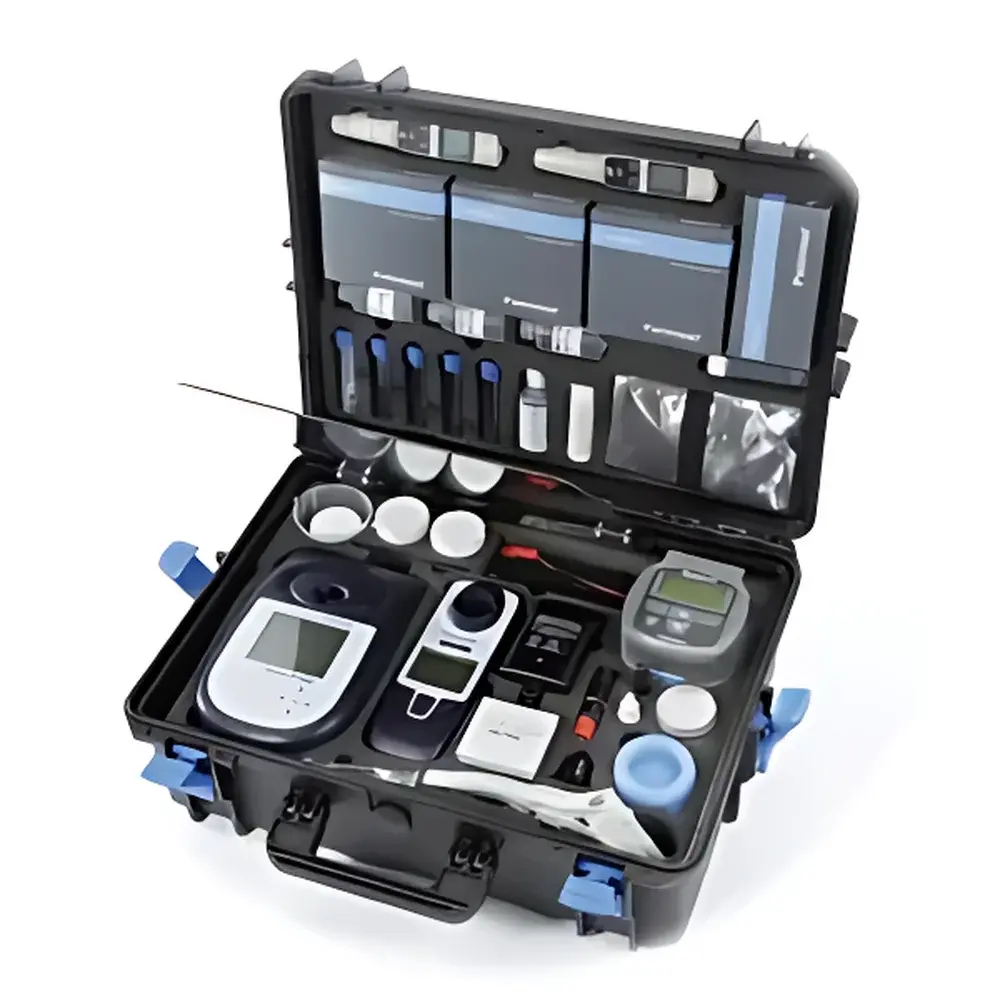
Palintest Potatech+ Portable Water Quality Laboratory
| Brand | Palintest |
|---|---|
| Origin | United Kingdom |
| Model | Potatech+ |
| Instrument Type | Portable/Handheld Water Quality Analyzer |
| Detection Parameters | Total Bacteria, *E. coli*, Fluoride, Nitrate, Nitrite, Ammonia-N, Free Chlorine, Chlorine Dioxide, Iron, Manganese, Chloride, Sulfate, Arsenic, pH, TDS, COD (Chemical Oxygen Demand), Turbidity |
| Reagent Format | Pre-formulated, lyophilized or stabilized dry-reagent tablets/packs with 5-year shelf life |
| Compliance | Designed to align with China’s GB/T 5750 series (Standard Methods for Examination of Drinking Water), including microbiological membrane filtration (GB/T 5750.12) and colorimetric/spectrophotometric methods (e.g., GB/T 5750.6 for metals, GB/T 5750.11 for disinfectants) |
| Power Options | Rechargeable 12 V battery, 12 V vehicle adapter, 220–240 V AC adapter |
| Enclosure | Integrated rugged carry-case with modular compartments for microbiology, physicochemical, and filtration modules |
Overview
The Palintest Potatech+ Portable Water Quality Laboratory is an integrated, field-deployable analytical system engineered for rapid, standardized assessment of drinking water safety in resource-constrained or mobile operational environments. It combines membrane filtration-based microbiological enumeration, spectrophotometric quantification of disinfectants and inorganic analytes, potentiometric pH measurement, conductometric TDS determination, and nephelometric turbidity analysis—all within a single, transportable case. Its methodological architecture adheres strictly to internationally recognized principles: membrane filtration (ISO 9308-1, APHA 9222B) for *E. coli* and total coliforms; DPD colorimetry (ISO 7393-2, USP ) for free and total chlorine; cadmium reduction with Griess reaction (ISO 6777) for nitrate/nitrite; and arsenic detection via silver diethyldithiocarbamate (SDDC) methodology (ISO 13877). Designed for compliance with China’s GB/T 5750 series and aligned with WHO Guidelines for Drinking-water Quality (4th ed.), the Potatech+ supports decentralized testing at source points, distribution endpoints, emergency response sites, and small-scale water supply facilities serving populations ≥10,000.
Key Features
- Modular, all-in-one field laboratory housed in a durable, impact-resistant carrying case with custom foam inserts for instrument protection and workflow organization.
- Dual-path microbiological module: Includes a programmable digital incubator (35–37 °C ±0.5 °C), 40 aluminum Petri dishes pre-filled with lauryl sulfate broth, membrane filter dispenser, sterile absorbent pads (n=200), 0.45 µm cellulose ester filters (φ47 mm), hand-operated vacuum filtration pump, and calibrated forceps.
- Multi-parameter photometer (7500-series): Capable of measuring 20+ parameters using wavelength-specific LED optics (420–610 nm), pre-programmed calibration curves, and built-in reference blank compensation—eliminating manual curve fitting.
- Pre-formulated reagent system: All test kits supplied as stable, dry-powder or tablet formats with ≥5-year shelf life under ambient storage (15–30 °C); no solvent handling, dilution, or weighing required on-site.
- Field-optimized electrochemical sensors: Pocket-sized pH and conductivity pens with automatic temperature compensation (ATC), NIST-traceable calibration using included buffer and standard solutions.
- Flexible power architecture: Operates via rechargeable 12 V Li-ion battery (≥8 h continuous use), 12 V vehicle socket adapter, or universal 220–240 V AC transformer—enabling uninterrupted operation across grid-connected labs and off-grid field deployments.
Sample Compatibility & Compliance
The Potatech+ accepts raw, filtered, chlorinated, or groundwater samples without pretreatment for most parameters. Turbidity measurements comply with ISO 7027 (nephelometric principle, 90° scatter detection). Microbiological assays meet ISO/IEC 17025 requirements for competence in testing laboratories when used with certified reagents and documented incubation protocols. All physicochemical methods are validated against GB/T 5750.2–5750.13 and referenced in China’s “Hygienic Standard for Drinking Water” (GB 5749–2022). The system supports GLP-aligned recordkeeping through optional data export (USB/SD card) and is compatible with audit-ready documentation workflows for regulatory submissions.
Software & Data Management
The 7500 photometer features embedded firmware supporting user-defined test protocols, date/time-stamped result logging (up to 1,000 records), and CSV export via micro-USB. No proprietary software installation is required—data files are readable in Excel or LIMS-compatible platforms. Calibration history, reagent lot tracking, and operator ID fields support traceability per ISO/IEC 17025 Clause 7.7 and FDA 21 CFR Part 11 principles (when paired with secure file management practices). Firmware updates are delivered via downloadable HEX files from Palintest’s technical portal.
Applications
- Routine surveillance of rural and peri-urban water supply systems serving ≥10,000 persons.
- Emergency response during natural disasters or contamination events—rapid deployment within 15 minutes of arrival.
- Validation of point-of-use (POU) and point-of-entry (POE) treatment devices (e.g., UV, chlorination, RO units).
- Regulatory compliance monitoring for small water utilities lacking centralized lab infrastructure.
- Training and capacity building for local health technicians—low skill-barrier operation with pictorial SOP cards included.
- Baseline water quality mapping in informal settlements and seasonal water sources (springs, wells, reservoirs).
FAQ
Does the Potatech+ require annual recalibration by an accredited service provider?
No—field calibration is performed using supplied NIST-traceable standards before each testing session. Photometer optical zero and gain are verified daily; sensor electrodes are calibrated per manufacturer protocol prior to use.
Can test results be directly uploaded to national water quality information systems?
Yes—CSV exports are structured to match common ingestion schemas used by China’s National Drinking Water Monitoring Information System (NDWMIS) and provincial CDC platforms.
Is the incubator suitable for simultaneous detection of both total coliforms and *E. coli*?
Yes—the digital controller maintains dual-temperature profiles (35 °C for total coliforms, 44.5 °C for *E. coli*) across separate incubation zones or sequential runs with auto-timed cycles.
What is the detection limit for arsenic using the included SDDC kit?
The method achieves a practical quantitation limit of 1 µg/L in drinking water matrices, consistent with GB 5749–2022 and WHO guidance values.
Are replacement membranes and culture media supplied as OEM-certified consumables?
Yes—Palintest supplies ISO 11133-compliant dehydrated media and sterile, low-autofluorescence 0.45 µm filters with full CoA documentation and batch-specific expiry dates.







