
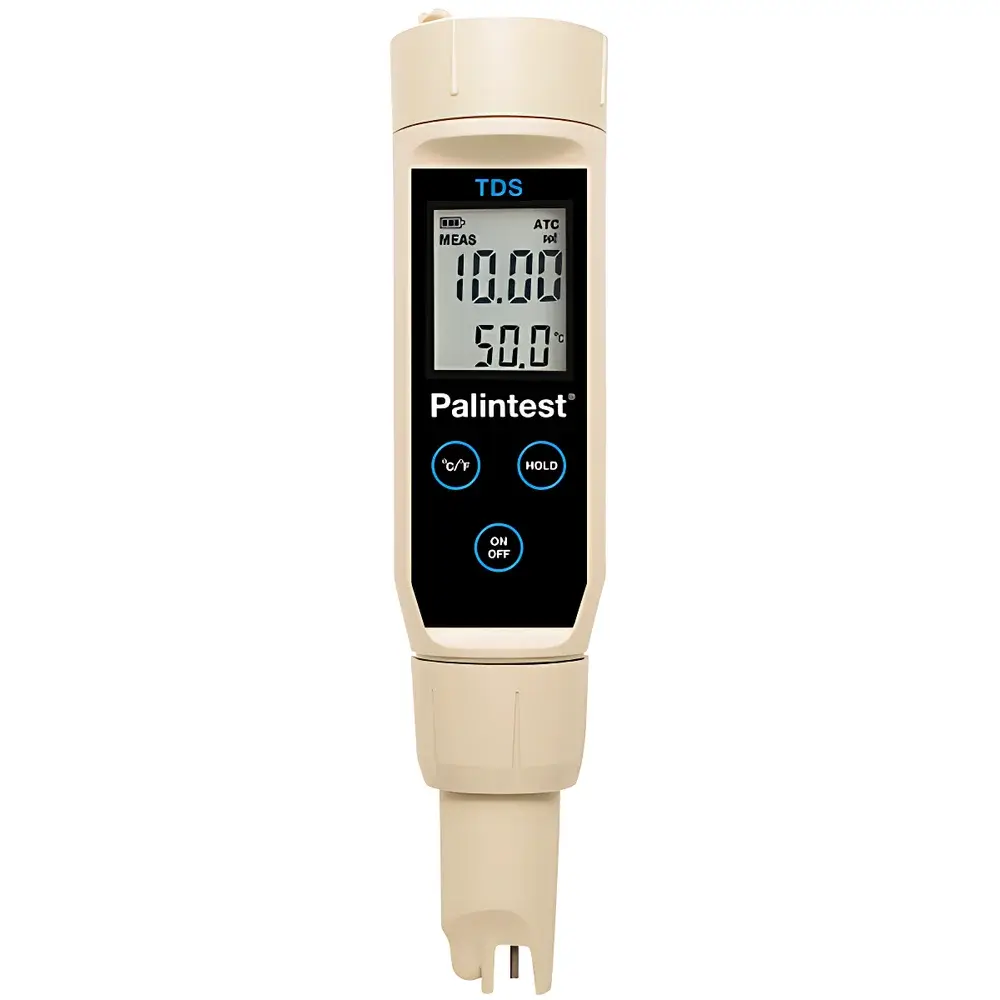
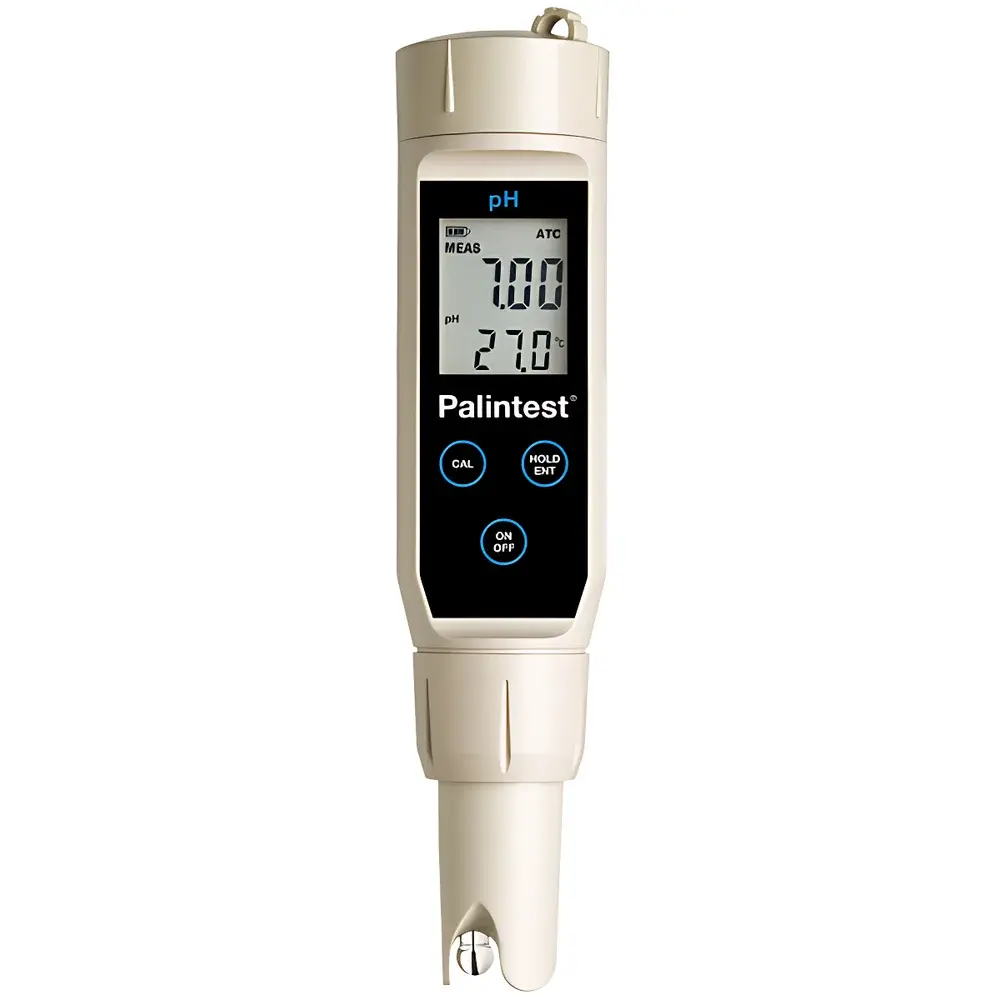
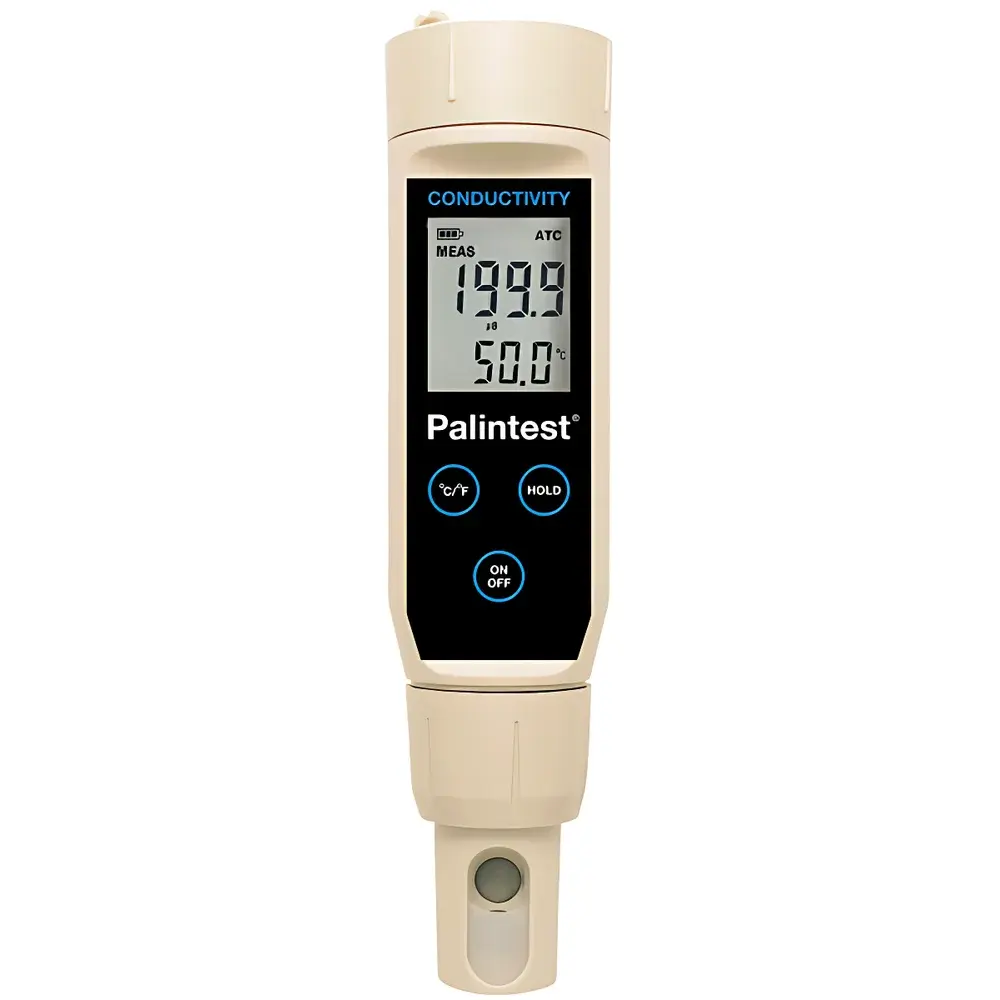
Palintest PT151 Pocket-Sized Single-Parameter pH / Conductivity / TDS Meter
| Brand | Palintest |
|---|---|
| Origin | United Kingdom |
| Model | PT151 |
| Instrument Type | Pen-style |
| Parameter Type | Single-parameter |
| Measurement Accuracy | ±0.1 pH / ±1% FS (Conductivity & TDS) |
| Calibration Standard | NIST-traceable buffer and standard solutions |
| Protection Rating | IP67 |
| Operating Temperature | 0–50 °C |
| Temperature Compensation | Automatic (ATC) |
| Power Supply | 4 × 1.5 V LR44/A76/V13GA button cells (>100 h battery life |
| Dimensions | 163 × 40 mm |
| Weight | 90 g |
Overview
The Palintest PT151 is a compact, rugged, single-parameter pen-style meter engineered for field-deployable electrochemical measurements in industrial water quality management, routine maintenance checks, and on-site process monitoring. Unlike multi-parameter handheld meters, the PT151 series adopts a dedicated sensor architecture—each unit is optimized for one primary parameter (pH, conductivity, or TDS)—ensuring signal integrity, reduced cross-sensitivity, and long-term stability under variable environmental conditions. The device operates on potentiometric (pH) and conductimetric (conductivity/TDS) principles: pH is measured via a glass electrode sensing hydrogen ion activity relative to an integrated Ag/AgCl reference; conductivity is determined by applying an alternating current across a two-electrode cell and calculating solution resistance using Ohm’s law, with TDS derived via standardized conversion factors (e.g., 0.64–0.71 × conductivity, configurable per application). Built-in automatic temperature compensation (ATC) uses a thermistor embedded in the sensor tip to correct readings to 25 °C, conforming to ISO 7888 and ASTM D1125 guidelines for aqueous conductivity reporting.
Key Features
- Rugged IP67-rated housing—fully dust-tight and submersible up to 1 m for 30 minutes—validated per IEC 60529, suitable for humid, outdoor, or splash-prone environments including cooling towers, wastewater channels, and pool decks.
- True single-parameter design: eliminates internal crosstalk and simplifies calibration traceability—critical for GLP-compliant recordkeeping where parameter-specific uncertainty budgets must be independently verified.
- Three-point calibration capability (pH) with NIST-traceable buffers (pH 4.01, 7.00, 10.01); manual or auto-recognizing calibration modes support both routine verification and audit-ready workflows.
- High-range TDS measurement (up to 10 g/L) with dual-scale resolution (0.1 mg/L at low range; 0.01 g/L at high range), specifically validated for chlorinated recreational water systems per EN 1657:2021.
- Low-power architecture: 4×LR44 cells deliver >100 hours of continuous operation; intelligent auto-shutdown (8.5 min idle timeout) extends battery service life without compromising measurement readiness.
- Ergonomic pen-form factor (163 × 40 mm, 90 g) enables one-handed operation, pocket storage, and rapid deployment—ideal for technicians conducting sequential spot checks across distributed assets.
Sample Compatibility & Compliance
The PT151 series is validated for use with aqueous samples across municipal, industrial, and recreational water matrices—including drinking water, boiler feedwater, reverse osmosis permeate, swimming pool water, and mild process effluents. It is not intended for highly viscous, suspended-solid-laden, or strongly oxidizing solutions (e.g., >50 ppm free chlorine beyond stabilization time). All calibration and verification reagents—including PT105/5 pH tablets (pH 4.01/7.00/10.01), PT142 series conductivity standards (74 µS/cm, 1412 µS/cm, 12.88 mS/cm), and PT142/8–10 TDS standards (50–3000 mg/L)—are supplied with full NIST traceability documentation and lot-specific uncertainty statements. Device firmware and calibration logs comply with data integrity requirements under FDA 21 CFR Part 11 when used in conjunction with Palintest’s optional PC-based logging software (sold separately).
Software & Data Management
While the PT151 operates as a standalone instrument with no onboard memory or Bluetooth connectivity, it supports structured manual data capture through Palintest’s free WaterLog Pro desktop application (Windows/macOS). Users enter timestamped readings alongside sample ID, location, operator, and calibration status—generating PDF reports compliant with ISO/IEC 17025 clause 7.8. Audit trails include calibration date, buffer lot numbers, and deviation flags. For regulated environments, the PT151’s fixed calibration logic (no user-modifiable slope/offset) inherently satisfies ALCOA+ principles (Attributable, Legible, Contemporaneous, Original, Accurate) when paired with controlled logbooks.
Applications
- Industrial Water Treatment: Monitoring pH drift in neutralization tanks; verifying conductivity of demineralized rinse water in electroplating lines; checking TDS buildup in closed-loop cooling systems.
- Recreational Water Safety: Daily verification of pool/spa pH (7.2–7.8) and TDS (≤1500 mg/L per CDC Model Aquatic Health Code) prior to public access.
- FACILITY MAINTENANCE: Rapid screening of condensate return lines for acidity (pH 10 µS/cm).
- Field Education & Training: Used in vocational labs and water operator certification courses due to intuitive interface, visual calibration prompts, and robust build—minimizing training overhead and instrument damage.
FAQ
Is the PT151 suitable for measuring seawater or brine solutions?
No. Its conductivity range (up to 20.00 mS/cm) and TDS upper limit (10 g/L) are insufficient for full-strength seawater (~53 mS/cm, ~35 g/L). Use Palintest PT161 or benchtop conductivity meters with four-electrode cells for such applications.
Can the same probe be used interchangeably across PT151 pH, TDS, and conductivity models?
No. Each PT151 variant contains a permanently integrated, parameter-specific sensor assembly. Electrodes are not cross-compatible; replacement parts (e.g., PT155/PH, PT153T/TDS) are model-locked.
Does the device meet GLP or GMP requirements for regulated laboratories?
As a field-grade instrument, the PT151 is designed for operational control—not release testing. It supports GLP-aligned practices (traceable calibration, defined SOPs, maintenance logs) but lacks electronic signature, audit trail, or 21 CFR Part 11 compliance features required for GMP release assays.
How often should calibration be performed?
Daily calibration is recommended before first use and after exposure to extreme pH or high-conductivity samples. For low-risk monitoring (e.g., stable cooling tower water), calibration every 8 hours or per shift meets ASTM D1293 and ISO 10523 best practices.






