
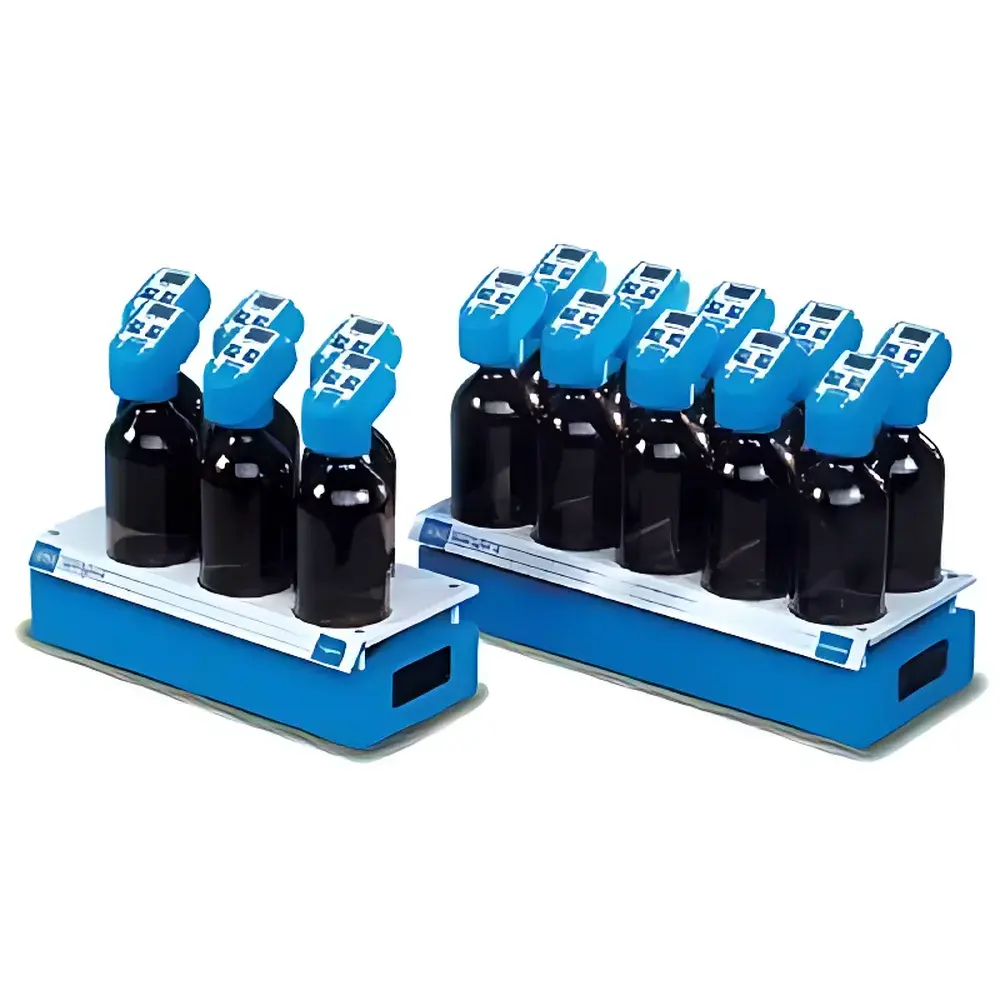
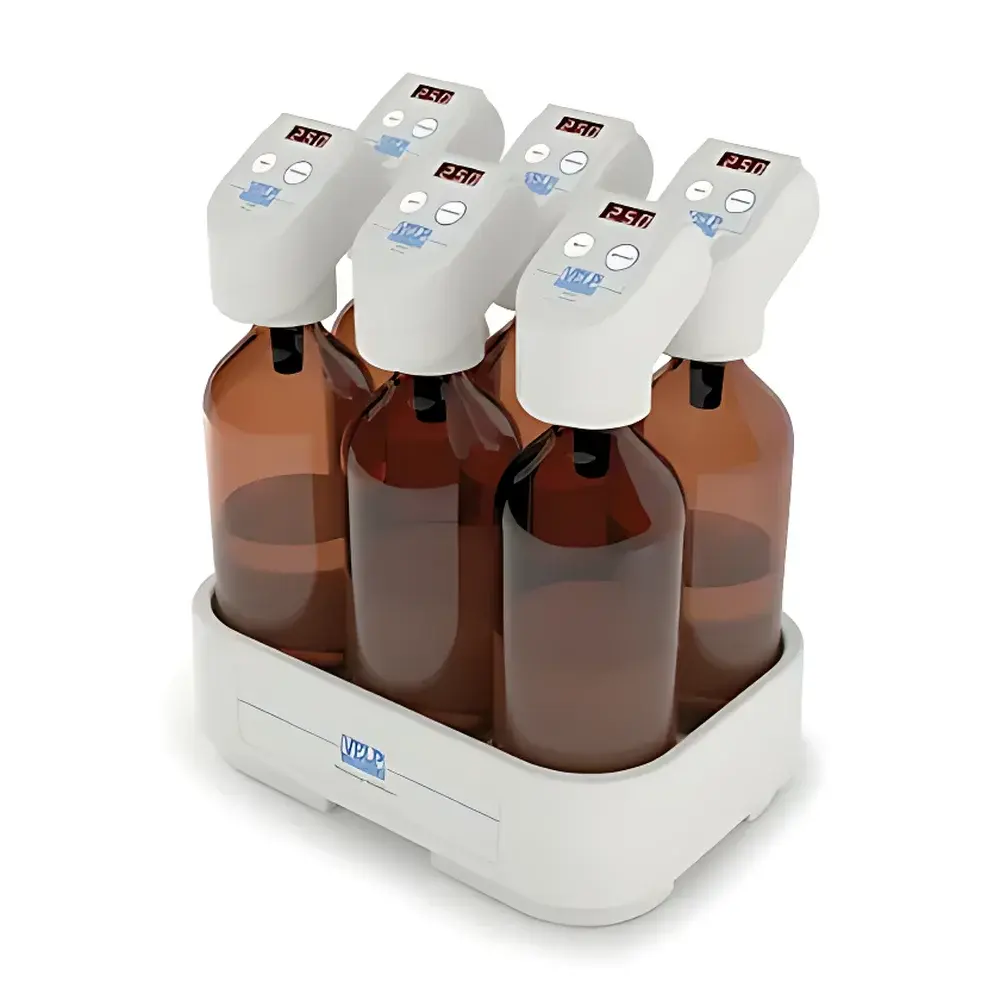
Palintest Wag-WE20010 Portable Differential Pressure BOD Analyzer
| Brand | Palintest |
|---|---|
| Origin | United Kingdom |
| Model | Wag-WE20010 |
| Instrument Type | Portable BOD Analyzer |
| Measurement Principle | Differential Pressure (Mercury-Free) |
| Measurement Range | 0–900 mg/L BOD |
| Resolution | 1 mg/L |
| Accuracy | ±5% at 100 mg/L |
| Data Logging | Up to 5 BOD measurement sets, recorded every 24 h |
| Sample Capacity | Simultaneous analysis of 6 or 10 samples |
| Display | LCD, real-time readout in mg/L |
| Sensor | Mercury-free digital pressure transducer |
| Power Supply | 2 × 250 mAh Li-ion batteries (up to 2-year life) or 115–230 V AC |
| Operating Temperature | −25 °C to +65 °C |
| IP Rating | IP44 |
| Weight per sensor unit | 0.4 kg |
| Compatible Incubator | Palintest Wag-WE20010 Smart Biochemical Incubator (215 L volume, 4-tier adjustable shelves, temp. control range 3–50 °C, stability ±0.5 °C, resolution 0.1 °C, 400 W) |
Overview
The Palintest Wag-WE20010 is a portable, mercury-free differential pressure BOD analyzer engineered for reliable, field-deployable assessment of biochemical oxygen demand in water and wastewater samples. It operates on the principle of measuring the pressure differential generated by microbial respiration within sealed, standardized BOD bottles—eliminating reliance on toxic mercury manometers or titrimetric endpoints. As a core parameter defined in ISO 5815-1:2019, ASTM D5210, and EPA Method 405.1, BOD quantifies the mass of dissolved oxygen consumed by aerobic microorganisms during the biodegradation of organic matter over a defined incubation period (typically 5 days at 20 °C). The Wag-WE20010 delivers direct, mg/L-scale readouts without manual calculations, supporting regulatory compliance workflows in municipal laboratories, environmental consultancies, and industrial effluent monitoring programs.
Key Features
- Mercury-free digital pressure sensing architecture compliant with EU RoHS Directive 2011/65/EU and global mercury phase-out initiatives.
- Simultaneous monitoring of up to 10 samples using interchangeable 6-bottle (Wag-WE20050) or 10-bottle (Wag-WE20060) sensor kits—each equipped with calibrated 500 mL amber glass BOD bottles, PVC caps, KOH absorbent pellets, and 35 mm magnetic stir bars.
- Integrated low-maintenance stirring mechanism ensures uniform oxygen transfer and microbial suspension without mechanical wear or recalibration.
- LCD display provides real-time, mg/L-scaled BOD values with 1 mg/L resolution; no post-processing or dilution factor correction required for standard ranges (0–90, 250, 600, or 999 mg/L).
- Battery-powered operation (2 × 250 mAh Li-ion cells, >2 years service life) enables unattended field deployment; optional AC adapter support for lab-based continuous use.
- IP44-rated enclosure ensures protection against splashing water and solid ingress—suitable for outdoor sampling stations, treatment plant perimeters, and mobile environmental units.
Sample Compatibility & Compliance
The Wag-WE20010 is validated for use with raw sewage, treated effluents, surface waters, and groundwater samples meeting ISO 5815-1:2019 sample preparation requirements—including pH adjustment (6.5–7.5), nutrient supplementation (phosphate buffer, MgSO₄, CaCl₂, FeCl₃), and nitrification inhibition (allylthiourea) where applicable. Each sensor unit is factory-calibrated against NIST-traceable pressure standards and shipped with documented calibration certificates. The system supports GLP-compliant data integrity through time-stamped logging (24-h intervals, 5 datasets retained), and its incubator counterpart (Wag-WE20010 Smart Biochemical Incubator) meets ISO 291:2018 thermal uniformity specifications (±0.5 °C stability, 0.1 °C resolution across 4 independently accessible shelves).
Software & Data Management
While the Wag-WE20010 operates as a standalone instrument with embedded firmware, its logged datasets (BOD value, timestamp, sample ID placeholder) are exportable via manual transcription or optional RS-232/USB interface (accessory module required). The device does not require proprietary software for routine operation but is compatible with LIMS platforms accepting ASCII-formatted time-series data. Audit trails are maintained via physical logbooks aligned with ISO/IEC 17025:2017 Clause 7.5.2; full traceability is ensured when paired with Palintest’s certified reference materials (CRM-BOD-01, CRM-BOD-02) and documented incubation protocols.
Applications
- Regulatory BOD₅ compliance testing for discharge permits under EU Urban Wastewater Treatment Directive (91/271/EEC) and US Clean Water Act NPDES requirements.
- Process control in activated sludge, trickling filter, and MBR wastewater treatment plants—enabling rapid feedback on biodegradability and loading capacity.
- Environmental impact assessments (EIAs) for industrial outfalls, landfill leachate, and agricultural runoff monitoring.
- Educational use in university environmental engineering labs, where safety, repeatability, and pedagogical clarity are prioritized over high-throughput automation.
- Field verification of online COD/BOD correlation models in remote catchment areas lacking centralized lab infrastructure.
FAQ
Does the Wag-WE20010 require daily calibration or zero-point adjustment?
No—each mercury-free pressure sensor is factory-calibrated and thermally compensated; only periodic verification against known BOD standards (e.g., glucose-glutamic acid solution) is recommended per ISO 5815-2:2019 Annex A.
Can the instrument measure BOD beyond 900 mg/L without sample dilution?
No—the maximum native range is 0–900 mg/L; samples exceeding this threshold must be diluted prior to analysis in accordance with ISO 5815-1:2019 Section 8.2.
Is the incubator included with the Wag-WE20010 analyzer?
No—the Wag-WE20010 refers specifically to the portable sensor unit; the 215 L Smart Biochemical Incubator (model Wag-WE20010-INC) is a separately ordered accessory designed for simultaneous thermal management of multiple sensor kits.
What is the expected service life of the magnetic stir bars and KOH absorbent?
Stir bars are reusable indefinitely if undamaged; KOH pellets must be replaced before each assay cycle to ensure complete CO₂ absorption—typically one 1.5 g dose per 500 mL bottle.
Does the system meet FDA 21 CFR Part 11 requirements for electronic records?
The base Wag-WE20010 does not include electronic signature capability or audit trail encryption; however, its manual logbook workflow aligns with Part 11 Subpart B for non-electronic record systems used in GMP-regulated environmental monitoring.







