
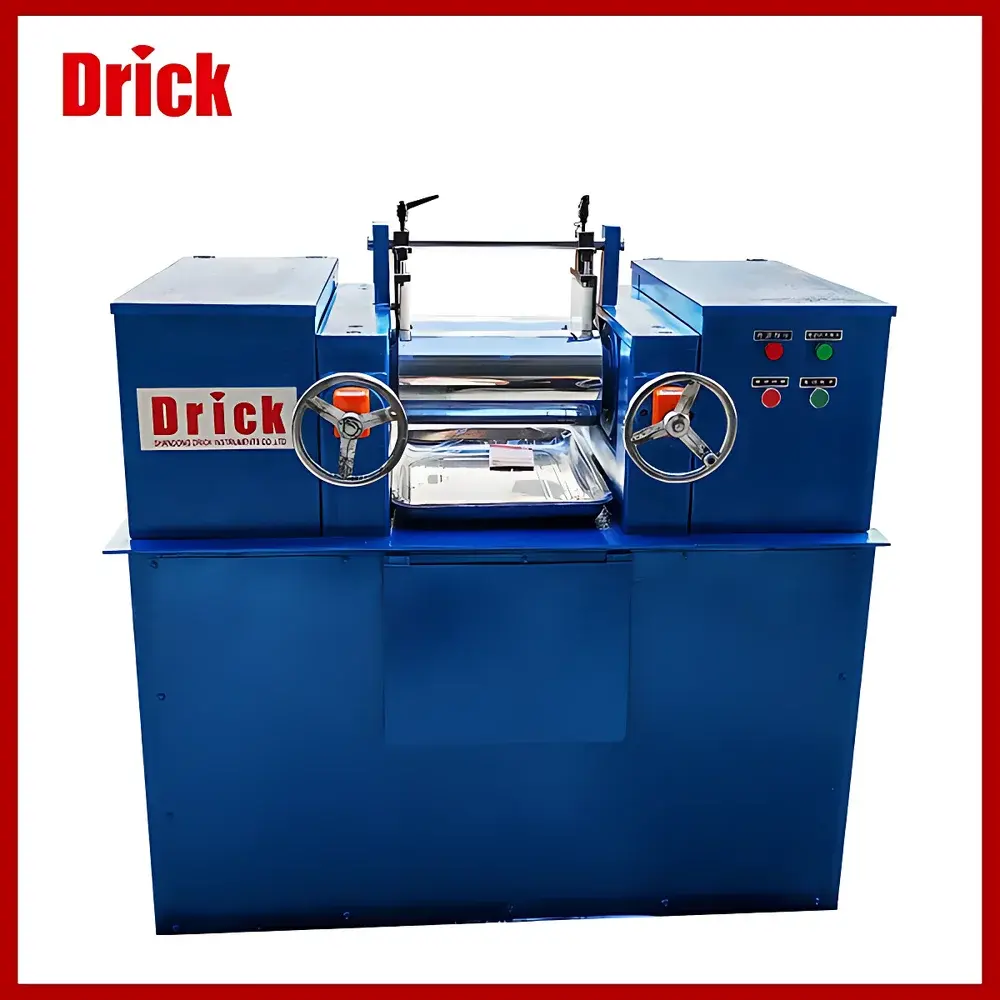
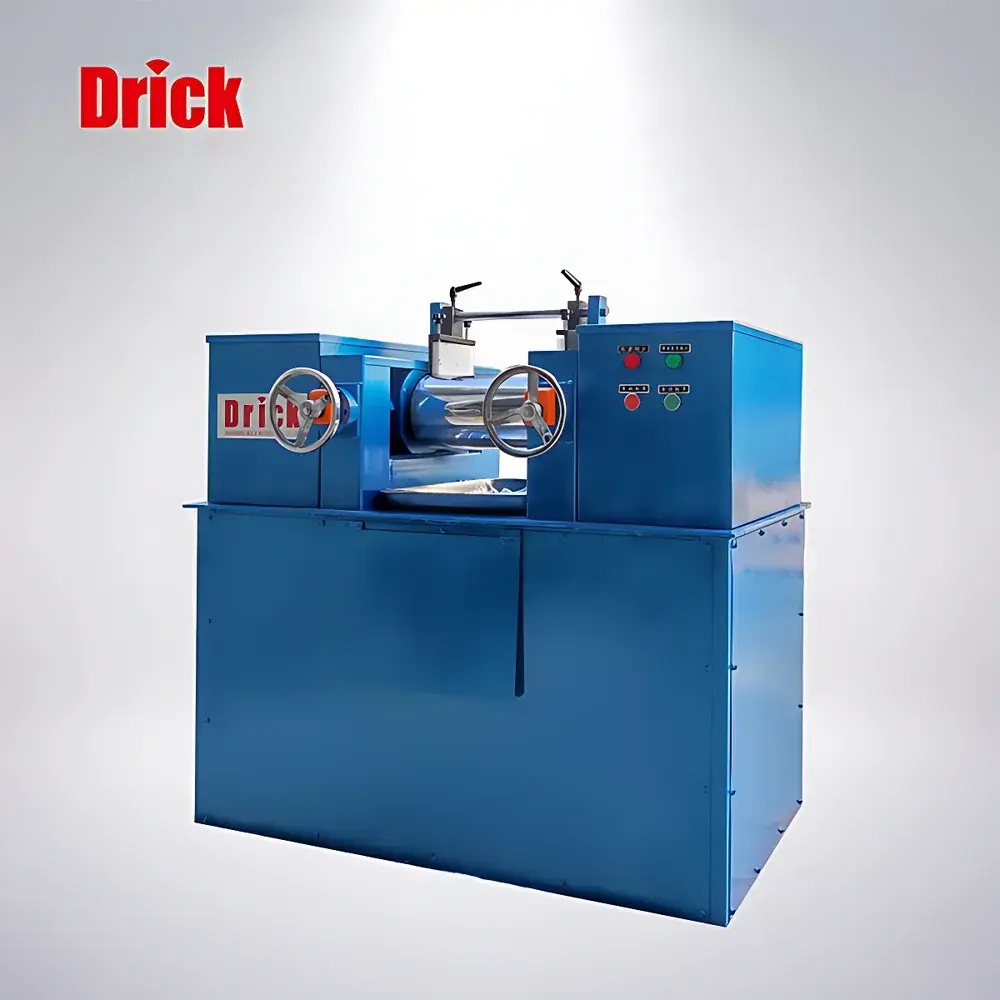
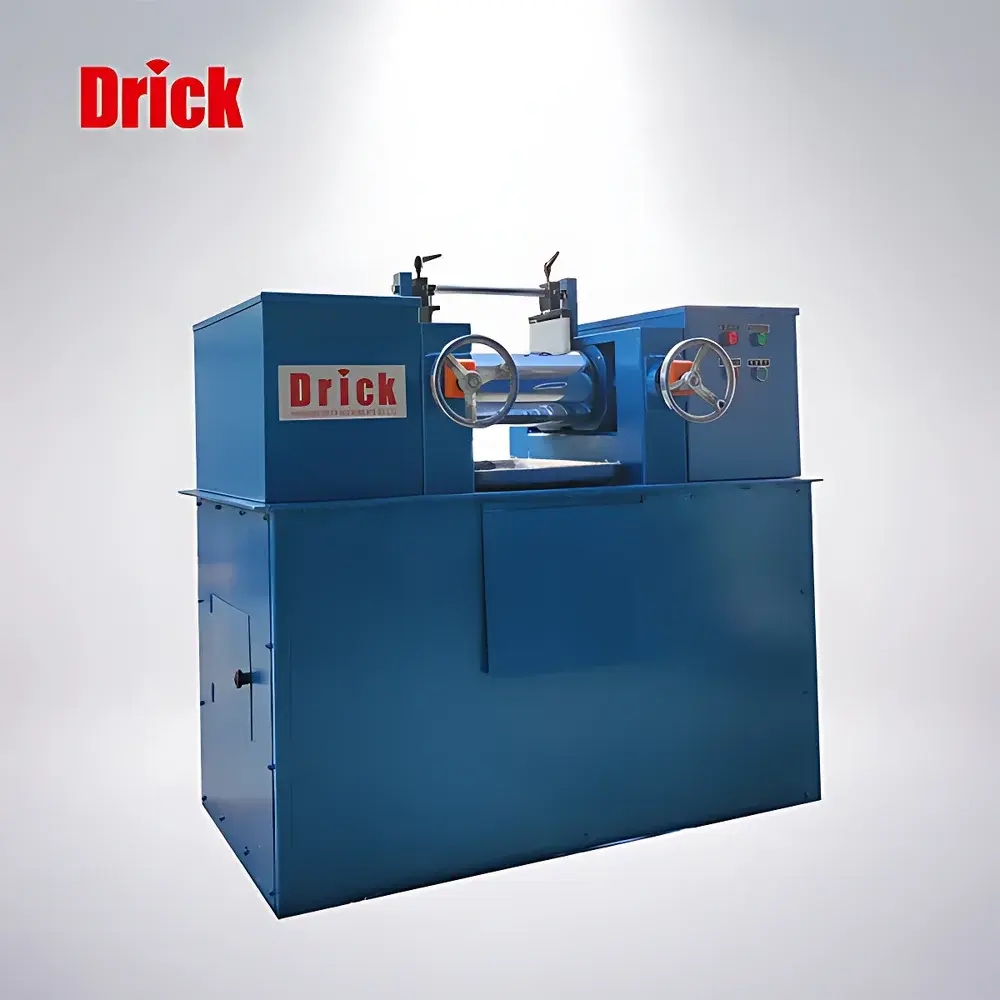
Drick XK160-320B Open-Drive Two-Roll Rubber Mill
| Brand | Drick |
|---|---|
| Origin | Shandong, China |
| Manufacturer Type | Direct Manufacturer |
| Model | XK160-320B |
| Roller Diameter | 160 mm |
| Roll Width | 320 mm |
| Front/Back Roll Speed Ratio | 1:1.35 |
| Front Roll Surface Speed | 12.78 m/min (20.34 rpm) |
| Back Roll Surface Speed | 15.08 m/min (24 rpm) |
| Roll Gap Adjustment | Manual handwheel with digital display |
| Adjustable Gap Range | 0–5 mm |
| Batch Capacity | 1–2 kg |
| Motor Power | 5.5 kW |
| Gearmotor | High-efficiency helical gear reducer |
| Bearing Type | Precision radial ball bearings (4 units) |
| Cooling System | Water-cooled roll jackets with left/right threaded rotary joints |
| Safety System | Knee-actuated emergency stop |
| Electrical Supply | 380 V, 50 Hz |
| Overall Dimensions (L×W×H) | 1335 × 750 × 1170 mm |
| Net Weight | ~800 kg |
| Standard Accessories | Stainless steel feed tray (1 pc), adjustable end scrapers (2 pcs), skeleton oil seals |
Overview
The Drick XK160-320B Open-Drive Two-Roll Rubber Mill is an industrial-grade laboratory and pilot-scale mixing apparatus engineered for precise, repeatable rubber compound processing. It operates on the principle of shear-dominated deformation between two counter-rotating rolls with a fixed speed differential—enabling controlled mastication, dispersion mixing, thermomechanical homogenization, and sheeting of raw elastomers and compounded formulations. Designed in accordance with ISO 289-1 (Rubber—Determination of Mooney viscosity) and ASTM D3182 (Standard Practice for Rubber—Materials, Equipment, and Procedures for Mixing Using Two-Roll Mills), this mill supports both R&D workflows and small-batch production under GLP-compliant environments. Its rigid cast-iron frame, hardened roller surfaces, and water-jacketed thermal management system ensure dimensional stability and consistent rheological response across extended operation cycles.
Key Features
- High-precision twin-roll geometry: 160 mm diameter × 320 mm working width rolls, ground to ≤0.01 mm surface tolerance and hardened to ≥58 HRC for wear resistance.
- Optimized kinematic ratio: Fixed 1:1.35 front-to-back roll speed ratio generates calibrated shear strain rates essential for polymer chain scission and filler dispersion.
- Digital gap monitoring: Integrated LED-based linear displacement indicator enables real-time readout of roll separation (0–5 mm range) with ±0.02 mm resolution; fine-tuning via ergonomic handwheel allows sub-millimeter process repeatability.
- Water-cooling architecture: Dual independent coolant circuits with left/right-hand rotary unions maintain roll surface temperatures within ±2 °C during continuous operation—critical for heat-sensitive compounds (e.g., EPDM, CR, or peroxide-cured systems).
- Robust drivetrain: 5.5 kW TEFC motor coupled to a low-noise, high-torque helical gear reducer delivers stable torque transmission at rated speeds (20.34 rpm front / 24 rpm back), minimizing mechanical vibration and power fluctuation.
- Operator safety compliance: Knee-activated emergency stop panel mounted at ergonomic height meets EN ISO 13857 (safety distances) and OSHA 1910.212 requirements; automatic roll deceleration occurs within <0.8 s upon actuation.
- Contamination control: Double-lip skeleton oil seals prevent lubricant migration into processing zones; stainless steel feed tray and adjustable end scrapers minimize cross-contamination between batches.
Sample Compatibility & Compliance
The XK160-320B accommodates natural rubber (NR), synthetic elastomers (SBR, BR, NBR, IIR), thermoplastic elastomers (TPE), masterbatches, carbon black/silica-filled compounds, curatives, plasticizers, and functional additives. It supports ASTM D3184 (Standard Practice for Rubber—Evaluation of Processing Characteristics of Raw Rubber and Unvulcanized Compounds), ISO 6601 (Rubber compounding—Two-roll mill mixing procedures), and internal QC protocols requiring batch traceability. All electrical components conform to IEC 60204-1; machine guarding satisfies CE Machinery Directive 2006/42/EC. Optional documentation packages include Factory Acceptance Test (FAT) reports and calibration certificates traceable to NIST standards.
Software & Data Management
While the XK160-320B operates as a stand-alone electromechanical system without embedded firmware, its operational parameters are fully compatible with external data acquisition systems. Analog outputs (0–10 V DC) for roll speed, motor current, and coolant temperature can be interfaced with SCADA platforms or LabVIEW-based logging setups. For regulated environments, users may integrate third-party electronic batch records (EBR) software compliant with FDA 21 CFR Part 11—including audit trail generation, user-level access control, and electronic signatures—to document mixing time, gap settings, material lot numbers, and operator IDs per batch.
Applications
- Rubber formulation development: Screening of vulcanization accelerators, anti-degradants, and reinforcing fillers under standardized shear history.
- Quality assurance testing: Reproducible preparation of test specimens for tensile, hardness, and resilience measurements per ASTM D412, D2240, and D2632.
- University teaching labs: Hands-on instruction in polymer processing fundamentals—including Payne effect observation, Mullins effect characterization, and melt fracture analysis.
- Pilot-scale compound validation: Pre-production trials prior to extrusion or calendering, ensuring dispersion uniformity verified via TEM or EDX mapping.
- Recycled rubber reprocessing: Controlled devulcanization studies using chemical or thermo-mechanical protocols.
FAQ
What is the maximum recommended operating temperature for the rolls?
Roll surface temperature should not exceed 80 °C continuously; sustained operation above this threshold may accelerate bearing grease degradation and compromise dimensional stability.
Can the mill be adapted for vacuum-assisted mixing?
Yes—custom vacuum hood integration is supported via flanged ports on the front guard; typical configurations achieve ≤10 mbar residual pressure for moisture-sensitive or foaming-prone compounds.
Is replacement tooling available for non-standard roll geometries?
Drick offers optional grooved, corrugated, or chilled rolls (–10 °C to +100 °C) with custom surface finishes (Ra ≤0.4 µm) upon request.
Does the unit comply with ATEX or hazardous area classification?
Standard configuration is rated for Zone 2/22 (non-hazardous); explosion-proof variants with Class I Div 2 motors and intrinsically safe controls are available under separate engineering quotation.
What maintenance intervals are recommended for the gearmotor and bearings?
Gearmotor oil change every 3,000 operating hours; bearing relubrication every 500 hours using ISO VG 220 synthetic gear oil—log entries must be retained for ISO 9001 audits.



