
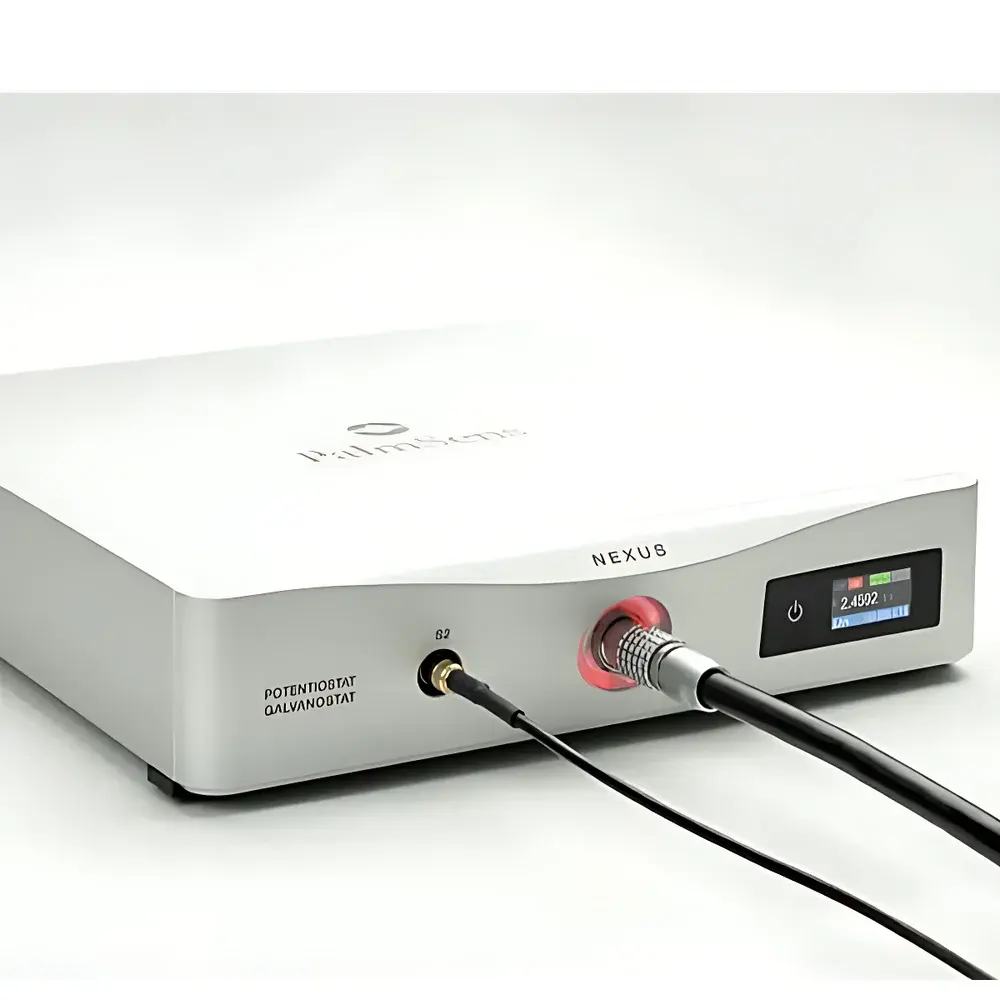
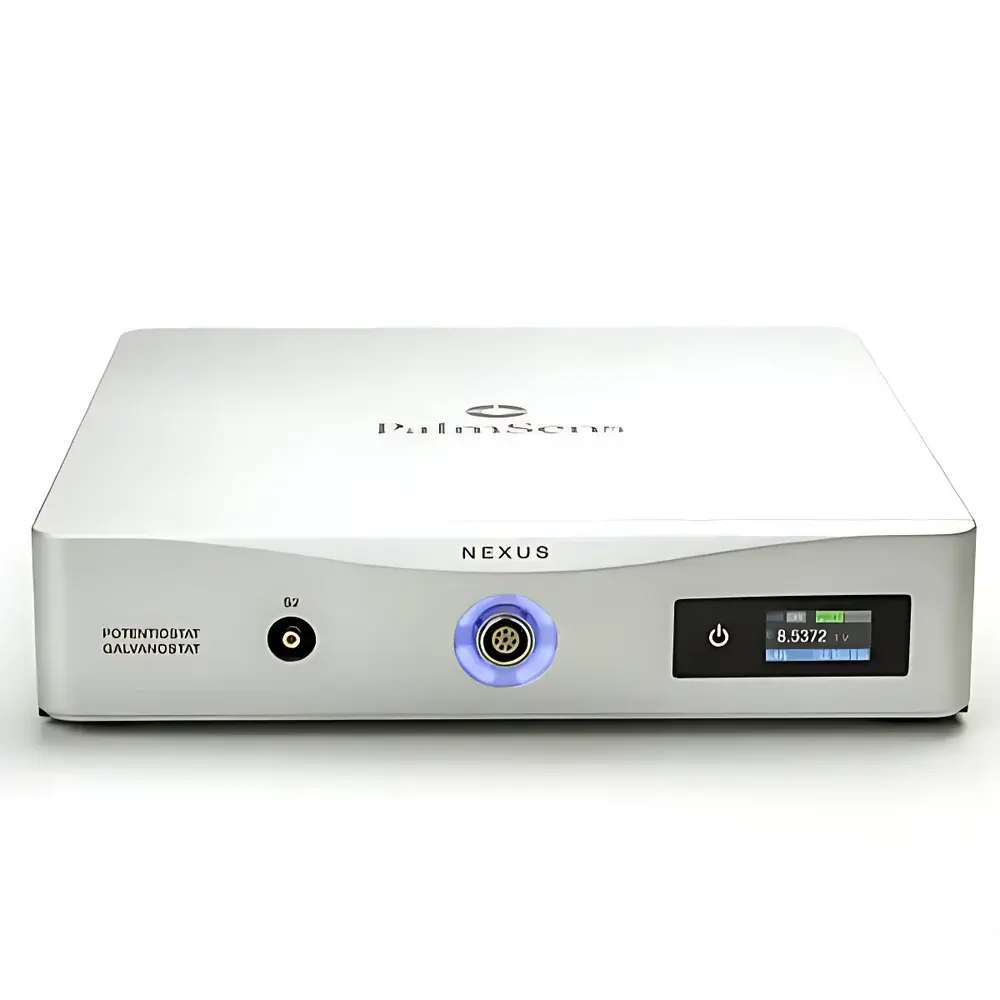
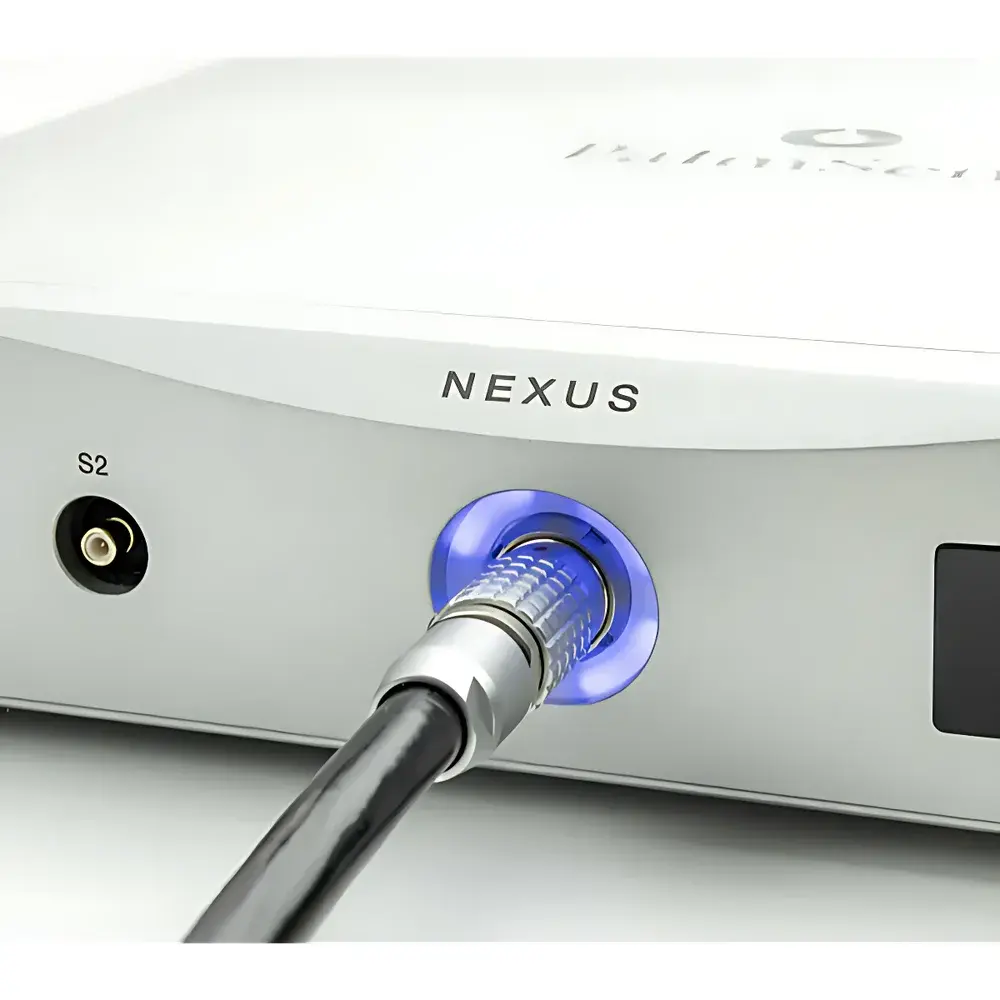
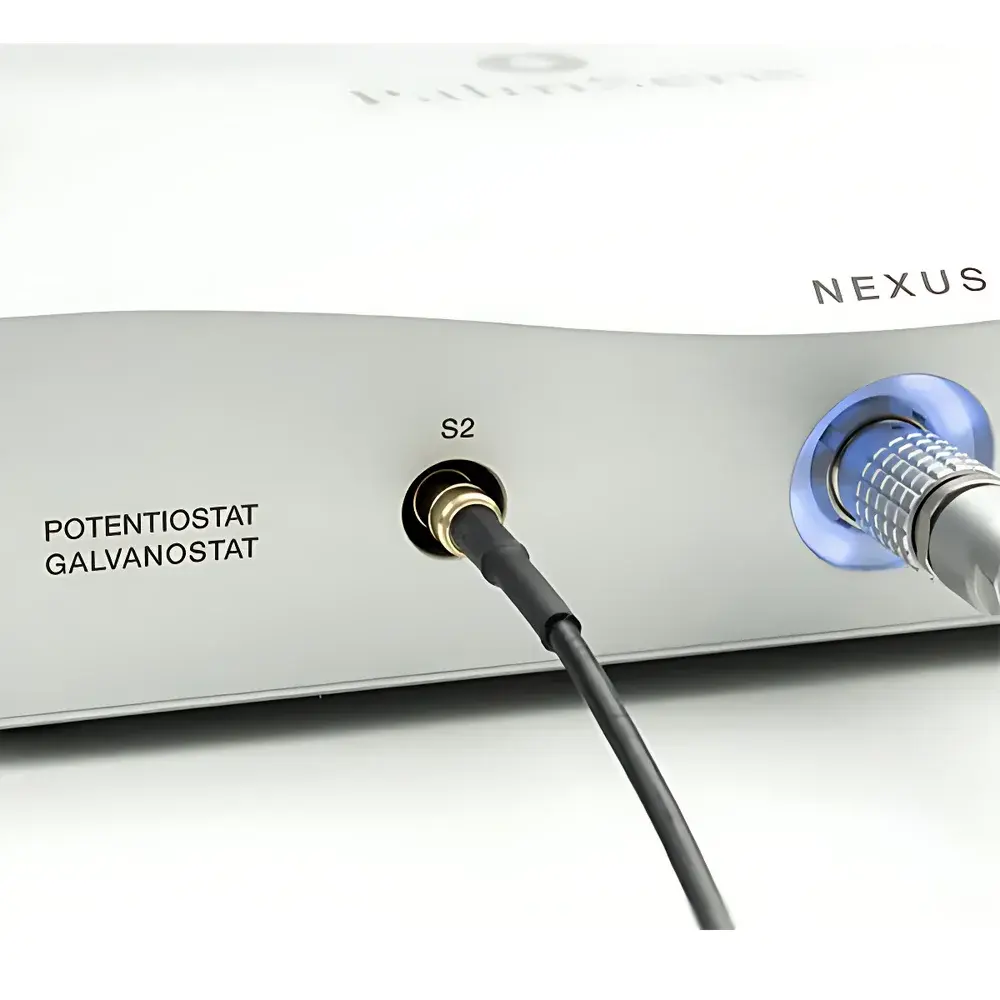
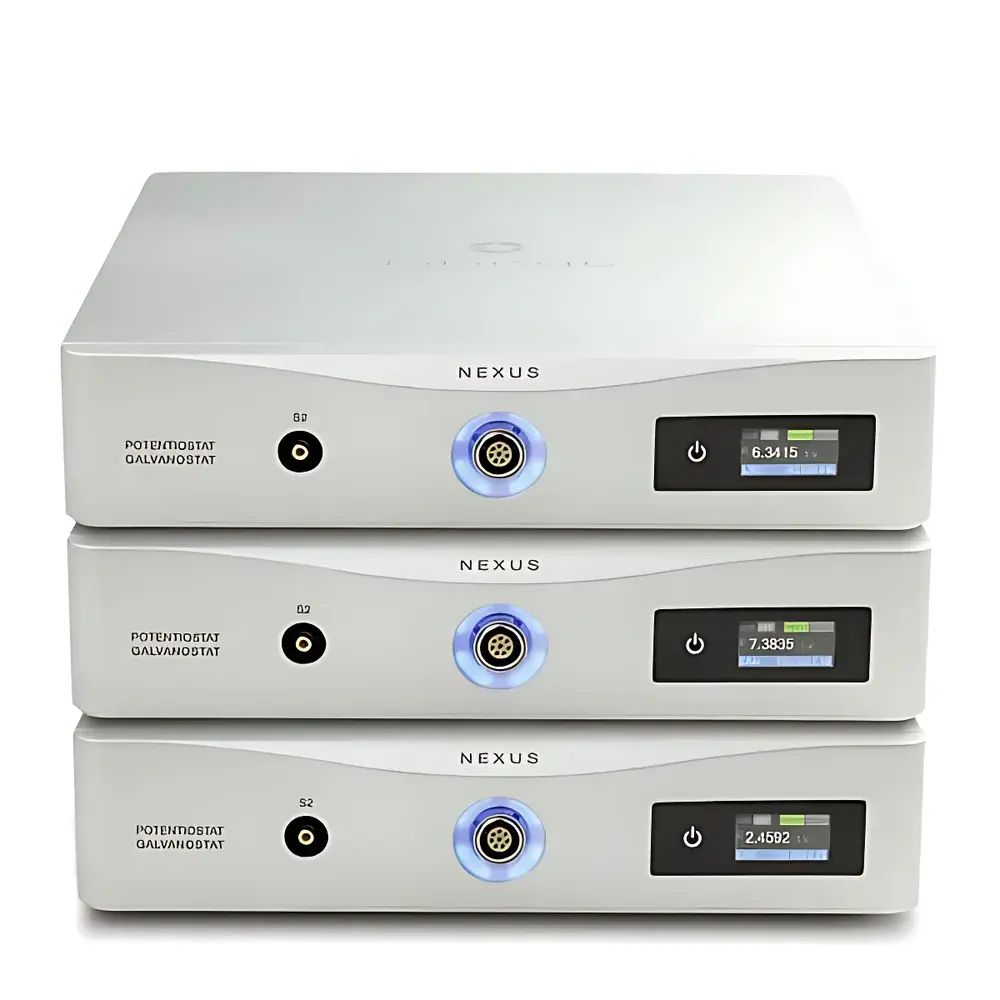
PalmSens NEXUS Desktop Electrochemical Workstation
| Brand | PalmSens |
|---|---|
| Origin | Netherlands |
| Manufacturer Type | Authorized Distributor |
| Origin Category | Imported |
| Model | NEXUS |
| Instrument Type | Electrochemical Workstation |
| Channel Count | Single-Channel |
| Current Range | 100 pA to 1 A (11 decades) |
| Current Accuracy | ±0.1% of reading |
| Potential Accuracy | ±0.1% of full scale |
| Potentiostatic Range | ±10 V |
| EIS Frequency Range | 10 µHz to 1 MHz |
| Communication Interface | USB-C and Ethernet |
| Onboard Storage | 32 GB internal flash memory |
| Optional Dual-Potentiostat Mode | Available |
| Software Platform | .NET-based desktop application with SDK and MethodSCRIPT™ support |
Overview
The PalmSens NEXUS Desktop Electrochemical Workstation is a high-fidelity, single-channel potentiostat/galvanostat engineered for precision electrochemical characterization in academic research laboratories, industrial R&D settings, and quality control environments. Built around a dual-core microcontroller architecture, the NEXUS delivers ultra-low-noise signal acquisition and real-time data processing—enabling rapid, uninterrupted measurements without compromising resolution or fidelity. Its core measurement principle adheres to classical three-electrode potentiostatic control, supporting both DC techniques (e.g., cyclic voltammetry, chronoamperometry, linear sweep voltammetry) and AC-based methods including electrochemical impedance spectroscopy (EIS) across an exceptionally wide frequency span (10 µHz to 1 MHz). The ±10 V compliance voltage and 11-decade current range (100 pA to 1 A) accommodate diverse electrochemical systems—from low-current biosensor interfaces and corrosion monitoring to high-power battery half-cell and full-cell testing.
Key Features
- Ultra-low-noise analog front-end optimized for sub-picoampere current resolution and stable baseline performance
- Dual EIS capability enabling simultaneous or sequential multi-frequency impedance acquisition on full-cell and half-cell configurations
- Integrated 32 GB non-volatile flash memory for autonomous, offline data logging—critical for long-term stability studies or field-deployed experiments
- Dual communication architecture: USB-C for plug-and-play lab integration and Gigabit Ethernet for secure, latency-insensitive remote operation in controlled network environments
- Optional dual-potentiostat mode for independent control of two working electrodes—ideal for comparative studies or reference electrode compensation schemes
- Hardware-level synchronization support for external triggers (TTL), enabling precise coordination with optical, thermal, or mechanical stimuli
Sample Compatibility & Compliance
The NEXUS supports standard three-electrode electrochemical cells (working, counter, reference) as well as two-electrode configurations for simplified sensor evaluation. It is compatible with aqueous and non-aqueous electrolytes, solid-state ion conductors, and thin-film electrode architectures. All analog signal paths comply with IEC 61326-1:2013 for electromagnetic compatibility (EMC) in laboratory environments. While the instrument itself does not carry FDA 510(k) or CE-IVD certification, its hardware design and firmware architecture align with GLP/GMP-aligned data integrity principles—including timestamped raw data capture, immutable metadata embedding, and audit-ready file structures. MethodSCRIPT™-generated protocols can be version-controlled and archived to satisfy ISO/IEC 17025 documentation requirements for method validation.
Software & Data Management
The workstation is operated via a native Windows desktop application built on the Microsoft .NET Framework, offering intuitive graphical configuration of experiment parameters, real-time visualization, and post-acquisition analysis tools. Crucially, PalmSens provides a comprehensive Software Development Kit (SDK) with full API documentation, enabling custom GUI development, integration into LIMS or MES platforms, and automated test sequencing. MethodSCRIPT™—a domain-specific scripting language—is embedded directly into the firmware and allows users to define complete electrochemical methods in human-readable text format. Scripts support conditional logic, parameter sweeps, looped sequences, and inter-method branching—facilitating reproducible method deployment across instruments and operators. All acquired datasets are saved in open-format HDF5 containers, ensuring long-term accessibility and interoperability with Python (h5py), MATLAB, and third-party analysis suites.
Applications
- Battery materials R&D: Half-cell cycling, SEI formation analysis, full-cell EIS under load, rate capability assessment
- Corrosion science: Polarization resistance, electrochemical noise analysis (ENA), localized corrosion mapping
- Biosensor development: Amperometric detection, enzyme kinetics, redox mediator characterization
- Electrocatalysis: Oxygen reduction reaction (ORR), hydrogen evolution reaction (HER), CO₂ reduction screening
- Conducting polymer characterization: Doping/dedoping kinetics, charge storage capacity, switching stability
- Quality assurance of electroplating baths and passivation layers via rapid EIS fingerprinting
FAQ
Does the NEXUS support true bipotentiostat operation?
Yes—when configured with the optional dual-potentiostat module, the NEXUS independently controls two working electrodes against a shared reference and counter electrode, enabling differential measurements and reference electrode drift correction.
Can MethodSCRIPT™ scripts be executed without a connected PC?
Yes—the onboard 32 GB storage allows pre-loaded MethodSCRIPT™ files to run autonomously; no host computer is required during execution.
Is the SDK compatible with Linux or macOS?
The official SDK targets Windows (.NET Framework 4.8+), but RESTful API wrappers and HDF5 data export enable cross-platform integration via Python or Node.js.
What level of EIS accuracy is maintained at sub-millihertz frequencies?
At 10 µHz, the system achieves <0.5° phase error and <1% magnitude deviation under calibrated conditions using a 1 kΩ–1 nF RC standard, verified per ASTM E2717-19 guidelines for low-frequency impedance validation.
How is data integrity ensured during power interruption?
All active measurements write incrementally to flash memory with journaling; abrupt power loss preserves all completed data points up to the last committed buffer cycle.





