
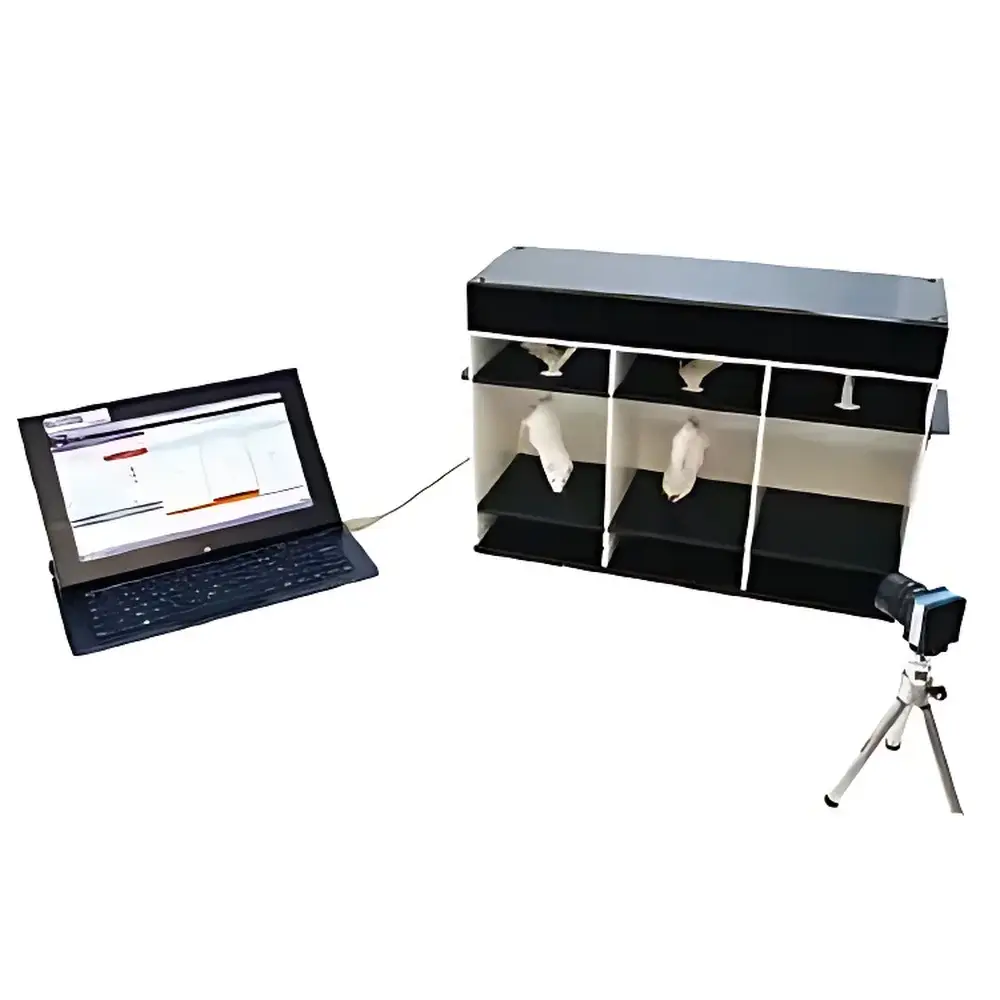
Panlab BIO-TST4 Automated Tail Suspension Test System
| Brand | Harvard Apparatus |
|---|---|
| Origin | USA |
| Model | BIO-TST4 |
| Sensor Type | Precision Load Cell (Gravity-Based Force Transduction) |
| Output Parameters | Immobility Time (s), Immobility Ratio (%), Mean Struggling Force (mN), Energy Expenditure (mJ), Threshold-Adjustable Immobility Detection |
| Connectivity | USB 2.0 |
| Max Concurrent Units per PC | 6 |
| Animal Capacity | 3–6 mice (configurable 3×2 array) |
| Housing Material | Black-and-White Acrylic Enclosure with Stainless Steel Hooks |
| Optional Integration | SMART 3.0 Video Analysis Module (add-on) |
| Data Export | CSV/Excel-compatible format |
Overview
The Panlab BIO-TST4 Automated Tail Suspension Test System is a validated, force-based behavioral phenotyping platform engineered for objective, high-throughput assessment of depressive-like behavior in murine models. Unlike video-based systems reliant on motion pixel analysis, the BIO-TST4 employs calibrated load cells positioned directly above the animal’s tail suspension point to transduce real-time mechanical output—specifically vertical force displacement and integrated energy expenditure—during the test session. This gravimetric measurement principle eliminates subjective observer bias, frame-rate dependency, lighting artifacts, and software-defined motion thresholds inherent in optical tracking. The system operates on the ethologically grounded premise that immobility in the tail suspension paradigm reflects behavioral despair: a quantifiable reduction in active escape attempts following repeated, inescapable stress exposure. As such, the BIO-TST4 delivers reproducible, continuous analog force-time and energy-time waveforms—enabling not only binary immobility classification but also kinetic profiling of struggle dynamics across time bins, critical for mechanistic studies of antidepressant onset, dose-response relationships, or neurogenetic modulation.
Key Features
- Force-transduction architecture: High-resolution load cells (±0.1 mN sensitivity) capture raw analog force signals at ≥100 Hz sampling rate, enabling precise derivation of struggling force (PM), cumulative energy (mJ), and temporal immobility onset/offset.
- Fully automated immobility detection: Algorithmic thresholding (user-adjustable between 0.5–5.0 mN force deviation) classifies immobility segments without manual scoring or video processing overhead.
- Scalable multi-unit operation: Single Windows PC supports up to six independent BIO-TST4 units via USB hub, permitting parallel testing of 3–6 mice in standardized 3×2 chamber arrays.
- Non-invasive, low-maintenance design: Modular acrylic enclosures (black/white contrast optimized for minimal visual distraction) with corrosion-resistant stainless steel suspension hooks ensure consistent biomechanical coupling and long-term calibration stability.
- Regulatory-ready data integrity: All raw force traces, processed metrics, and user-defined parameters are timestamped, digitally signed, and stored in audit-trail-enabled project files compliant with GLP documentation requirements.
Sample Compatibility & Compliance
The BIO-TST4 is validated for C57BL/6, BALB/c, Swiss Webster, and CD-1 male and female mice (18–30 g). Chamber dimensions (L×W×H: 15 × 10 × 25 cm) accommodate standard tail suspension protocols per NIH and OECD TG 426 guidelines. All force sensors undergo annual NIST-traceable calibration; system firmware conforms to IEC 62304 Class B medical device software standards. Data acquisition and reporting modules support 21 CFR Part 11-compliant electronic signatures when deployed with validated SMART 3.0 add-on licensing and networked server storage.
Software & Data Management
The native BioTst v4.2 software (Windows 10/11, 64-bit) provides synchronized acquisition, real-time visualization of force/energy curves, and batch statistical export. Each session generates a structured .bts project file containing raw sensor data (CSV-embeddable), metadata (animal ID, strain, drug regimen, operator), and computed endpoints: total immobility duration, immobility ratio (% of total test time), mean struggling force (PM), and integrated energy expenditure. Export functions include direct Excel (.xlsx) generation with worksheet tabs for individual animals and group summary statistics. Audit logs record all parameter modifications, file exports, and user login events—essential for FDA or EMA preclinical study submissions.
Applications
- Preclinical antidepressant screening: Quantitative comparison of onset kinetics, efficacy ceilings, and dose–response profiles across SSRIs, SNRIs, ketamine analogs, and novel neuromodulators.
- Genetic model characterization: Phenotypic validation of depression-relevant knockouts (e.g., BDNF+/-, CREB-deficient), transgenic lines, or CRISPR-edited strains under controlled environmental conditions.
- Neuroinflammatory and aging studies: Longitudinal tracking of immobility progression in LPS-challenged, high-fat-diet-induced, or senescent mouse cohorts.
- Combination therapy evaluation: Assessment of synergistic or antagonistic interactions between pharmacological agents and non-pharmacological interventions (e.g., environmental enrichment, vagus nerve stimulation).
- Behavioral pharmacokinetic–pharmacodynamic modeling: Alignment of plasma drug concentrations with dynamic changes in force-derived struggle metrics across time.
FAQ
How does the BIO-TST4 define “immobility” without video analysis?
Immobility is determined by sustained force signal deviation below a user-configurable threshold (default: 1.2 mN) for ≥2 seconds, reflecting absence of active tail or body movement against gravity. This is derived directly from load cell output—not pixel displacement.
Can the system distinguish between passive hanging and active tail wrapping?
Yes. Tail wrapping generates characteristic high-frequency, low-amplitude force oscillations distinct from static suspension or whole-body struggling; these are preserved in raw waveform data for post-hoc spectral analysis.
Is calibration required before each experiment?
No. Factory-calibrated load cells maintain stability for ≥12 months under standard lab conditions. A quick zero-balance check (<5 sec) is recommended prior to each daily session.
What validation documentation is provided?
Each unit ships with NIST-traceable calibration certificate, ISO 17025-accredited performance verification report, and full SOP templates aligned with AAALAC and OECD TG 426.
Does the system support integration with third-party electrophysiology or telemetry platforms?
Yes. TTL-triggered synchronization input/output ports enable hardware-level alignment with EEG, EMG, or telemetric cardiovascular recordings during concurrent testing sessions.
Related Products



