
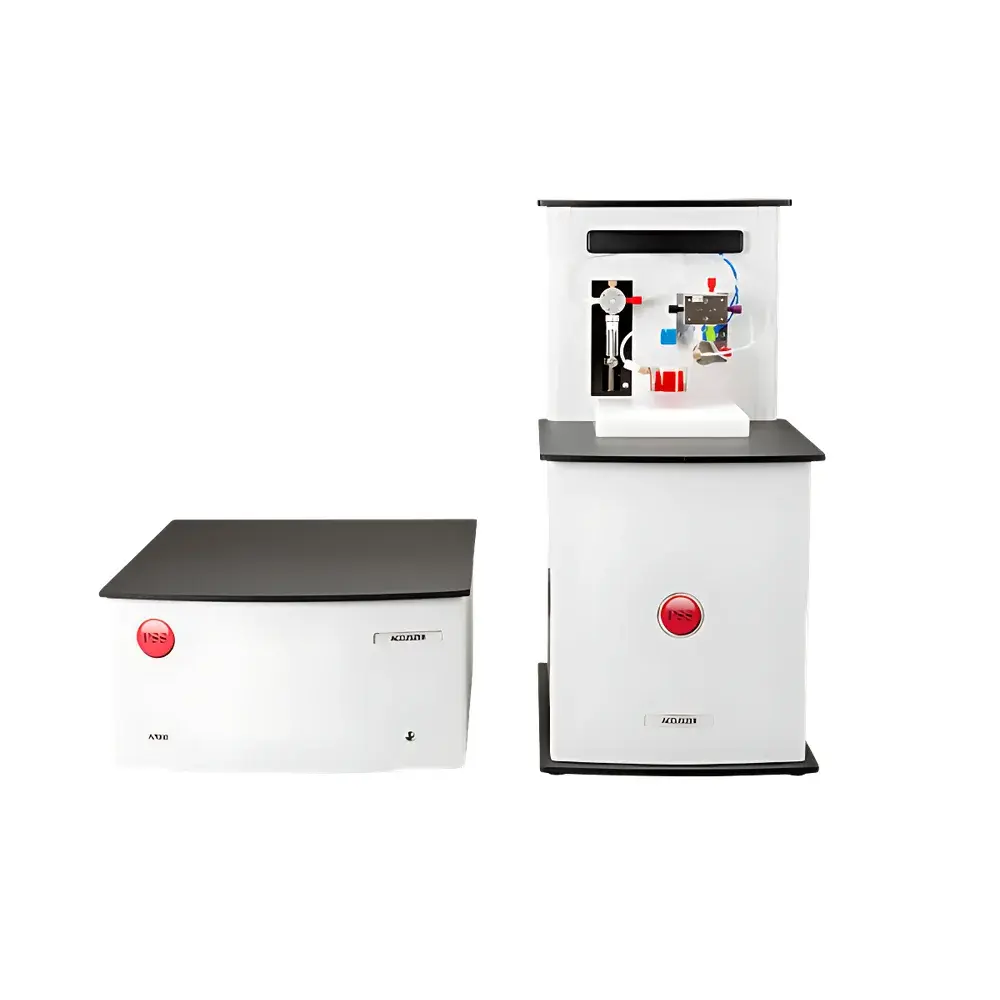
Particle Sizing Systems AccuSizer A7000 APS Automated Nanoparticle Size and Count Analyzer
| Brand | Particle Sizing Systems (PSS) |
|---|---|
| Origin | USA |
| Model | A7000 APS |
| Instrument Type | Optical Particle Counter (SPOS-based) |
| Detection Principle | Single Particle Optical Sensing (SPOS) combining Light Extinction (LE) and Light Scattering (LS) |
| Size Range | 0.5 µm – 400 µm |
| Channel Resolution | 512 logarithmically spaced channels |
| Maximum Sample Concentration | 10¹¹ particles/mL |
| Dilution System | Dual-stage automated dilution (static + dynamic) |
| Compliance | USP <729>, CP 2015, 21 CFR Part 11, GLP/GMP-ready |
| Software | Regulatory-grade AccuSizer software with audit trail, role-based access control, electronic signatures, and LIMS connectivity |
| Sample Handling | Fully automated sampling, dilution, measurement, data processing, and cleaning |
| Sensor Options | LE400-05 (0.5–400 µm), LE400-1 (1–400 µm), LE1000-2 (2–1000 µm), etc. |
| Flow Rate | 60–180 mL/min |
| Sample Volume | 5 µL – 5 mL (via programmable loop or syringe) |
| Operating System | Windows 7 Professional or later |
Overview
The Particle Sizing Systems AccuSizer A7000 APS is a fully automated nanoparticle size and count analyzer engineered for high-fidelity quantification of particle populations in low-to-high concentration liquid dispersions. It operates on the validated Single Particle Optical Sensing (SPOS) principle—a direct-counting methodology that combines light extinction (LE) and light scattering (LS) detection within a single flow cell. Unlike ensemble-averaging techniques such as laser diffraction or dynamic light scattering, SPOS resolves each particle individually, generating statistically robust number-weighted distributions with exceptional sensitivity to rare, large particles in the distribution tail—commonly referred to as “outliers” or “subvisible particles.” This capability is critical in pharmaceutical parenterals, CMP slurries, injectable biologics, pigment dispersions, and inkjet inks, where regulatory acceptance hinges on the absence of particles exceeding defined thresholds (e.g., PFAT5 in lipid emulsions per USP and CP 2015). The A7000 APS delivers trace-level detection down to 0.5 µm while maintaining quantitative accuracy across a 0.5–400 µm dynamic range, enabled by its dual-detection architecture and 512-channel pulse amplitude analysis.
Key Features
- True single-particle resolution via synchronized LE+LS detection—eliminating ensemble averaging artifacts and enabling unambiguous identification of tail-end particles.
- Dual-stage automated dilution system: first-stage static dilution in a 30 mL quartz chamber with PFA-coated magnetic stirrer; second-stage dynamic dilution using ceramic piston pumps and precision syringes (dilution factor range: 20× to 144,060×).
- 512 logarithmically binned detection channels—providing sub-micron granularity in the critical 0.5–5 µm region and resolving discrete peaks from multi-modal standards (e.g., 0.7, 0.8, 1.3, 2, 5, 10, 15, 20, 50, 100, and 200 µm PSLs) without overlap.
- Regulatory-compliant software platform certified to 21 CFR Part 11 requirements—including full audit trail, user authentication, electronic signatures, permission-tiered workflows, and secure data backup.
- Modular sensor architecture supporting interchangeable flow cells (e.g., LE400-05, LE1000-2) optimized for specific application ranges and matrix compatibility (aqueous and organic solvents).
- Integrated sample handling: programmable loop/syringe injection, temperature-stable fluidic path, PFA-lined valves and tubing, 0.2 µm pre-filtered diluent delivery, and automated post-run cleaning sequence.
- On-site calibration and performance qualification using NIST-traceable standard particles (Duke Scientific, MicroMetric Labs), eliminating need for factory return.
Sample Compatibility & Compliance
The A7000 APS accommodates a broad spectrum of sample types—including water-based suspensions, polar organic solvents (e.g., ethanol, IPA), oil-in-water and water-in-oil emulsions, CMP slurries containing SiO₂ or Al₂O₃ abrasives, protein-containing biopharmaceutical formulations, and pigment-loaded inks. Its optical design minimizes refractive index dependency, ensuring consistent sizing across diverse chemistries. From a regulatory standpoint, the instrument meets key pharmacopeial and quality system requirements: it is explicitly cited in USP for PFAT5 determination in lipid emulsions and referenced in Chinese Pharmacopoeia CP 2015 for large particle testing in injectables. All hardware and firmware components are designed and documented to support GLP and GMP environments. The included regulatory software satisfies FDA 21 CFR Part 11 criteria for electronic records and signatures, including immutable audit logs, time-stamped operator actions, and configurable retention policies. Optional IQ/OQ/PQ documentation packages are available for installation and operational qualification under ISO/IEC 17025 and Annex 11 frameworks.
Software & Data Management
The AccuSizer software suite comprises two interoperable editions: the Research Edition (L2W) for method development and exploratory analysis, and the Regulatory Edition—fully compliant with 21 CFR Part 11. The latter implements hierarchical user roles (Administrator, Analyst, Reviewer), session-locking, electronic signature capture with biometric or token-based verification, and real-time synchronization with enterprise LIMS platforms via OPC UA or HL7 interfaces. All raw pulse data, processed histograms, and metadata are stored in encrypted SQLite databases with automatic daily backups to network drives or cloud repositories. Reporting templates adhere to ICH M4 Q5A guidelines and support customizable pass/fail criteria, statistical summaries (mean, Dv10/Dv50/Dv90, % >5 µm), and overlay comparisons across batches or timepoints. Data integrity is enforced through checksum validation, write-once-read-many (WORM) archival options, and tamper-evident log entries for every data modification event.
Applications
The A7000 APS addresses mission-critical particle characterization challenges across multiple regulated and industrial sectors. In pharmaceutical development, it quantifies subvisible particles in monoclonal antibody formulations, mRNA-LNP vaccines, and sterile injectables—supporting root-cause analysis of aggregation, filtration efficiency validation, and container-closure integrity assessment. For semiconductor manufacturing, it detects oversized agglomerates (>30 µm) in CMP slurries at sensitivities up to 25,000× greater than laser diffraction—directly correlating with wafer defect density and polishing uniformity. In advanced materials R&D, it monitors dispersion stability of quantum dots, metal oxides, and carbon nanotubes during milling and surface functionalization. Inkjet ink manufacturers rely on its ability to detect clogging-prone aggregates >1.5 µm in pigment dispersions, while cosmetic and nutraceutical formulators use it to verify nanoemulsion homogeneity and shelf-life stability. Each application benefits from the instrument’s capacity to report absolute particle counts—not just relative intensities—enabling statistically powered comparability studies and process capability assessments (Cp/Cpk).
FAQ
How does SPOS differ from laser diffraction in detecting large particles?
SPOS measures each particle individually, producing number-based distributions with high sensitivity to rare outliers. Laser diffraction infers size from ensemble scattering patterns and often over-represents large particles due to signal weighting bias—leading to false positives above ~30 µm.
Can the A7000 APS analyze undiluted biological samples?
No—biological matrices typically exceed the maximum detectable concentration (10¹¹/mL). The dual-stage dilution system enables accurate analysis of concentrated samples by reducing them to optimal counting densities (<10⁶/mL) while preserving statistical fidelity.
Is sensor recalibration required after changing solvents?
Yes—refractive index shifts affect LS signal gain. The system supports solvent-specific calibration curves, and users may load pre-validated profiles for common media (e.g., PBS, 10% ethanol, propylene glycol).
What validation documentation is provided?
Standard delivery includes Factory Acceptance Test (FAT) report, Installation Qualification (IQ) checklist, and Performance Qualification (PQ) protocol with NIST-traceable standard particles (0.5–100 µm). Full GxP-compliant validation packages are available upon request.
Does the system support non-aqueous solvents?
Yes—the fluidic path uses PFA, PTFE, and 316 stainless steel components compatible with alcohols, acetone, DMF, and hydrocarbon solvents. Optional LS module tuning ensures optimal signal-to-noise ratio across varying RI ranges.



