
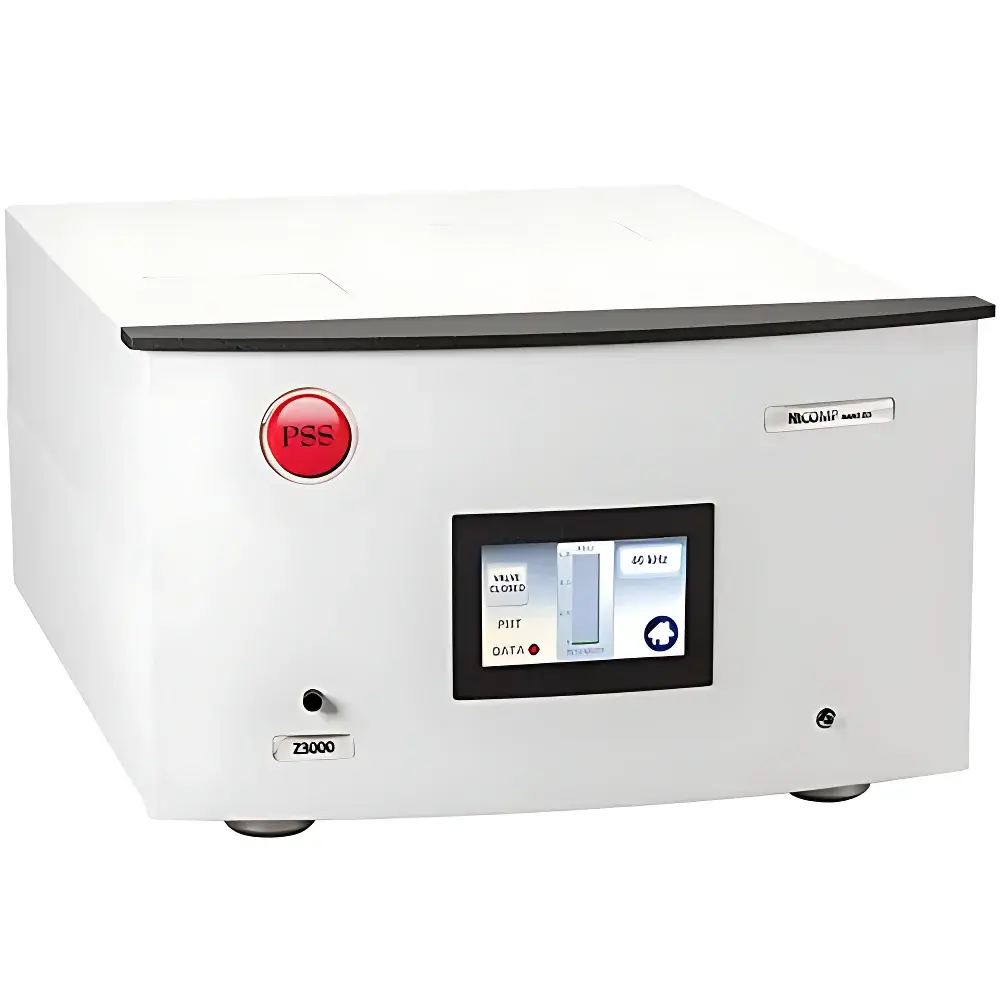
PSS Nicomp Z3000 Basic Zeta Potential Analyzer
| Brand | Particle Sizing Systems (PSS) |
|---|---|
| Origin | USA |
| Model | PSS Nicomp Z3000 Basic |
| Zeta Potential Range | ±500 mV |
| pH Range | 1–14 |
| Temperature Range | 0–90 °C |
| pH Resolution | 0.1 |
| Temperature Resolution | 0.1 °C |
| Accuracy | ≥99% |
| Repeatability | ≥99% |
Overview
The PSS Nicomp Z3000 Basic Zeta Potential Analyzer is a high-precision electrophoretic light scattering (ELS) instrument engineered for robust, reproducible measurement of surface charge and colloidal stability in aqueous and organic dispersions. Built upon the proven architecture of the Nicomp 3000 platform, it integrates electrophoretic mobility detection with dynamic light scattering (DLS) capability—enabling simultaneous zeta potential and particle size analysis within a single optical module. The system operates on the principle of laser Doppler velocimetry: charged particles undergo electrophoretic motion under an applied electric field, and their velocity is determined via frequency shift analysis of scattered light (the Doppler effect). This velocity, combined with medium viscosity, dielectric constant, and temperature data, is converted to zeta potential using the Henry equation (with Smoluchowski or Hückel approximation selectable per sample conditions). Designed for laboratories requiring regulatory-compliant characterization of nanomaterials, biologics, liposomes, polymeric nanoparticles, and industrial colloids, the Z3000 Basic delivers traceable, ISO 13321- and ASTM D7853-aligned measurements under controlled thermal and electrochemical conditions.
Key Features
- Electrophoretic light scattering (ELS) with integrated DLS optics for concurrent zeta potential and hydrodynamic diameter measurement
- Dual-mode electrode configuration: reusable, low-resistance palladium parallel-plate electrodes—designed for rapid cleaning, minimal polarization, and extended service life
- High-stability temperature control (±0.1 °C) across 0–90 °C range, with condensation-free operation and real-time thermal feedback
- Automated pH and conductivity compensation algorithms compliant with IUPAC recommendations for electrophoretic mobility conversion
- Optimized signal-to-noise architecture featuring avalanche photodiode (APD-LDC) detection—delivering 7–10× higher sensitivity than conventional PMT detectors
- Modular expandability: compatible with optional auto-dilution, autosampler (60-position), and multi-angle DLS modules (10°–175°, 0.7° step resolution)
- Laser source options: 35 mW or 50 mW red diode (635 nm) for enhanced scattering from low-refractive-index or sub-5 nm particles
Sample Compatibility & Compliance
The Z3000 Basic supports a broad spectrum of dispersion media—including water, ethanol, isopropanol, THF, DMF, and chloroform—with compatibility verified for ionic strengths up to 200 mM and viscosities ≤20 cP. Sample volume requirements are flexible: standard 4 mL quartz cuvettes (10 mm path length) and low-volume 1 mL glass cells (minimum 10 μL injection) accommodate both routine QC and precious research samples. All hardware and firmware meet electromagnetic compatibility (EMC) standards per IEC 61326-1 and safety requirements per IEC 61010-1. Data integrity and audit readiness are ensured through full 21 CFR Part 11 compliance: electronic signatures, role-based access control, immutable audit trails, and secure user authentication are embedded in the native Nicomp Analysis Software v4.x. The system also supports GLP/GMP workflows with IQ/OQ documentation packages available upon request.
Software & Data Management
Nicomp Analysis Software provides a validated, Windows-based environment for instrument control, real-time data acquisition, and advanced statistical reporting. The software implements dual-algorithm particle sizing—Gaussian distribution for monodisperse systems and proprietary Nicomp multimodal deconvolution for complex, polydisperse samples (capable of resolving components with volume ratio as low as 1:2). For zeta potential, the software applies automatic baseline correction, field reversal optimization, and adaptive voltage ramping to minimize electrode polarization artifacts. All raw correlation functions, mobility histograms, and derived zeta distributions are stored in vendor-neutral .csv and .xml formats. Batch processing, custom report templates (PDF/Excel), and LIMS integration via OPC UA or REST API are supported. Validation documentation—including installation qualification (IQ), operational qualification (OQ), and performance qualification (PQ) protocols—is provided with each system shipment.
Applications
This analyzer serves critical roles across pharmaceutical development (liposomal drug carriers, mRNA-LNPs, protein aggregates), materials science (ceramic slurries, CMP abrasives, quantum dots), cosmetics (emulsion stability, sunscreen nanoparticle dispersion), and environmental nanotoxicology (colloidal fate and transport modeling). It is routinely employed to assess formulation robustness during stability studies, optimize surfactant selection for emulsion stabilization, validate sterilization-induced aggregation, and support regulatory submissions under USP , EP 2.9.31, and ISO 13099. In QC environments, its repeatability (<1% RSD for ζ-potential on NIST-traceable latex standards) enables tight process control for batch release testing of injectables, vaccines, and topical nanomedicines.
FAQ
What sample preparation is required prior to zeta potential measurement?
Samples must be filtered (0.45 µm or 0.22 µm syringe filter) to remove dust and large aggregates; conductivity should be adjusted to 50–200 µS/cm for optimal field response. No centrifugation is needed unless macro-aggregates are present.
Can the Z3000 Basic measure zeta potential in non-aqueous solvents?
Yes—provided the solvent has sufficient dielectric constant (>5) and conductivity (>1 µS/cm); methanol, ethanol, acetone, and ethyl acetate are routinely supported with appropriate electrode conditioning.
How does the system handle highly concentrated or viscous samples?
The optional auto-dilution module enables programmable dilution down to 0.01× original concentration; for viscous media (>10 cP), temperature-controlled measurement at elevated temperatures (e.g., 40–60 °C) improves mobility resolution.
Is calibration traceable to national standards?
Yes—zeta potential calibration uses NIST SRM 1980 (polystyrene latex) and SRM 2800 (silica nanoparticles); all calibrations are logged with timestamp, operator ID, and environmental metadata.
Does the software support method transfer between instruments?
Yes—method files (.nms) include all instrument parameters, analysis settings, and reporting configurations, ensuring identical processing across multiple Z3000 units in multi-site operations.



