
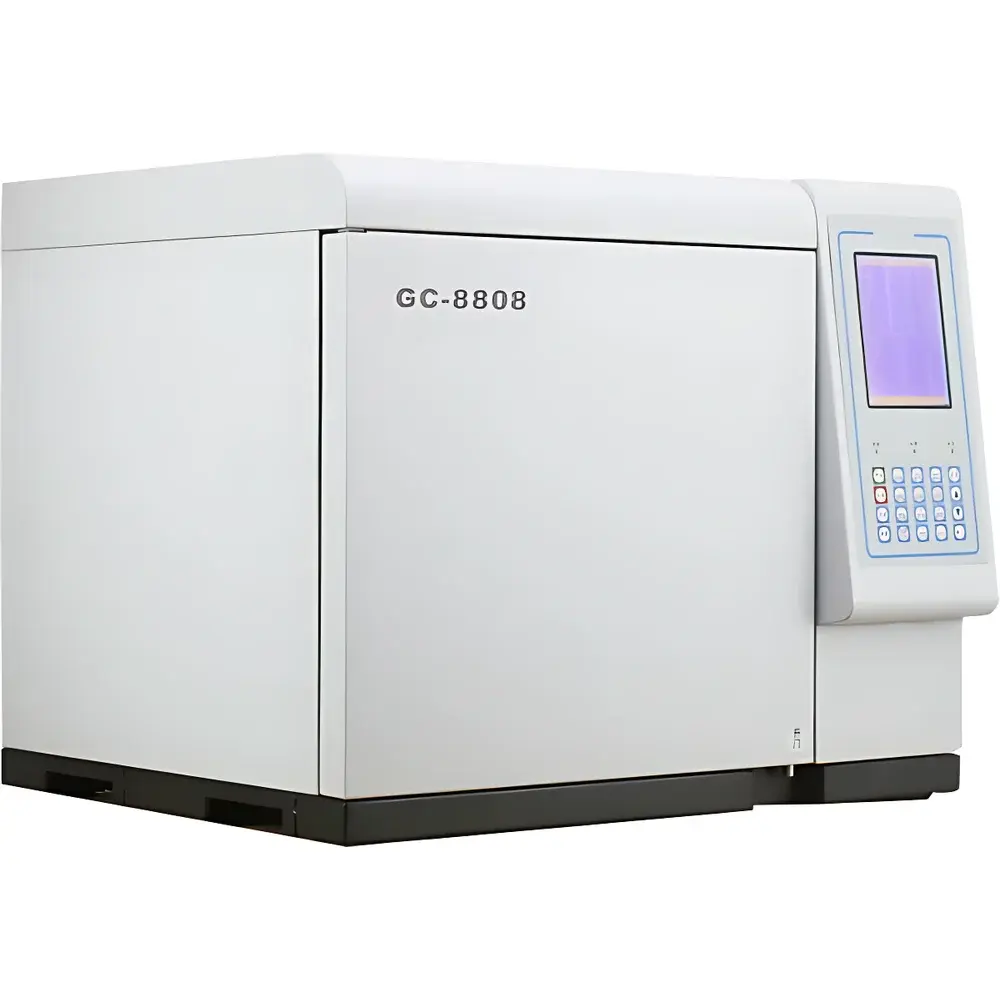
PDHID-Specific Gas Chromatograph GC8800 by MNK
| Brand | MNK |
|---|---|
| Origin | Beijing, China |
| Model | GC8800 |
| Instrument Type | Online Gas Chromatograph |
| Application Domain | Ultra-High-Purity (UHP) Gas Impurity Analysis |
| Detector Type | Pulsed Discharge Helium Ionization Detector (PDHID) |
| Carrier Gas | Ultra-High-Purity Helium (≥99.999%, purified to ≤10 ppb total impurities) |
| Baseline Noise | ≤0.1 mV |
| Baseline Drift | ≤0.5 mV/30 min |
| Detection Limit | ≤1.0 × 10⁻¹⁰ g/mL |
| Gas Control Options | Manual Valving & Electronic Pressure Control (EPC) |
| Data Transmission | Ethernet-enabled Remote Monitoring & Unattended Operation |
| Regulatory Compliance Support | ASTM D7622, ISO 8573-8, SEMI F57, IEC 60400, USP <621>, FDA 21 CFR Part 11-ready audit trail capability |
Overview
The GC8800 PDHID-Specific Gas Chromatograph is an online analytical platform engineered for trace-level impurity profiling in ultra-high-purity (UHP) process gases. It employs pulsed discharge helium ionization detection (PDHID), a non-radioactive, high-sensitivity detection principle based on electron impact ionization of analytes in a metastable helium plasma. Unlike conventional TCD or FID systems, PDHID delivers universal response across permanent gases (H₂, O₂, N₂, CO, CH₄), noble gases (He, Ne, Ar, Kr, Xe), and reactive species (HF, HCl, SiH₄, PH₃, AsH₃), with sub-part-per-trillion (ppt) detection capability when coupled with optimized cryogenic preconcentration and high-efficiency capillary separation columns. Designed for continuous integration into semiconductor fab gas delivery networks, electronics-grade cylinder certification labs, and high-purity CO₂ beverage production lines, the GC8800 operates under Class 100 cleanroom-compatible environmental specifications and supports real-time, multi-point gas stream monitoring without manual intervention.
Key Features
- Integrated PDHID detector with patented pulsed discharge source and super-sealed,吹扫-protected (purge-protected) electrode architecture — eliminates baseline instability from ambient moisture or oxygen ingress
- Dual-mode gas control system: selectable manual flow/pressure regulation or fully automated Electronic Pressure Control (EPC) with ±0.01 psi precision and dynamic backpressure compensation
- Onboard helium purification module: custom-engineered getter-based gas purifier reduces total hydrocarbon, H₂O, O₂, and N₂ impurities in carrier He to ≤10 ppb, extending detector lifetime and ensuring reproducible ionization efficiency
- Modular column oven with rapid thermal equilibration (±0.05 °C stability over 40–200 °C) and independent zone control for parallel analysis of light and heavy impurities
- Embedded industrial-grade controller with dual Ethernet ports: enables remote configuration, real-time chromatogram streaming, alarm-triggered email/SMS notifications, and secure HTTPS-based data export
- Robust mechanical architecture: stainless-steel pneumatic manifolds, VCR-fitted gas pathways, and ISO-KF vacuum-compatible interfaces rated for continuous operation >6,000 hours MTBF
Sample Compatibility & Compliance
The GC8800 is validated for quantitative analysis of ≥28 impurity species across five critical gas families: (1) Permanent gases (H₂, O₂, N₂, CO, CO₂, CH₄); (2) Noble gases (He, Ne, Ar, Kr, Xe); (3) Toxic and corrosive gases (HF, HCl, Cl₂, SO₂, NH₃); (4) Electronically active dopants (PH₃, AsH₃, B₂H₆, SiH₄); and (5) SF₆ decomposition products (SO₂F₂, SOF₂, S₂F₁₀). Method development complies with ASTM D7622 (trace hydrocarbon analysis in helium), ISO 8573-8 (compressed air purity classes), SEMI F57 (electronic specialty gases), and IEC 60400 (SF₆ quality verification). Instrument firmware includes GLP/GMP-compliant audit trail logging, electronic signature support, and 21 CFR Part 11–ready user access controls (role-based permissions, password complexity enforcement, session timeout).
Software & Data Management
Chromatographic acquisition and reporting are managed via ChromaLink™ v4.2 — a Windows-based, FDA 21 CFR Part 11–compliant software suite. It provides sequence-driven batch processing, automatic peak integration using adaptive retention time locking (RTL), and built-in calibration curve generation with quadratic weighting. Raw data (.cdf) and processed reports (.pdf/.xlsx) are stored in encrypted local databases with optional synchronization to network-attached storage (NAS) or LIMS via HL7 or ASTM E1384 interfaces. The embedded web server allows browser-based access to live chromatograms, instrument status dashboards, maintenance logs, and predictive diagnostics (e.g., column degradation index, detector gain drift trend analysis).
Applications
- Monitoring residual O₂ and H₂O in 99.9999% (6N) helium supply lines for EUV lithography tools
- Quantifying ppm/ppb-level phosphine and arsine in silane blends used in CVD chamber cleaning
- Verifying food-grade CO₂ compliance per ISO 22000:2018 — detecting ethylene, acetaldehyde, and formaldehyde at ≤50 ppb
- Tracking SF₆ decomposition byproducts (SOF₂, SO₂F₂) in GIS switchgear for predictive maintenance
- Validating electronic-grade nitrogen purity per SEMI F21-0301 — measuring CO, CO₂, and hydrocarbons down to 10 ppt
FAQ
What carrier gas is required for PDHID operation, and how is its purity maintained?
Ultra-high-purity helium (≥99.999%) is mandatory. The integrated gas purifier uses dual-stage metal hydride and molecular sieve beds to reduce O₂, H₂O, N₂, and total hydrocarbons to ≤10 ppb before entering the detector.
Can the GC8800 operate unattended for extended periods?
Yes. With scheduled auto-calibration, remote diagnostic polling, and redundant power supply options, it supports >30-day unattended operation in 24/7 production environments.
Is method transfer supported between laboratory and online configurations?
All methods developed on benchtop GC platforms (e.g., Agilent 8890, Thermo ISQ) can be ported via standardized .meth files; retention time alignment is ensured through internal standard referencing and RTL compensation.
How does the system handle moisture-sensitive analytes like HF or NH₃?
It utilizes deactivated, silanized stainless-steel sample loops and zero-dead-volume PTFE-lined fittings; optional heated transfer lines (up to 150 °C) prevent condensation and surface adsorption.
What cybersecurity measures are implemented for network-connected operation?
TLS 1.2 encryption, configurable firewall rules, MAC address binding, and firmware signing ensure compliance with IEC 62443-3-3 Level 2 requirements for industrial control systems.






