
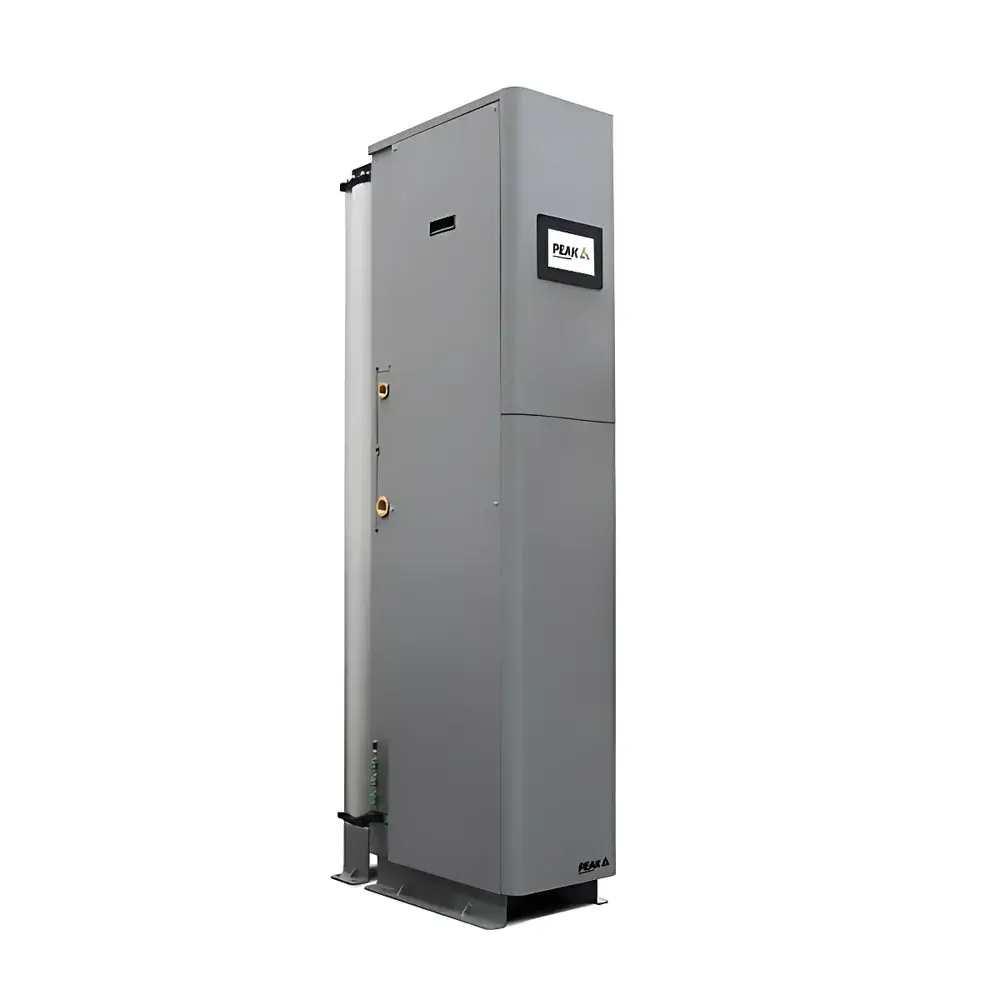
PEAK i-Flow Prime N2 7XX1/7XX2 Nitrogen Generator
| Brand | PEAK |
|---|---|
| Origin | United Kingdom |
| Manufacturer | PEAK Scientific Instruments Ltd. |
| Type | On-site Nitrogen Generator |
| Nitrogen Generation Principle | Pressure Swing Adsorption (PSA) using Carbon Molecular Sieve (CMS) |
| Output Flow Rate | 39–4181 L/min |
| Output Pressure | Up to 10 bar(g) |
| Nitrogen Purity | 99.9995% (v/v) |
| Dew Point | −40 °C (at 10 bar) |
| Power Consumption | 250 W |
| Input Voltage | 100–250 V AC ±10%, 50/60 Hz |
| Dimensions (H×W×D) | 1948 × 418 × 730 mm |
| Noise Level | 59 dBA |
| Air Inlet Requirement | Oil-free, dried, particle-filtered compressed air (ISO 8573-1 Class 2:2:2 or better) |
| Compliance | EIGA G6-2, EC 1935/2004 (Food Contact), Ph. Eur. 2.5.27, JECFA, FDA 21 CFR Part 11 ready (via optional software audit trail) |
Overview
The PEAK i-Flow Prime N2 7XX1/7XX2 is an industrial-grade, on-site nitrogen generator engineered for continuous, high-reliability gas supply in demanding laboratory and research environments. It employs pressure swing adsorption (PSA) technology with high-efficiency carbon molecular sieve (CMS) beds to separate nitrogen from compressed air—removing oxygen, moisture, CO₂, and trace hydrocarbons through selective adsorption under elevated pressure and subsequent desorption during depressurization. Unlike cryogenic or membrane-based systems, PSA delivers consistent purity across the full operational flow range without degradation at partial load. Designed for integration into centralized lab gas infrastructure, the i-Flow Prime supports uninterrupted operation for chromatography (GC, GC-MS), inert atmosphere glove boxes, sample preparation, laser cutting assist, and pharmaceutical stability testing—where stable pressure, ultra-low dew point, and documented purity are critical for method validity and regulatory compliance.
Key Features
- Modular Scalability: Configurable multi-module architecture enables incremental capacity expansion—from single 7XX1 unit (39 L/min) up to parallel 7XX2 arrays delivering 4181 L/min—without system redesign or downtime.
- Real-Time Purity Assurance: Integrated electrochemical oxygen analyzer (0–100 ppm O₂ range) coupled with PurityGuard™ monitoring continuously validates nitrogen purity at the point of use; automatic shutdown triggers if purity falls below user-defined threshold (e.g., <99.9995%).
- Multi-Stage Air Pretreatment: Three-stage inlet filtration (coalescing + activated carbon + desiccant) ensures CMS bed longevity and eliminates oil carryover, particulates, and humidity per ISO 8573-1 Class 2:2:2 specifications.
- Energy-Optimized Operation: Adaptive “Standby Mode” reduces compressed air demand by up to 70% during low-flow periods; intelligent valve sequencing and CMS regeneration timing maximize air utilization efficiency (≥92% volumetric recovery).
- IoT-Ready Architecture: Standard Ethernet port and Modbus TCP interface support BMS integration; optional cloud-enabled remote diagnostics, predictive maintenance alerts, and firmware over-the-air (FOTA) updates.
- Regulatory-Grade Documentation: Factory-calibrated sensors with NIST-traceable certificates; configurable electronic logbook with time-stamped events, alarm history, and purity trend data export (CSV/PDF) compliant with GLP/GMP audit requirements.
Sample Compatibility & Compliance
The i-Flow Prime N2 7XX1/7XX2 is validated for use with analytical instrumentation requiring Grade 5.5 (ISO 8573-1:2010) or higher nitrogen—particularly GC carrier gas, LC-MS mobile phase blanking, and residual solvent purge applications. Its certified output meets or exceeds EIGA G6-2 (Industrial Gases), European Pharmacopoeia Chapter 2.5.27 (Nitrogen for Pharmaceutical Use), EC Regulation 1935/2004 (Food Contact Materials), and JECFA specifications for food-grade nitrogen. When paired with PEAK’s optional 21 CFR Part 11-compliant software suite, the system supports electronic signatures, role-based access control, and immutable audit trails required for FDA-regulated laboratories.
Software & Data Management
Control and monitoring are managed via the web-based i-Flow Connect platform—accessible from any modern browser or mobile device. The interface displays live metrics including O₂ concentration, dew point, CMS bed cycle status, filter service life, and cumulative runtime. All operational parameters are logged at 1-second intervals; historical data can be exported for trending analysis or inclusion in SOP documentation. Optional API integration allows synchronization with LIMS or ELN systems. Firmware updates preserve configuration integrity and include version-controlled change logs aligned with ICH Q9 quality risk management principles.
Applications
- Gas chromatography (GC, GC-MS, GC-FID, GC-TCD) as carrier and detector gases
- LC-MS source gas and collision gas for triple quadrupole and Q-TOF systems
- Inert atmosphere generation for glove boxes, reactors, and sample storage
- Blanking and purging in elemental analyzers (e.g., CHNS/O instruments)
- Pharmaceutical stability chambers and accelerated aging studies
- Food packaging line blanking and modified atmosphere processing (MAP)
- Electronics manufacturing: solder paste reflow protection and component drying
FAQ
What compressed air quality is required for optimal i-Flow Prime performance?
Oil-free, desiccated air meeting ISO 8573-1 Class 2:2:2 (≤0.1 µm particles, ≤0.1 mg/m³ oil aerosol, −40 °C pressure dew point) is mandatory. PEAK recommends pairing with a refrigerated dryer and coalescing filter upstream.
Can the system operate unattended for extended periods?
Yes—the i-Flow Prime includes redundant safety interlocks, auto-recovery from power interruption, and configurable email/SNMP alerts for abnormal conditions (e.g., filter saturation, purity deviation).
Is validation support available for IQ/OQ protocols?
PEAK provides comprehensive validation documentation packages—including DQ templates, FAT/SAT checklists, and URS alignment guides—as part of its GxP Support Program.
How often must CMS modules be replaced?
Under specified inlet air conditions and routine maintenance, CMS lifespan exceeds 8 years (60,000 operating hours); replacement is condition-based, not time-based, and monitored via integrated performance algorithms.
Does the system require external cooling or ventilation?
No dedicated cooling is needed; ambient airflow around the chassis (minimum 150 mm clearance on all sides) suffices. The 59 dBA noise rating permits installation in shared lab spaces without acoustic enclosures.



