
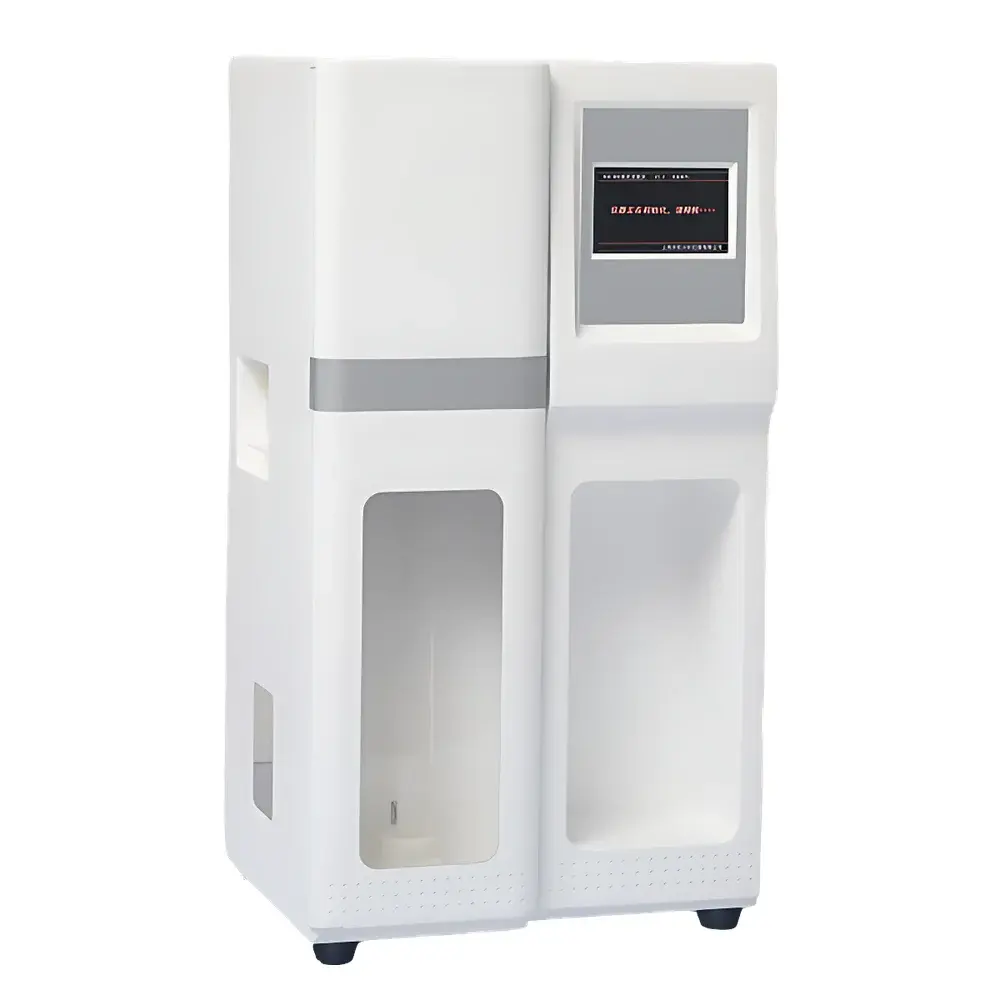
Peiou SKD-800 Kjeldahl Nitrogen Determinator
| Brand | Peiou |
|---|---|
| Origin | Shanghai, China |
| Manufacturer Type | Authorized Distributor |
| Country of Origin | China |
| Model | SKD-800 |
| Price Range | USD 2,800 – 7,200 (FOB Shanghai) |
| Instrument Type | Kjeldahl Nitrogen Analyzer |
| Automation Level | Semi-Automatic |
| Nitrogen Measurement Range | 0.08–240 mg N |
| Distillation Time | 1–99 min |
| Repeatability | RSD < 0.5% |
| Sample Weight Capacity | Solids ≤ 5 g, Liquids ≤ 15 mL |
| Nitrogen Recovery Rate | > 99.5% |
| Adjustable Distillation Power | 1500 W |
| Dimensions (L×W×H) | 370 × 300 × 680 mm |
Overview
The Peiou SKD-800 Kjeldahl Nitrogen Determinator is a semi-automatic benchtop analyzer engineered for precise and reliable quantification of total nitrogen content in organic and inorganic samples via classical Kjeldahl digestion and steam distillation methodology. It complies with internationally recognized standard methods—including AOAC 984.13, ISO 8968-1:2014 (milk), ISO 1871:2009 (feed), and GB/T 6423–2022 (Chinese national standard for food and feed)—ensuring methodological traceability across quality control, regulatory compliance, and research applications. The instrument operates on the principle of acid digestion (typically using concentrated H₂SO₄ and catalysts), followed by alkaline distillation to liberate ammonium ions as NH₃ gas, which is subsequently trapped in boric acid solution and titrated potentiometrically or colorimetrically. Designed for laboratories requiring robustness without full automation overhead, the SKD-800 delivers high reproducibility (RSD 99.5%) across diverse matrices—from low-nitrogen environmental water samples (0.08 mg N) to high-protein foodstuffs and fertilizers (up to 240 mg N per sample).
Key Features
- Real-time dual-level liquid monitoring: Independent optical sensors track reagent levels (acid, alkali, diluent, distilled water) and trigger automatic pause-and-resume operation upon replenishment—ensuring uninterrupted workflow integrity.
- Integrated thermal safety architecture: Continuous temperature monitoring of both the distillation chamber and receiving flask; distillation halts automatically if condensate temperature exceeds preset thresholds and resumes once thermal equilibrium is restored.
- Dual-liquid-level protection in the distillation vessel prevents dry-burning and ensures consistent steam generation under variable load conditions.
- Modular fluidic design: All reagent reservoirs are externally mounted, minimizing internal corrosion risk and simplifying maintenance. Internal tubing is constructed from PTFE and high-purity silicone—chemically inert to strong acids, bases, and elevated temperatures.
- ABS engineering-grade enclosure: One-piece molded housing resists sulfuric acid splashes and ambient laboratory corrosion—eliminating metal chassis degradation common in legacy Kjeldahl systems.
- Programmable distillation power (0–1500 W): Enables optimized steam generation for both trace-level and high-concentration samples, improving recovery consistency across wide dynamic ranges.
- Manual/automatic mode toggle: Operators may intervene at any stage (e.g., manual alkali addition during distillation) to accommodate atypical sample behavior or method validation requirements.
Sample Compatibility & Compliance
The SKD-800 accommodates solid samples up to 5 g (e.g., cereal grains, meat tissue, soil composites) and liquid samples up to 15 mL (e.g., milk, urine, digestates, wastewater). Its validated performance meets GLP-aligned operational criteria: full audit trail logging (via internal memory), time-stamped event records (reagent additions, pauses, thermal anomalies), and password-protected parameter editing. While not inherently 21 CFR Part 11 compliant out-of-the-box, the system supports integration with LIMS platforms via RS-232/USB interfaces for electronic record retention. It fulfills essential requirements for ISO/IEC 17025-accredited testing laboratories performing nitrogen analysis in food, feed, agricultural, and environmental sectors.
Software & Data Management
The SKD-800 features an embedded 5.7-inch monochrome LCD interface with intuitive navigation. It stores ≥100 customizable distillation programs—including digestion delay (0–1800 s), alkali addition timing, power ramp profiles, and endpoint detection logic—and retains ≥1000 sample result entries with metadata (date/time, operator ID, program name, raw titration volume). All data are exportable via USB flash drive in CSV format for downstream statistical analysis (e.g., ANOVA, control charting). No proprietary software installation is required—data files are natively readable in Excel, JMP, or Minitab. System diagnostics—including pump calibration logs, sensor health status, and thermal history—are accessible through service menus.
Applications
The SKD-800 serves as a core analytical platform in QA/QC labs across multiple regulated domains: protein quantification in dairy and plant-based foods (using N-to-protein conversion factors); crude protein assessment in animal feed formulations; total Kjeldahl nitrogen (TKN) determination in municipal wastewater and sludge per EPA Method 351.2; fertilizer nitrogen content verification (urea, ammonium nitrate, organic amendments); and research-scale nitrogen balance studies in agronomy and soil science. Its reliability in detecting volatile basic nitrogen (VBN) in fish spoilage evaluation and its adaptability for ammonium salt quantification further extend its utility beyond classical protein analysis.
FAQ
What standards does the SKD-800 comply with?
It adheres to AOAC, ISO, and GB/T methodologies for Kjeldahl nitrogen analysis—including AOAC 984.13, ISO 8968-1, ISO 1871, and GB/T 6423–2022.
Can the SKD-800 be used for VBN (volatile basic nitrogen) analysis?
Yes—by modifying distillation parameters (lower alkali volume, shorter distillation time, and chilled collection), it supports standardized VBN protocols such as GB/T 5009.44–2003.
Is remote data export supported?
Data are exportable via USB 2.0 to standard CSV files; no network connectivity or cloud upload capability is built-in.
What maintenance intervals are recommended?
Internal tubing requires replacement only after ≥3 years of routine use; reagent pumps and sensors undergo self-diagnostic checks during startup and are field-serviceable.
Does the instrument support GLP documentation requirements?
It provides timestamped event logs, operator identification fields, and editable method parameters—sufficient for internal GLP adherence when paired with documented SOPs and external audit trails.





