
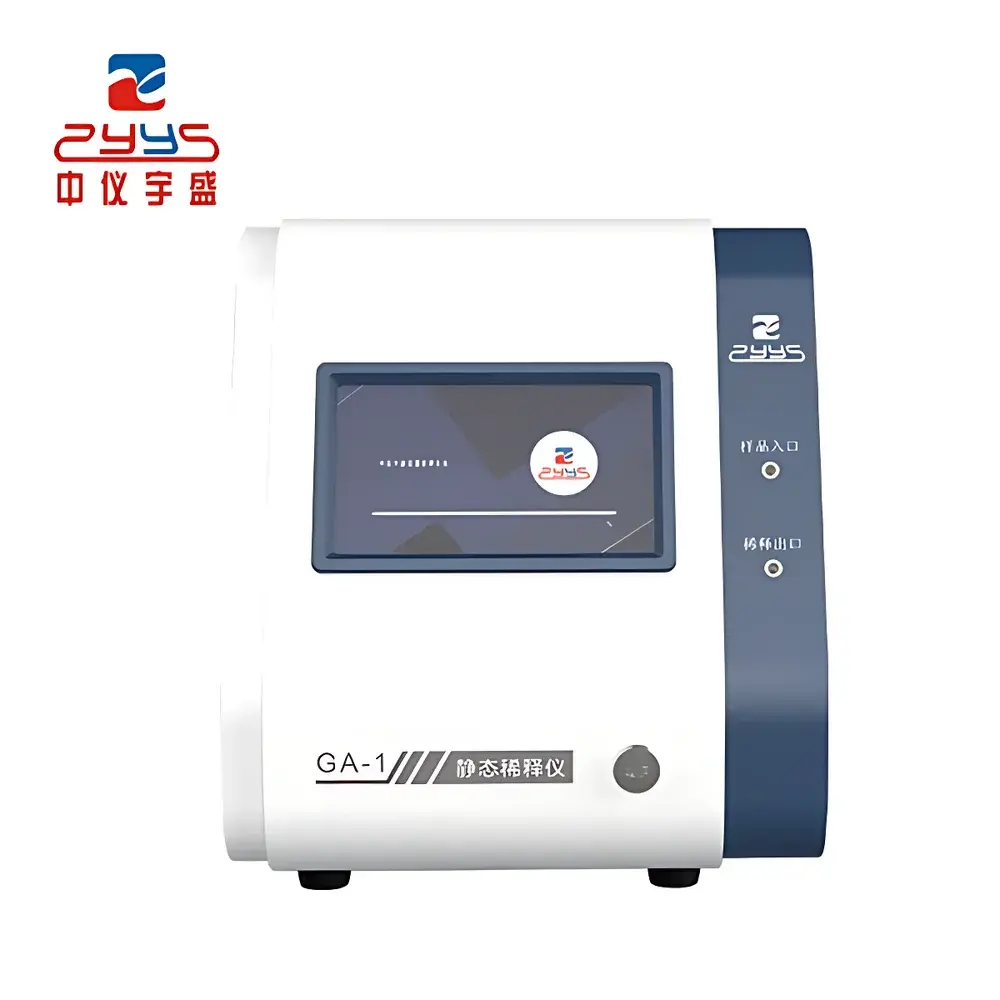
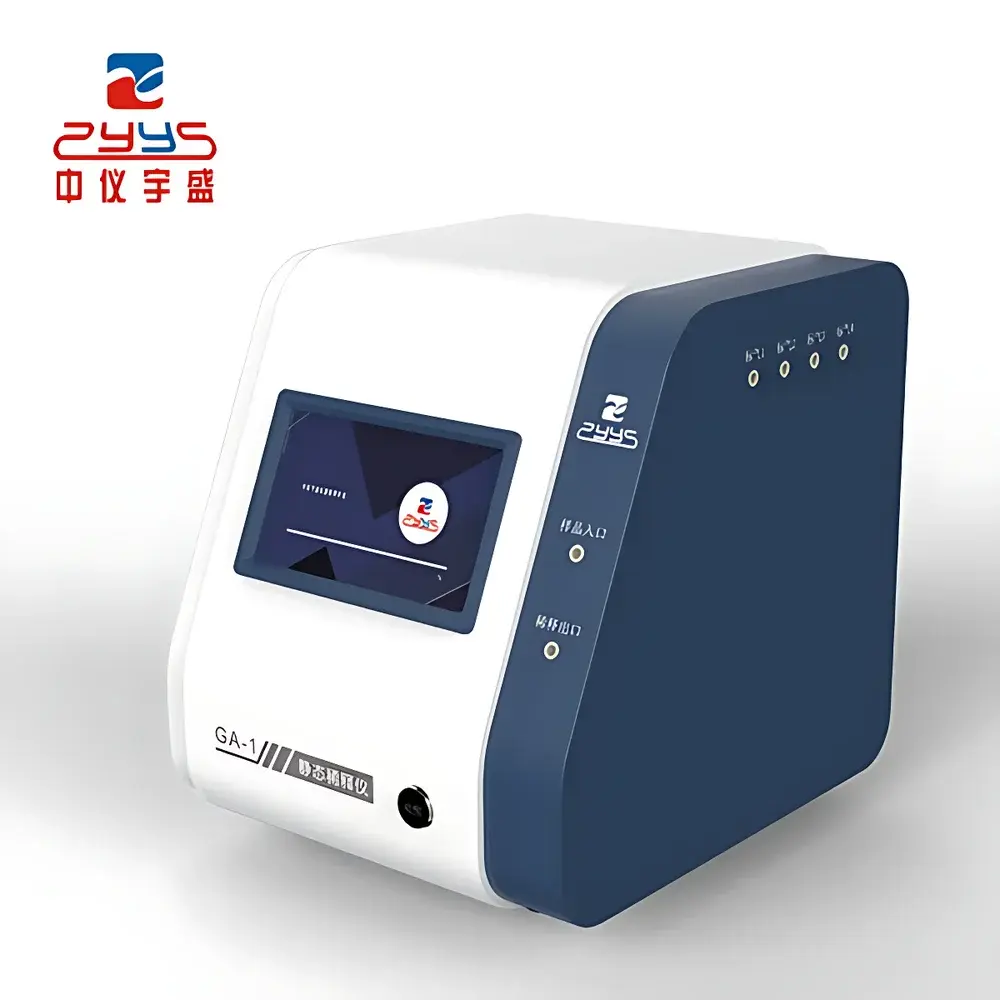
Zhongyi Yusheng GA-1 Static Gas Dilution System
| Brand | Zhongyi Yusheng |
|---|---|
| Origin | Beijing, China |
| Manufacturer Type | OEM Manufacturer |
| Country of Origin | China |
| Model | GA-1 |
| Pricing | Upon Request |
| Dilution Stages | Two-stage (Primary: 200×, Secondary: >10,000×) |
| Flow Control | High-precision mass flow controllers (MFCs) and pressure sensors |
| Tubing Material | PTFE and PEEK |
| Valve Type | Electrically actuated multi-position heated valve (temperature displayed in software) |
| Channel Configuration | 6 total channels — 4 standard gas inlets, 1 diluent gas inlet, 1 secondary dilution channel |
| Touch Interface | 7-inch capacitive color touchscreen |
| Sample Handling | Pressurized sample dilution with automatic initial/final pressure reading and ratio calculation |
| Compliance | Designed for ISO/IEC 17025-compliant calibration labs and EPA Method TO-14/TO-15 trace gas preparation workflows |
Overview
The Zhongyi Yusheng GA-1 Static Gas Dilution System is an engineered solution for precise, reproducible preparation of low-concentration calibration and working standards from high-concentration reference gases. It operates on the principle of static volumetric dilution—where known volumes of concentrated gas and diluent (e.g., zero air or nitrogen) are sequentially metered into a fixed-volume chamber under controlled pressure and temperature conditions—enabling trace-level concentration generation without dynamic flow-dependent errors. Unlike continuous-flow dilutors, the GA-1 eliminates dependency on real-time flow stability, making it particularly suitable for preparing certified reference materials (CRMs), calibrating GC-FID/ECD/PID detectors, and supporting regulatory-compliant ambient air monitoring programs per U.S. EPA Methods TO-14A and TO-15, as well as ISO 16000-6 and EN 13649-2. Its two-stage architecture ensures metrological traceability across six orders of magnitude—from parts-per-million (ppm) down to sub-parts-per-trillion (ppt) levels—while maintaining <±1.5% relative uncertainty in final concentration assignment when operated within specified environmental and pressure ranges.
Key Features
- Two-stage dilution architecture: Primary stage achieves up to 200× dilution; secondary stage extends capability beyond 10,000×, enabling direct preparation of ultra-trace standards for VOC, SVOC, and odorant analysis.
- Chemically inert fluidic path constructed entirely from PTFE tubing and PEEK fittings, minimizing adsorption, memory effects, and cross-contamination between sequential dilutions.
- Electrically actuated multi-position valve with integrated heating (software-monitored temperature display), preventing condensation and ensuring consistent gas-phase behavior during low-concentration transfers.
- Six independently configurable gas channels: four dedicated standard gas inlets, one diluent gas port, and one secondary dilution pathway—supporting parallel calibration gas preparation and method flexibility.
- High-accuracy mass flow controllers (MFCs) coupled with calibrated pressure transducers provide closed-loop control over injection volumes, eliminating overshoot and hysteresis associated with differential-pressure-based systems.
- 7-inch capacitive touchscreen interface with intuitive workflow navigation, real-time status feedback, and audit-ready operation logging—including timestamps, operator ID, and parameter settings.
Sample Compatibility & Compliance
The GA-1 accommodates pressurized sample cylinders (up to 10 MPa rated input), Tedlar® bags, and SUMMA®-coated canisters. Automatic pressure sensing at both initial and target states allows the system to compute exact dilution ratios based on ideal gas law assumptions—corrected for temperature and compressibility where applicable. All hardware and firmware comply with general requirements for laboratory instrumentation under ISO/IEC 17025:2017 clause 6.4 (Equipment) and support GLP/GMP-aligned documentation practices. While not pre-certified to FDA 21 CFR Part 11, the system’s built-in event logging, user access controls, and non-editable audit trails facilitate validation for regulated environments requiring electronic record integrity.
Software & Data Management
Embedded firmware supports local data storage of all dilution events—including date/time stamps, channel assignments, pressure readings, calculated dilution factors, and operator inputs. Export functionality enables CSV-formatted reports compatible with LIMS integration. No external PC is required for routine operation; however, optional USB or Ethernet connectivity permits remote configuration updates and centralized log retrieval. The interface enforces mandatory entry of calibration certificate numbers for each standard gas used, reinforcing traceability back to NIST-traceable sources or equivalent national metrology institutes.
Applications
- Preparation of multi-component VOC calibration standards for GC-MS analysis in environmental laboratories.
- Generation of low-level challenge gases for sensor response testing and drift verification of fixed-site air quality monitors.
- Supporting method development and validation studies under ASTM D6196, ISO 16017-1, and EU Directive 2008/50/EC.
- Dilution of high-concentration stack emission samples prior to introduction into FTIR or chemiluminescence analyzers.
- Trace-level spiking experiments in indoor air quality research involving aldehydes, terpenes, and halogenated compounds.
FAQ
What is the maximum allowable inlet pressure for standard gas cylinders?
The GA-1 accepts inlet pressures up to 10 MPa (1450 psi); regulators must be installed upstream if cylinder pressure exceeds this limit.
Can the system be validated for ISO/IEC 17025 accreditation?
Yes—the instrument’s design, documentation structure, and traceable component specifications align with Clause 6.4 requirements; users must perform periodic verification using gravimetric or dynamic dilution reference methods.
Does the GA-1 support custom dilution protocols beyond two stages?
No—it is configured exclusively for two-stage static dilution; additional serial dilutions require manual intervention and separate chamber handling.
Is PTFE/PEEK compatibility verified for reactive gases such as Cl₂ or NO₂?
Material compatibility depends on concentration, exposure duration, and temperature; consult chemical resistance charts for PTFE and PEEK before use with strongly oxidizing or acidic species.
How frequently should MFCs and pressure sensors be recalibrated?
Annual recalibration is recommended; more frequent intervals may be necessary depending on usage intensity and criticality of measurement outcomes.
Related Products







