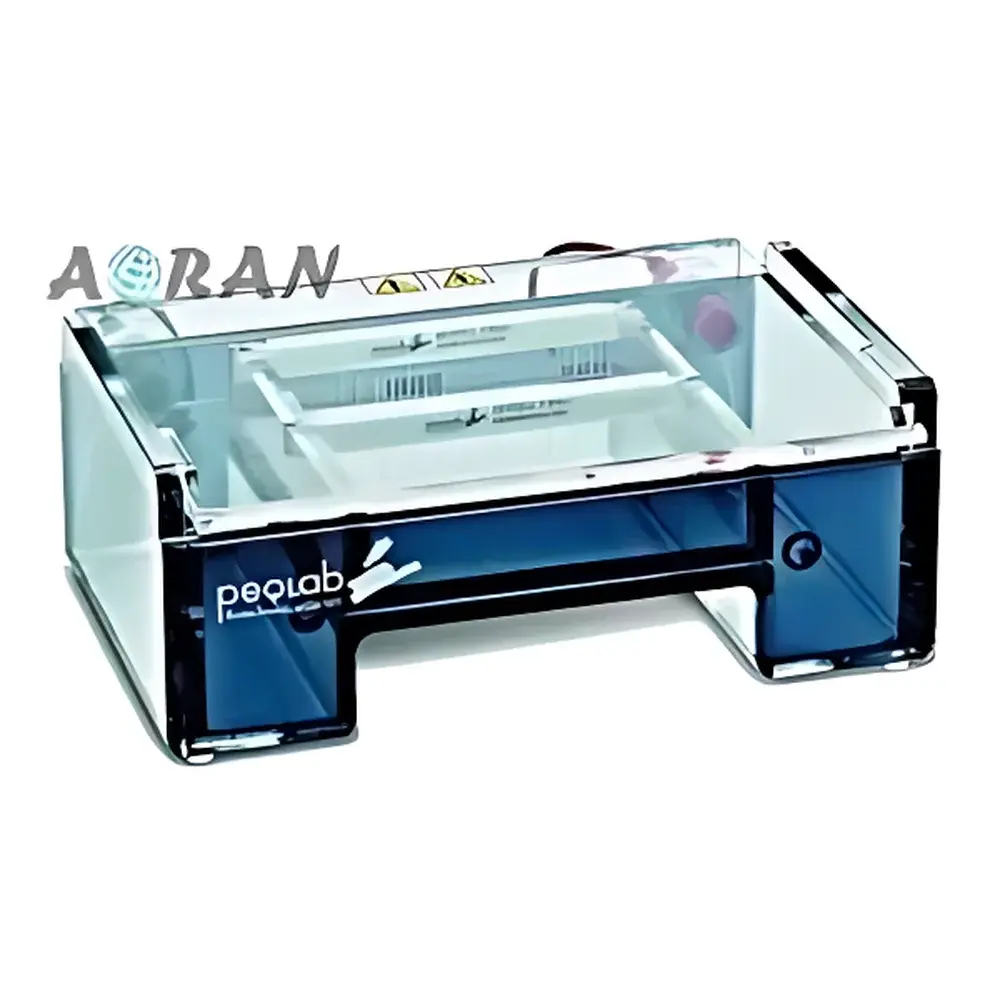
peQLab Perfect Blue Horizontal Electrophoresis System
| Brand | peQLab |
|---|---|
| Origin | Germany |
| Model | Perfect Blue |
| Instrument Type | Horizontal Electrophoresis Apparatus |
| Gel Dimensions | 23 × 25 cm |
| Sample Capacity | 500 |
| Max. Operating Voltage | 300 V |
| Construction Material | 6 mm Polypropylene |
| Electrode Configuration | Triple Cathode (Epoxy-Encapsulated) |
| Lid | Transparent Safety Cover with UV Transparency |
| Gel Tray | UV-Transmissive, Integrated Casting & Running Platform |
| Buffer Circulation | Integrated Passive Flow Design |
| Compliance | CE-marked, RoHS-compliant, Designed for ISO/IEC 17025 Laboratory Environments |
Overview
The peQLab Perfect Blue Horizontal Electrophoresis System is a precision-engineered platform for nucleic acid and protein separation under standardized agarose or polyacrylamide matrix conditions. Based on classical horizontal electrophoretic principles—where charged biomolecules migrate through a porous gel matrix under the influence of a uniform DC electric field—the Perfect Blue system delivers high reproducibility and operational consistency across routine QC, academic research, and diagnostic laboratory workflows. Its design centers on eliminating common sources of variability: gel distortion, buffer pH drift, electrode corrosion, and manual sealing errors. Engineered in Germany and manufactured to stringent DIN-quality tolerances, the system supports both standard and high-throughput applications without compromising resolution or run-to-run fidelity.
Key Features
- 6 mm thick, chemically resistant polypropylene housing—machined via CNC for dimensional accuracy and long-term structural integrity
- Triple cathode configuration with epoxy-encapsulated stainless-steel electrodes—ensures uniform current distribution and eliminates localized electrolysis-induced pH gradients
- Integrated gel casting and electrophoresis platform (“One-Step Tray” design)—eliminates manual gel sealing, reduces bubble formation, and prevents leakage during polymerization and run phases
- Dual-function UV-transparent gel tray—compatible with direct imaging post-electrophoresis under UV transilluminators (254 nm and 302 nm), minimizing gel handling and transfer artifacts
- Passive buffer circulation architecture—maintains homogeneous ionic strength and pH across the entire gel surface, critical for sharp band definition and quantitative densitometry
- Non-slip rubber base with full-radius edge contours—enhances stability during loading and transport; conforms to IEC 61010-1 safety standards for laboratory equipment
- Gold-plated electrical connectors—guarantee low-resistance contact and corrosion resistance over extended service life (>10,000 voltage cycles)
- Modular comb system—supports variable well configurations (e.g., 25-, 50-, or dual-comb setups) optimized for micro-volume or high-sample-density applications
Sample Compatibility & Compliance
The Perfect Blue accommodates standard agarose concentrations (0.7–3.0%) and native or denaturing polyacrylamide gels (up to 20%). Its 23 × 25 cm gel format enables simultaneous analysis of up to 500 samples using multi-well combs—ideal for genotyping, PCR product screening, restriction fragment analysis, and plasmid quality control. All materials comply with EU Directive 2011/65/EU (RoHS) and bear CE marking per EN 61010-1:2010. The system is validated for use in GLP environments and supports audit-ready documentation when paired with peQLab’s optional power supply units featuring digital logging and timestamped event records (compliant with FDA 21 CFR Part 11 requirements for electronic records).
Software & Data Management
While the Perfect Blue itself is a hardware-only electrophoresis platform (no embedded firmware or touchscreen interface), it is fully interoperable with third-party imaging and analysis software suites—including ImageLab (Bio-Rad), AlphaView SA (ProteinSimple), and GelAnalyzer (GelAnalyzer.com). Its UV-transmissive tray and consistent gel geometry facilitate automated band detection, molecular weight calibration, and relative quantification. When used with peQLab’s optional PowerBox Pro series power supplies, users gain access to USB-connected parameter logging (voltage, current, time), exportable CSV datasets, and configurable safety interlocks—all traceable for ISO/IEC 17025 accreditation purposes.
Applications
- High-throughput DNA fragment sizing in molecular diagnostics laboratories
- Plasmid purity assessment and supercoiled vs. linear isoform differentiation
- RNA integrity verification (RIN estimation via 18S/28S rRNA band ratio)
- CRISPR-Cas9 editing validation through mismatch cleavage assays (e.g., T7E1)
- SSR and SNP genotyping in plant and animal breeding programs
- Quality control of synthetic oligonucleotides and enzymatic reaction products
- Educational demonstrations of charge-based macromolecular mobility under controlled field conditions
FAQ
Is the Perfect Blue compatible with ethidium bromide and SYBR Safe staining protocols?
Yes—its UV-transparent tray and optical-grade polypropylene construction are fully compatible with standard fluorescent nucleic acid dyes, including EtBr, SYBR Gold, SYBR Safe, and GelRed.
Can the system be used for pulse-field electrophoresis (PFGE)?
No—the Perfect Blue is designed exclusively for constant-field horizontal electrophoresis. PFGE requires specialized apparatus with programmable electrode switching and thermal management not present in this platform.
What buffer systems are recommended for optimal performance?
TAE (Tris-Acetate-EDTA) and TBE (Tris-Borate-EDTA) are both supported; however, TAE is preferred for downstream DNA recovery due to lower ionic strength and reduced interference with enzymatic reactions.
Does the triple-cathode design require special power supply configuration?
No—standard DC power supplies with 300 V / 500 mA output are sufficient. The triple-cathode is internally balanced and does not necessitate multi-channel or phase-controlled outputs.
How is buffer volume replenishment managed during extended runs?
For runs exceeding 90 minutes at >120 V, periodic top-up (≤10% volume) with pre-chilled matching buffer is recommended to compensate for evaporation—particularly in low-humidity environments.
Related Products