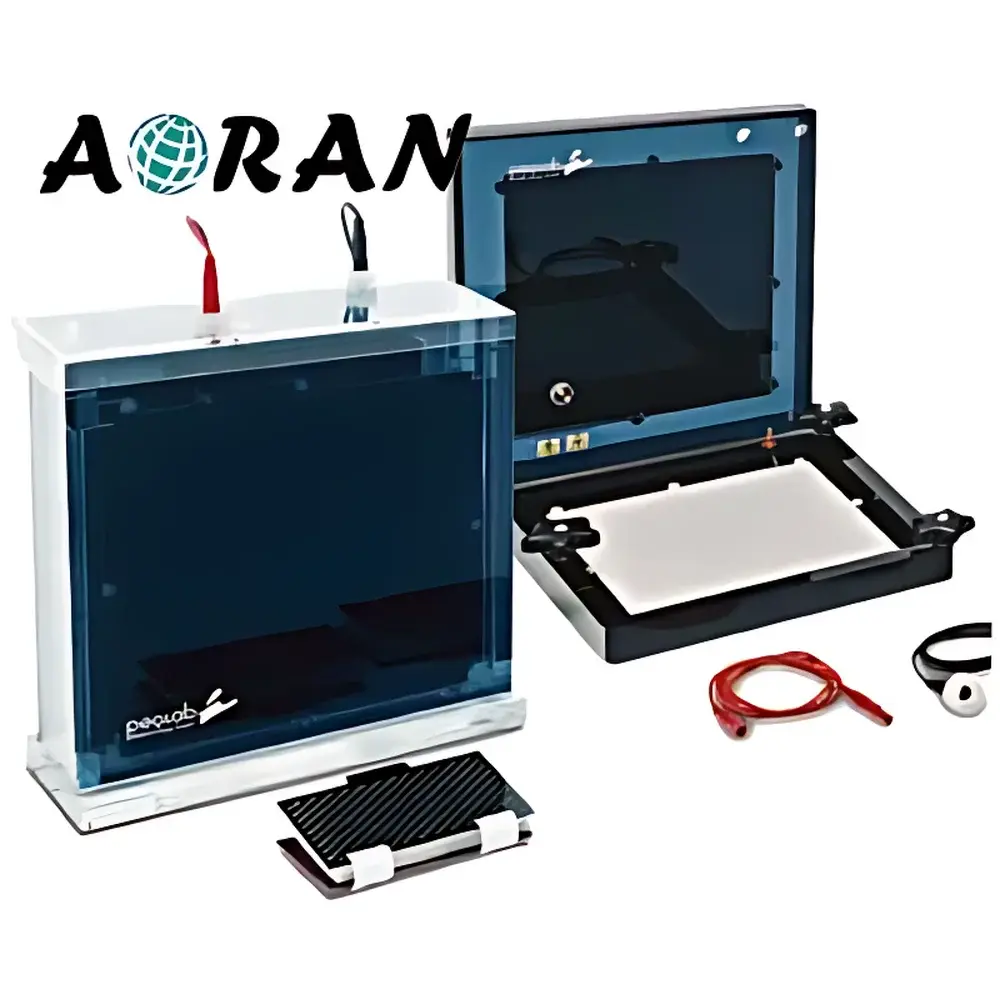
peQLab PerfectBlue Semi-Dry and Wet Transfer Electrophoresis Systems
| Brand | peQLab |
|---|---|
| Origin | Germany |
| Model Series | Sedec (S/M), Web (S/M) |
| Transfer Mode | Semi-dry & Wet |
| Gel Dimensions | Sedec S: 10 × 10 cm, Sedec M: 20 × 20 cm, Web S: 8.5 × 9.5 cm, Web M: 18 × 20 cm |
| Buffer Volume | Sedec S: ~50 mL, Sedec M: ~200 mL, Web S: ~1300 mL, Web M: ~3000 mL |
| Electrode Material | Platinum–titanium anode / Stainless steel cathode |
| Cooling | Passive (semi-dry) / Active water-circulated aluminum heat sink (wet) |
| Compliance | CE-marked, IEC 61010-1 compliant |
Overview
The peQLab PerfectBlue Electrophoresis Transfer Systems comprise two distinct platform families—Sedec for semi-dry transfer and Web for wet transfer—engineered to meet rigorous demands of protein and nucleic acid blotting in academic, clinical, and industrial life science laboratories. These systems operate on fundamental electrophoretic principles: in semi-dry mode, proteins or nucleic acids migrate under a direct current electric field across a short buffer-saturated sandwich (gel–membrane–filter paper), achieving rapid, efficient transfer with minimal joule heating; in wet mode, the gel–membrane assembly is fully immersed in circulating buffer, enabling high-fidelity transfer of large-molecular-weight biomolecules (>200 kDa) and extended run times without thermal denaturation. Designed and manufactured in Germany, each PerfectBlue unit adheres to IEC 61010-1 safety standards and bears CE marking, ensuring compatibility with GLP-compliant workflows and ISO 17025-accredited environments.
Key Features
- Two-platform architecture: Sedec series optimized for speed and reagent economy (semi-dry), Web series engineered for reproducibility and high-molecular-weight target integrity (wet)
- Electrode configuration: Platinum–titanium anode provides corrosion resistance and stable current distribution; stainless steel cathode ensures mechanical durability and uniform field geometry
- Thermal management: Sedec units operate at low voltage (typically 10–25 V), minimizing resistive heating and eliminating need for external cooling; Web units integrate dual-stage thermal control—aluminum heat-sink plates coupled with recirculating water jacket—for precise temperature stabilization during prolonged transfers
- Modular cassette design: Interchangeable gel frames accommodate standard slab-gel dimensions; all models support standard PVDF, nitrocellulose, and nylon membranes without adapter modification
- Robust construction: Acrylic housing with chemical-resistant sealing gaskets; non-slip base and ergonomic lid latches ensure stability during high-current operation
Sample Compatibility & Compliance
The PerfectBlue systems support a broad range of electrophoretic matrices—including SDS-PAGE, native PAGE, agarose, and gradient gels—and are validated for transfer of proteins from 10 kDa to >300 kDa, as well as DNA fragments up to 20 kb. Both Sedec and Web platforms maintain consistent transfer efficiency across varying gel thicknesses (0.75–1.5 mm) and acrylamide concentrations (8–20%). All units comply with European Directive 2014/30/EU (EMC) and 2014/35/EU (LVD); documentation includes Declaration of Conformity and traceable calibration records per manufacturer’s quality system (ISO 9001 certified). For regulated environments, the systems are compatible with laboratory information management systems (LIMS) via standardized data export (CSV, TXT) and support audit-trail-ready documentation when paired with validated SOPs.
Software & Data Management
While the PerfectBlue hardware operates via analog voltage/current controls (no embedded microprocessor), peQLab provides complementary digital tools for protocol management and performance tracking. The optional PerfectBlue Protocol Manager software (Windows-based) enables storage of transfer parameters—including voltage, time, buffer composition, and gel/membrane lot numbers—with timestamped logging and user-access controls. Exported datasets conform to FAIR principles (Findable, Accessible, Interoperable, Reusable) and may be integrated into ELN platforms supporting ASTM E2857 or ISO/IEC 17025 data integrity requirements. All firmware and utility updates are distributed through peQLab’s secure customer portal, with version history and change logs maintained per FDA 21 CFR Part 11 alignment guidance.
Applications
- Western blotting of post-translational modifications (e.g., phosphorylation, ubiquitination) requiring high-transfer fidelity and low background
- Eastern blotting for glycoprotein detection using lectin-based probes
- Northern and Southern blotting of fragmented genomic DNA and RNA under denaturing conditions
- High-throughput screening workflows where parallel processing of multiple gels (up to four Web cassettes per run) reduces cycle time
- Method development and validation studies in QC/QA labs supporting biopharmaceutical characterization (ICH Q5E, USP )
FAQ
What buffer systems are recommended for PerfectBlue semi-dry transfer?
Standard Towbin buffer (25 mM Tris, 192 mM glycine, 20% methanol) is validated for most applications; alternative low-methanol or SDS-containing buffers may be used with minor optimization.
Can the Web wet transfer system accommodate custom-sized gels?
Only standard frame sizes (Web S: 8.5 × 9.5 cm; Web M: 18 × 20 cm) are supported; non-standard dimensions require third-party adapters not covered under warranty.
Is the platinum–titanium electrode replaceable, and what is its service life?
Yes—electrodes are field-replaceable service kits (P/N: PB-EL-PT-TI); typical lifespan exceeds 500 transfer cycles under proper cleaning and storage protocols.
Does peQLab provide IQ/OQ documentation for GMP environments?
Yes—customizable Installation Qualification (IQ) and Operational Qualification (OQ) packages are available upon request, aligned with EU Annex 15 and ASTM E2500 guidelines.
Are spare parts and consumables supplied with batch-specific CoA?
All critical consumables (e.g., electrode assemblies, buffer reservoir seals) ship with Certificate of Analysis referencing manufacturing lot and material traceability per ISO 13485 requirements.