
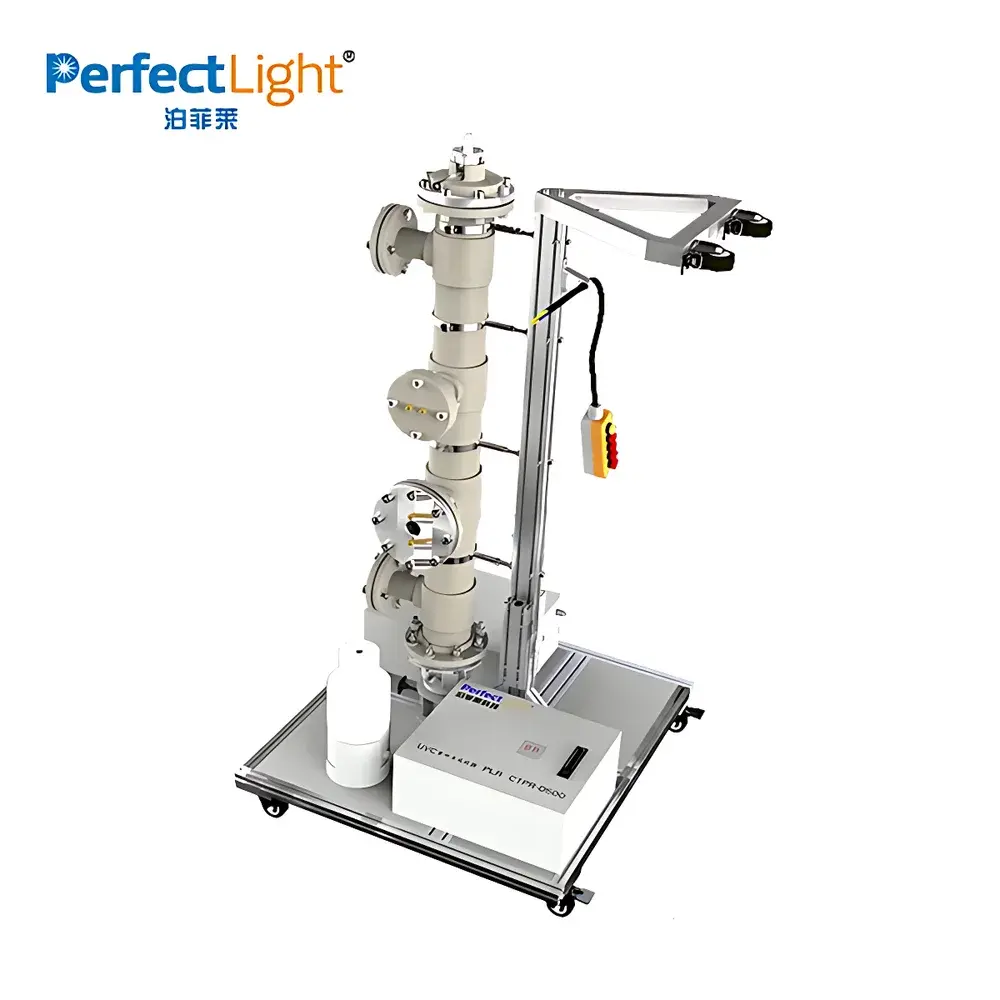
PerfecLight PLR-CTPR-O500 UV Photochemical Reactor
| Brand | PerfecLight |
|---|---|
| Origin | Beijing, China |
| Model | PLR-CTPR-O500 |
| Reactor Volume | 3 × 300 mL (modular) |
| Operating Pressure | 0–0.3 MPa |
| Temperature Range | −20 to 100 °C |
| Light Source | 800 W low-pressure mercury lamp (UVC, ~254 nm) |
| Illumination Geometry | Internal cylindrical irradiation |
| Reactor Tube Material | UV-transparent polymer (Φ6 mm standard, customizable) |
| UV Window Material | High-transmittance quartz-glass |
| Outer Housing | Reflective polymer cylinder (Φ140 × 1500 mm) |
| Overall Dimensions | 1000 × 1000 × 1900 mm |
| Weight | 50 kg |
| Configuration | Modular, vertical/horizontal adaptable |
Overview
The PerfecLight PLR-CTPR-O500 UV Photochemical Reactor is an engineered flow-through photochemical synthesis platform designed for controlled, scalable ultraviolet-driven reactions under laboratory and pilot-scale conditions. It operates on the principle of homogeneous photolysis and photoinduced electron transfer, leveraging high-intensity UVC irradiation (centered at 254 nm) to activate molecular substrates in transparent flow channels. Unlike batch-type photoreactors, the PLR-CTPR-O500 employs a segmented, helically wound tubular architecture—three independent 300 mL reaction sections arranged in series or parallel—enabling precise residence time control, improved photon flux utilization, and minimized thermal gradients. The system integrates a coaxial internal illumination design: the light source is centrally mounted within a highly reflective cylindrical cavity, ensuring uniform radial irradiance across the entire inner surface of the UV-transparent reactor tubing. This geometry maximizes quantum yield consistency and minimizes shadowing effects common in external irradiation setups. The reactor is explicitly intended for applications requiring reproducible, traceable photochemical process development—including route scouting, kinetic profiling, and GLP-compliant method validation—prior to transition into continuous manufacturing environments.
Key Features
- Modular three-section flow reactor (3 × 300 mL), each section independently configurable for serial, parallel, or bypass operation
- Internal cylindrical irradiation architecture with high-reflectivity polymer housing (≥92% reflectance in 200–280 nm range)
- UV-transparent Φ6 mm polymer tubing (standard); compatible with custom diameters (Φ3–Φ12 mm) and alternative materials (e.g., FEP, quartz-lined PFA) upon request
- Low-pressure mercury lamp (800 W, UVC dominant emission), thermally stabilized with integrated forced-air cooling for ≥5,000 h operational lifetime
- Pressure-rated operation up to 0.3 MPa and temperature-controlled range from −20 °C to +100 °C, supporting both cryogenic photochemistry and elevated-temperature photocatalysis
- Universal mounting frame with telescoping support rods enabling rapid reconfiguration between vertical (gravity-assisted flow) and horizontal (pump-driven laminar flow) orientations
- Interlocked safety interface: automatic lamp shutoff upon cabinet door opening or overtemperature detection (≥105 °C)
Sample Compatibility & Compliance
The PLR-CTPR-O500 accommodates a broad spectrum of organic solvents (e.g., acetonitrile, THF, DMF, methanol), aqueous buffers, and heterogeneous slurries containing supported photocatalysts (e.g., TiO₂, Ru(bpy)₃²⁺ immobilized on silica). Its chemically resistant tubing and sealed optical cavity meet ISO 10993-5 biocompatibility screening requirements for non-implantable device testing. While not certified as explosion-proof, the system complies with IEC 61000-6-3 (EMC emissions) and IEC 61010-1 (safety for laboratory equipment). For regulated environments, optional integration with analog 4–20 mA process signals and digital RS485 Modbus RTU enables linkage to SCADA systems compliant with FDA 21 CFR Part 11 data integrity requirements when paired with validated acquisition software.
Software & Data Management
The PLR-CTPR-O500 operates via a dedicated industrial-grade PLC-based controller with local HMI touchscreen (7″ resistive LCD). All critical parameters—including lamp power output (monitored via integrated photodiode), jacket temperature (PT100), system pressure (strain-gauge transducer), and cumulative irradiation dose (J/cm²)—are logged at 1 Hz resolution to internal microSD storage (8 GB, user-replaceable). Export formats include CSV and XML, supporting post-processing in MATLAB, Python (Pandas), or commercial kinetics modeling tools (e.g., Kinetics Toolkit, gPROMS). Optional Ethernet/IP or OPC UA gateway modules permit real-time data streaming to LIMS or MES platforms. Audit trails record operator login, parameter changes, and emergency stops with timestamped user ID—fully traceable per ALCOA+ principles.
Applications
- Synthesis of pharmaceutical intermediates via [2+2] cycloadditions, Norrish-type cleavages, and photooxidations under GMP-aligned process windows
- Photocatalytic C–H functionalization and decarboxylative couplings using Ir/Ni dual-catalyst systems in continuous flow
- Environmental photocatalysis studies: degradation kinetics of micropollutants (e.g., carbamazepine, diclofenac) in synthetic wastewater matrices
- Material science: UV-initiated polymerization of acrylates and methacrylates with controlled molecular weight distribution (Đ < 1.2)
- Photochemical screening of ligand-metal complexes for solar fuel generation (e.g., H₂ evolution, CO₂ reduction)
FAQ
What wavelength ranges are supported beyond standard UVC?
Custom lamp configurations—including medium-pressure Hg lamps (200–400 nm), UV-A LED arrays (365 nm), and deuterium broadband sources (190–400 nm)—can be integrated with recalibrated irradiance calibration certificates.
Can the system be integrated with automated liquid handling or downstream quenching modules?
Yes. Standard 1/4″ Swagelok ports and 0–10 V analog I/O allow synchronization with syringe pumps, back-pressure regulators, and inline IR/UV-Vis spectrophotometers (e.g., Metrohm Instant Raman, Agilent Cary 60 Flow Cell).
Is validation documentation available for IQ/OQ protocols?
Factory-issued DQ/IQ templates aligned with ASTM E2500 and ISPE GAMP5 are provided; OQ execution requires on-site instrumentation calibration by qualified personnel using NIST-traceable radiometers and thermocouple calibrators.
What maintenance intervals are recommended for lamp and tubing replacement?
Lamp output degrades ≤10% after 5,000 h; scheduled replacement is advised at 4,500 h for critical applications. Tubing replacement frequency depends on solvent aggressiveness—typical service life exceeds 500 h in acetonitrile, 200 h in concentrated TFA.



