
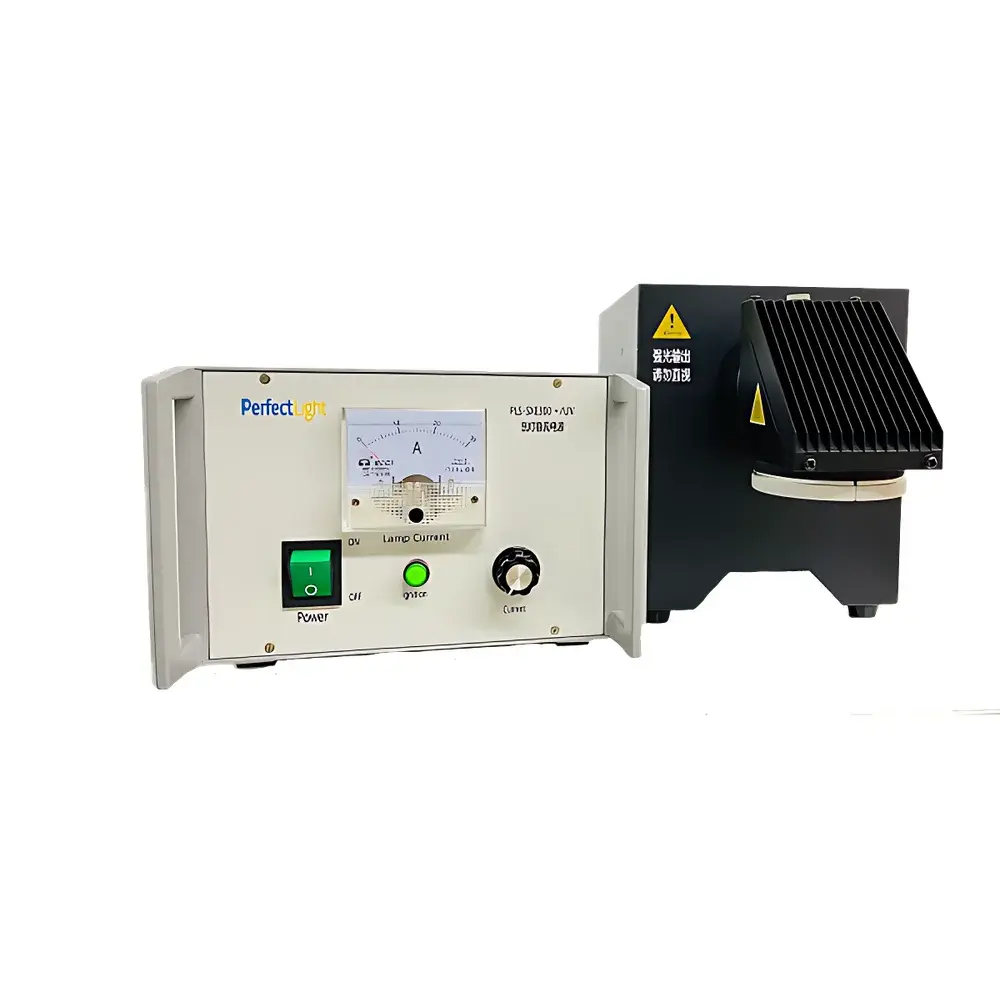
PerfectLight PL-X300UV High-Stability Xenon Arc Light Source for Solar Simulation
| Brand | PerfectLight |
|---|---|
| Origin | Shanghai, China |
| Manufacturer Type | Authorized Distributor |
| Product Origin | Domestic (China) |
| Model | PL-X300UV |
| Light Source Type | 300 W Short-Arc Xenon Lamp |
| Illumination Mode | External Irradiation |
| Total Optical Power Output | 50 W |
| Spectral Range | 320–780 nm (extendable to 2500 nm) |
| Beam Divergence | ~6° (FWHM) |
| Spot Diameter | 30–60 mm (at working distance) |
| Long-Term Irradiance Stability | ≤ ±3% (over 8 h) |
| Lamp Power Adjustment Range | 150–300 W |
| Rated Lamp Current Limit | 21 A |
| Lamp Lifetime | >1000 h (under standard photocatalytic operating conditions) |
| Trigger System | Integrated High-Voltage Ignition (dual-stage, no high-voltage cabling) |
| Cooling | Passive aluminum heat sink array |
| EMI Shielding | Enclosed metal lamp housing |
| Control Interface | Microprocessor-based digital power management with programmable mode |
Overview
The PerfectLight PL-X300UV is a purpose-engineered xenon arc light source designed to emulate the spectral distribution and irradiance characteristics of natural sunlight for laboratory-scale photoreactor systems. Operating on the principle of high-intensity plasma discharge in a pressurized xenon environment, it delivers continuous, broadband emission from the near-UV through visible to near-infrared (320–780 nm), with optional extension into the short-wave IR up to 2500 nm via auxiliary optics and filter modules. Unlike pulsed or LED-based alternatives, this source provides stable, spatially uniform irradiance essential for kinetic studies in heterogeneous photocatalysis, photoelectrochemical (PEC) cell evaluation, and standardized solar-simulated aging tests. Its optical architecture—featuring a precisely aligned ellipsoidal reflector and collimating optics—ensures minimal divergence (~6° FWHM) and reproducible beam geometry across variable working distances (30–60 mm spot diameter), enabling direct integration with quartz reaction vessels, gas-phase flow cells, and thin-film electrochemical cells.
Key Features
- High-stability 300 W short-arc xenon lamp with digitally regulated DC power supply, delivering ≤ ±3% irradiance drift over 8-hour continuous operation
- Passive thermal management via large-area extruded aluminum heat sink—eliminates fan-induced vibration and acoustic noise, critical for long-duration kinetic experiments
- Integrated dual-stage ignition system: high-voltage pulse generation occurs entirely within the lamp housing; no high-voltage transmission along interconnect cables—enhancing operator safety and electrical noise immunity
- EMI-shielded all-metal lamp enclosure compliant with IEC 61000-6-3 for electromagnetic compatibility in shared lab environments
- Programmable current control (150–300 W range) with real-time monitoring of lamp voltage, current, and thermal status via embedded microprocessor
- Modular optical interface supporting interchangeable bandpass, longpass, and cut-on filters for UV-only (e.g., UVA-365), visible-only (400–700 nm), or NIR-selective irradiation protocols
Sample Compatibility & Compliance
The PL-X300UV is routinely deployed in ISO/IEC 17025-accredited laboratories conducting photocatalytic activity assessments per ISO 22197-1 (NO removal), ISO 22197-2 (acetaldehyde decomposition), and ASTM C1732 (photocatalytic self-cleaning performance). Its spectral output aligns closely with AM 1.5G reference spectra (IEC 60904-3) when paired with appropriate optical filters and calibrated radiometers. The external irradiation configuration enables non-invasive illumination of sealed reactors, gas-phase flow-through cells, and liquid-phase slurry systems without thermal coupling or window degradation concerns. All electrical subsystems conform to UL/EN 61010-1 safety standards for laboratory equipment. No hazardous substance declarations (RoHS Directive 2011/65/EU) apply, as the lamp contains no mercury or lead-based phosphors.
Software & Data Management
While the PL-X300UV operates as a stand-alone analog/digital hybrid instrument, its microcontroller supports TTL-level trigger input and analog 0–5 V output for synchronization with external data acquisition systems (e.g., potentiostats, gas chromatographs, or spectroradiometers). Optional USB-to-serial firmware upgrade enables remote parameter setting (power level, dwell time, ramp profiles) and logging of operational timestamps, cumulative lamp-on hours, and thermal event flags. Audit trails comply with GLP and FDA 21 CFR Part 11 requirements when integrated into validated laboratory information management systems (LIMS)—provided user-defined electronic signatures and role-based access controls are implemented at the host software layer.
Applications
- Photocatalytic water splitting (H2/O2 evolution) and overall water decomposition under simulated solar irradiation
- CO2 photoreduction to CH4, CO, or methanol using semiconductor or MOF-based catalysts
- Gas-phase degradation of VOCs (formaldehyde, toluene, NOx, SO2) in annular or monolith reactors
- Liquid-phase dye decolorization (methylene blue, rhodamine B) and aromatic pollutant mineralization (phenol, benzene derivatives)
- Quantum yield determination (Φ) via actinometry (e.g., potassium ferrioxalate or Reinecke’s salt methods)
- Photoelectrochemical characterization of semiconductor electrodes under controlled illumination intensity and spectrum
- Accelerated photostability testing of optical coatings, polymers, and perovskite thin films
FAQ
What spectral calibration options are available for quantitative irradiance measurements?
NIST-traceable spectroradiometric calibration certificates (350–1050 nm) can be ordered separately. Calibration includes absolute irradiance (W/m²/nm) at 100 mm working distance and full-width half-maximum (FWHM) bandwidth verification.
Can the PL-X300UV be used with optical fibers or liquid light guides?
Yes—via optional SMA905 or FC/PC coupler adapters. Maximum coupled power is limited to 35 W to prevent thermal damage to fiber end faces.
Is lamp replacement a user-serviceable procedure?
Yes. Lamp replacement requires only standard hex tools and adherence to the torque specifications in the service manual. Used lamps must be disposed of as hazardous waste per local regulations due to high-pressure quartz envelope content.
Does the system support automated shutter control?
Not natively—but the 5 V TTL trigger input accepts external shutter signals from programmable controllers (e.g., Arduino, LabVIEW DAQ) for timed irradiation sequences.
How does ambient temperature affect long-term stability?
Operation is rated for 15–35 °C ambient. Above 35 °C, passive cooling efficiency declines; active forced-air assist (optional accessory) restores ≤ ±3% stability.





