
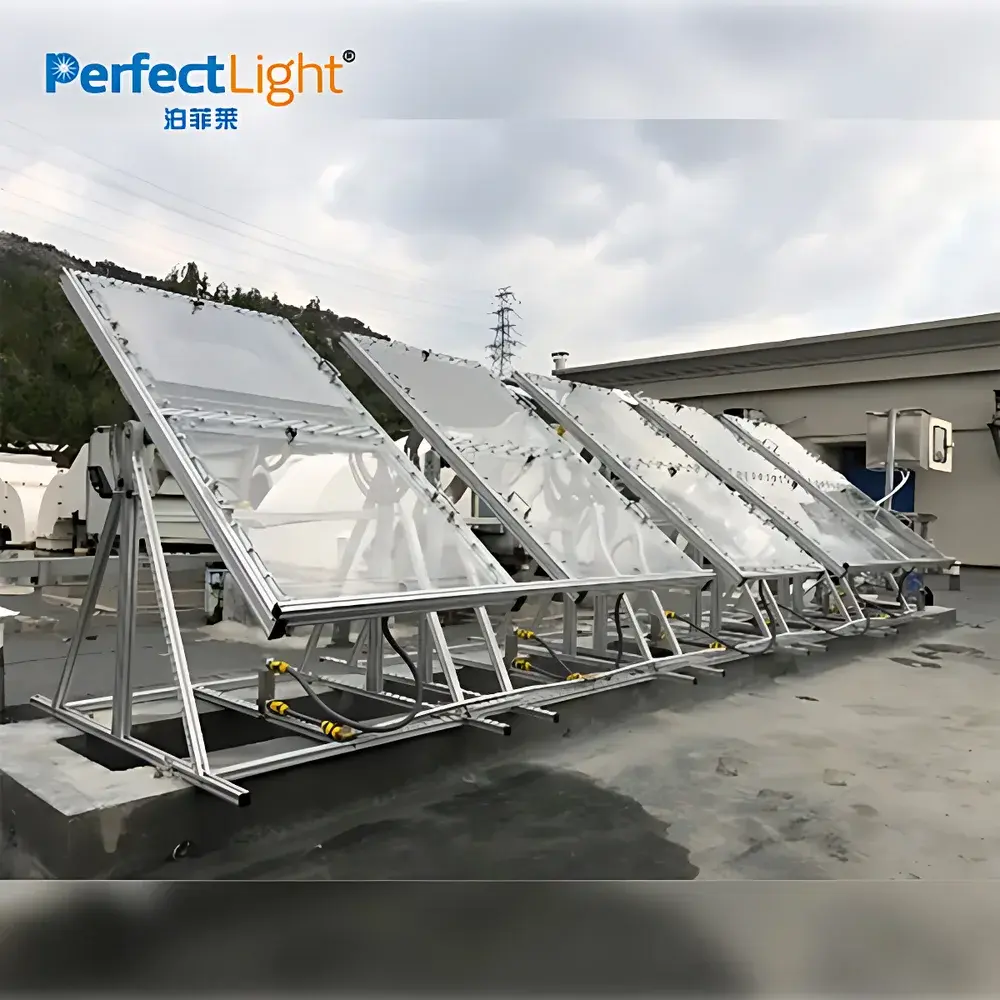
PerfectLight PLR-SPR Series Flat-Plate Photoreactor System
| Brand | PerfectLight |
|---|---|
| Origin | Beijing, China |
| Model | PLR-SPR Series |
| Type | Laboratory-to-Industrial Flat-Plate Photoreactor |
| Reactor Area (PLR-SPRL) | 0.0025–0.0625 m² |
| Reactor Area (PLR-SPRF) | 0.1–0.5 m² |
| Reactor Area (PLR-SPRG) | 0.5–10 m² |
| Flow Rate Range | 0–120 L/min |
| Liquid Reservoir Capacity | 0.2–1000 L |
| Construction Materials | PTFE, SS316, PP-R, PU |
| Compliance | Designed for ISO/IEC 17025-aligned photoreactor validation and GLP-compliant solar fuel research |
Overview
The PerfectLight PLR-SPR Series Flat-Plate Photoreactor System is an engineered platform for scalable photocatalytic reaction studies under natural or simulated solar irradiation. Based on the fundamental principles of heterogeneous photocatalysis—where photon absorption by semiconductor catalysts (e.g., BiVO₄, TiO₂, g-C₃N₄) generates electron-hole pairs that drive redox reactions—the PLR-SPR system replaces conventional batch-type slurry reactors with a planar, flow-through architecture optimized for high photon utilization efficiency and minimal scale-up deviation. Developed in collaboration with the Dalian Institute of Chemical Physics, Chinese Academy of Sciences (CAS), and inspired by the “Hydrogen Farm Project” (HFP) published in Angewandte Chemie, this system enables direct solar-driven water splitting and CO₂ reduction at laboratory, pilot, and pre-commercial scales. Its flat-plate geometry ensures uniform incident irradiance distribution across the catalyst layer, mitigating shadowing, thermal gradients, and mass-transfer limitations inherent in cylindrical or stirred-tank configurations. The system operates under ambient to moderate pressure (≤0.5 MPa), supports both liquid-phase and gas-liquid two-phase operation, and is compatible with UV–vis–NIR spectral input (280–1100 nm), making it suitable for STC (Solar-to-Chemical) and STH (Solar-to-Hydrogen) efficiency benchmarking per ASTM E2583 and ISO 15489 standards.
Key Features
- Optimized optical geometry: Flat-plate configuration maximizes effective irradiated surface area while maintaining consistent photon path length; eliminates self-shading and enables >92% irradiance uniformity (measured via calibrated silicon photodiode array).
- Enhanced mass transfer: Integrated turbulence-inducing flow channels and precisely tuned catalyst bed height (0.2–5 mm) reduce diffusion boundary layers; computational fluid dynamics (CFD) modeling validates >85% volumetric mixing efficiency at design flow rates.
- Robust sealing & structural integrity: High-temperature, chemically resistant fluoroelastomer gaskets (FKM) ensure leak-tight operation up to 80 °C and 0.5 MPa; finite element analysis (FEA)-verified pressure vessel design complies with ASME BPVC Section VIII Div. 1 stress criteria.
- Real-time process monitoring: Standard pH sensing (±0.02 pH accuracy); optional modules include Pt100 temperature probes (±0.1 °C), piezoresistive pressure transducers (±0.25% FS), UV-A/B radiometers (calibrated to NIST-traceable standards), and ORP electrodes (±5 mV).
- Modular serviceability: Patented quick-release clamping mechanism (CN Patent No. 202220428290.X) enables tool-free disassembly within 90 seconds, facilitating catalyst regeneration, fouling inspection, and cleaning without seal replacement.
Sample Compatibility & Compliance
The PLR-SPR system accommodates powdered, immobilized, or monolithic photocatalysts—including metal oxides (TiO₂, WO₃, BiVO₄), nitrides (Ta₃N₅), carbon-based composites, and perovskite derivatives—on transparent conductive substrates (FTO, ITO) or porous ceramic supports. It supports aqueous, organic, and biphasic reaction media (e.g., water/methanol, water/ethylene glycol). All wetted components meet USP Class VI biocompatibility requirements and are certified non-leaching per ISO 10993-12. For regulatory traceability, the system supports audit-ready data logging aligned with FDA 21 CFR Part 11 (when paired with validated SCADA software), and its operational parameters adhere to ISO 17025 method validation frameworks for photochemical kinetics quantification.
Software & Data Management
Data acquisition is managed via a modular DAQ interface supporting Modbus RTU/TCP and OPC UA protocols. Raw sensor streams (pH, T, P, irradiance) are timestamped and stored in CSV/SQLite format with configurable sampling intervals (100 ms–10 s). Optional cloud synchronization enables remote monitoring and cross-site dataset aggregation. Calibration certificates for all sensors are provided with NIST-traceable references. The system’s architecture permits integration with third-party kinetic modeling tools (e.g., MATLAB Simulink, Python-based Pyomo) for real-time parameter estimation and reactor performance mapping.
Applications
- Solar hydrogen production via particulate photocatalytic water splitting (HFP protocol implementation)
- Photocatalytic degradation of emerging contaminants (pharmaceuticals, PFAS, dyes) in wastewater matrices
- CO₂ photoreduction to C₁–C₃ hydrocarbons and oxygenates under simulated AM1.5G illumination
- Photoelectrochemical (PEC) cell testing with integrated counter/reference electrode ports
- Accelerated aging studies of photocatalyst stability under continuous solar flux (≥1000 h operational validation)
FAQ
What catalyst loading methods are supported?
Spin-coating, dip-coating, spray pyrolysis, and electrophoretic deposition are compatible; substrate dimensions must conform to standard plate sizes (5×5 cm² to 100×100 cm²).
Can the system operate under inert atmosphere?
Yes—integrated gas purging ports and vacuum-rated seals support N₂, Ar, or H₂ atmospheres; optional mass flow controllers enable precise stoichiometric gas dosing.
Is outdoor deployment feasible in varying climatic conditions?
PLR-SPRF and PLR-SPRG models feature IP65-rated enclosures, UV-stabilized polymer housings, and passive thermal management; operational range: −10 °C to +50 °C ambient.
How is light intensity calibrated across different reactor sizes?
Each unit ships with a factory-calibrated reference photodiode mounted adjacent to the catalyst plane; users may perform in-situ recalibration using a portable spectroradiometer traceable to NIST SRM 2257.
Does the system support automated long-term unattended operation?
Yes—programmable logic controller (PLC) firmware allows scheduled start/stop cycles, fault-triggered shutdown (e.g., overpressure, temperature excursion), and email/SMS alerts via Ethernet/WiFi gateway.



