
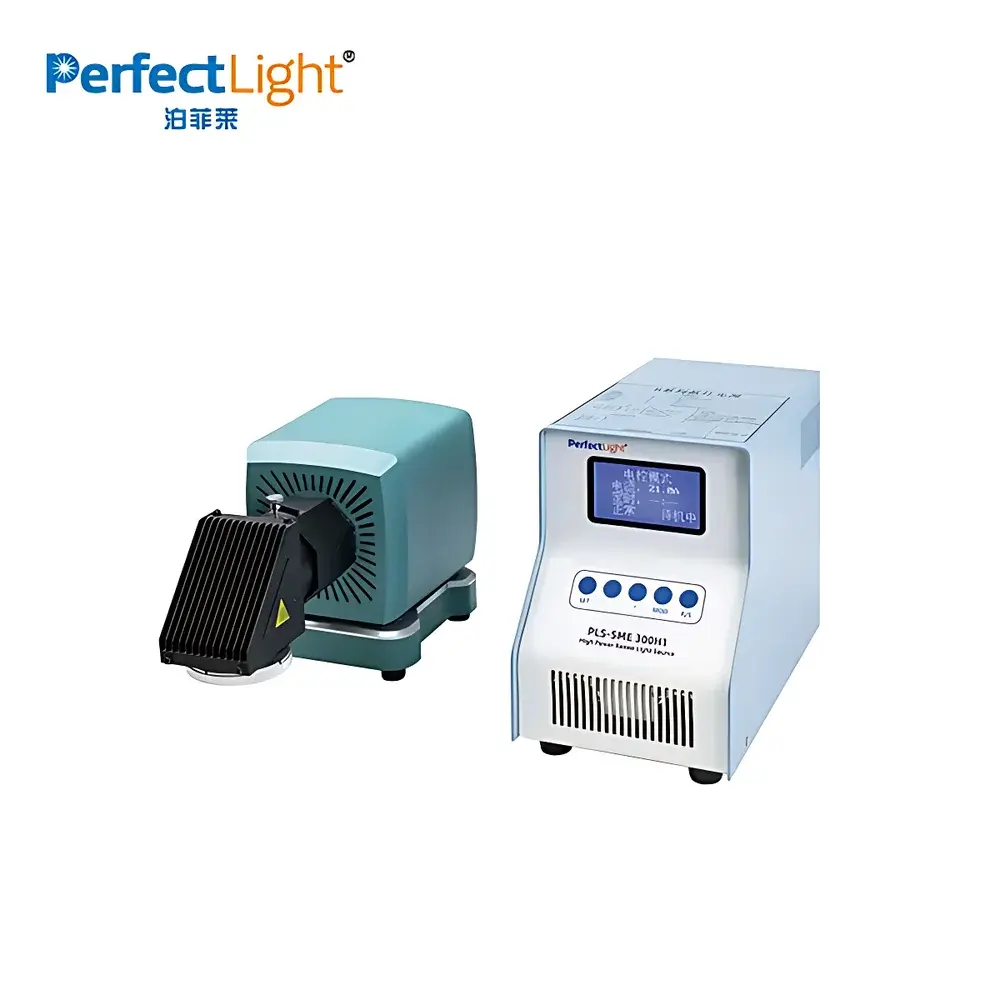
PerfectLight PLS-SME300E H1 Xenon Light Source
| Brand | PerfectLight |
|---|---|
| Origin | Beijing, China |
| Model | SME300E |
| Light Source Type | Xenon Arc Lamp |
| Illumination Mode | External Irradiation |
| Lamp Power | 300 W |
| Total Optical Output | 75 W |
| Spectral Range | 320–780 nm (extendable to 2500 nm) |
| Beam Diameter | 30–60 mm |
| Maximum Irradiance | >4200 mW/cm² |
| Long-Term Stability | ≤±3% |
| Power Supply Stability | ±0.3% |
| Lamp Lifetime | >1000 h |
| Control Modes | Constant Current (Electrical Control) & Constant Irradiance (Optical Feedback Control) |
| Triggering | Integrated High-Voltage Ignition (Two-Stage, No HV Cabling) |
| Cooling | Patented Integrated Heat Dissipation Structure (Patent No. CN201320740323.5) |
| Software Interface | PC-based Control via Network Serial Port |
| Safety Features | Fan Fault Protection, Auto-Start/Shutdown Delay, Overcurrent & Overload Cut-off, Non-HV Interconnect Cabling |
| Optional Accessories | Fiber Optic Couplers, Homogenizers, Liquid Filters, Light Guides, Motorized Height Adjusters, Mechanical Shutters, Five-Point Irradiance Calibration Kit, Bandpass/Cut-off/Solar-Spectrum-Corrected Filters, Attenuators, Light Shields, Optical Power Meters, Fiber-Coupled Spectrometers |
Overview
The PerfectLight PLS-SME300E H1 Xenon Light Source is a high-stability, externally irradiating broadband light source engineered for precision photochemical and photophysical experimentation. It employs a 300 W short-arc xenon lamp operating under controlled DC current or closed-loop optical feedback, delivering continuous spectral output from the deep UV (320 nm) through the visible spectrum and into the near-infrared (780 nm), with optional extension up to 2500 nm using appropriate optics and detector configurations. Its non-metallic, high-insulation enclosure ensures electrical safety in laboratory environments where grounding constraints or EMI-sensitive instrumentation are present. The compact form factor (W × D × H: 220 × 280 × 180 mm) supports integration into confined reaction chambers, gloveboxes, multi-axis optical benches, and custom-built photoreactor systems—particularly those requiring multi-directional or spatially selective illumination. Designed for reproducible photon flux delivery over extended durations, the PLS-SME300E H1 meets the stringent demands of quantitative photocatalysis, photoelectrochemical (PEC) characterization, quantum yield determination, and accelerated aging studies under standardized irradiance conditions.
Key Features
- Two operational modes: constant-current (electrical control) and constant-irradiance (optical feedback control), enabling both power stability and photometric repeatability across experimental campaigns.
- Digital microprocessor-based power management ensures ±0.3% instantaneous power stability and programmable timing functions—including auto-shutdown—to support unattended long-duration experiments.
- Integrated optical feedback system directly monitors real-time irradiance at the sample plane using a calibrated photodiode sensor; closed-loop adjustment maintains setpoint irradiance within ±3% over ≥8 h at nominal output.
- Patented thermal architecture (CN201320740323.5) combines forced-air convection with optimized heat-path geometry to sustain lamp wall temperature below critical thresholds, extending electrode life and minimizing spectral drift.
- PC-based control interface via Ethernet-enabled serial port allows remote monitoring of lamp voltage/current, irradiance output, fan RPM, and thermal status—compatible with LabVIEW, Python (PySerial), and MATLAB automation frameworks.
- High-voltage ignition is fully integrated into the lamp housing; no external HV cabling eliminates arcing risk and simplifies system layout compliance with IEC 61010-1 safety standards.
Sample Compatibility & Compliance
The PLS-SME300E H1 is compatible with solid, liquid, and gas-phase photocatalytic reactors—including slurry-based suspension systems, immobilized thin-film configurations, and flow-through gas-phase photoreactors. Its external irradiation design permits direct coupling with PerfectLight’s PLR-RP series photothermal evaluation platforms and PLR-PSTRⅡ reactor systems via lens assemblies or right-angle light guides. Spectral output conforms to ISO 9022-18 (optical instruments—environmental testing) and supports ASTM E2027 (standard practice for calibration of broadband UV radiometers). When configured with solar-spectrum-corrected filters and calibrated irradiance sensors, the system satisfies requirements for simulated AM1.5G illumination per ASTM G173-03 and IEC 60904-9. All electrical subsystems comply with CE marking directives (EMC Directive 2014/30/EU and Low Voltage Directive 2014/35/EU), and firmware implements audit-trail-capable event logging suitable for GLP-compliant laboratories.
Software & Data Management
The included Windows-compatible software provides real-time graphical display of irradiance (mW/cm²), lamp current (A), voltage (V), heatsink temperature (°C), and elapsed runtime. Users may define multi-step irradiation protocols—including ramping, dwell, and cycling sequences—with timestamped data export in CSV format. Communication uses ASCII-based serial protocol over TCP/IP, enabling integration into centralized lab data acquisition systems. Firmware supports firmware-over-the-air (FOTA) updates via secure HTTPS handshake. All parameter changes, emergency shutdowns, and hardware fault events are logged with UTC timestamps and stored in non-volatile memory for traceability—meeting FDA 21 CFR Part 11 requirements when deployed with validated user access controls and electronic signature modules.
Applications
- Photocatalysis: Quantitative H₂/O₂ evolution from water splitting, CO₂ reduction to CH₄/C₂H₄, degradation of VOCs (formaldehyde, NOₓ, SOₓ), aqueous organic pollutants (dyes, pharmaceuticals), and membrane-integrated photocatalytic systems.
- Photothermal catalysis: Solar-driven interfacial evaporation, CO₂ hydrogenation under combined photon-thermal activation, and localized plasmonic heating studies.
- Photoelectrochemistry: Incident photon-to-current efficiency (IPCE) mapping, transient photocurrent spectroscopy, and open-circuit voltage decay measurements on semiconductor photoanodes/cathodes.
- Quantum yield determination: Actinometry-compliant irradiance calibration using ferrioxalate or potassium acid phthalate chemical actinometers per IUPAC recommendations.
- Accelerated photostability testing: ISO 4892-2 (Xenon-arc exposure) and ASTM G155 protocols for polymer degradation, pigment fading, and OLED material lifetime assessment.
FAQ
What is the spectral irradiance distribution of the PLS-SME300E H1 without filters?
The unfiltered output follows the characteristic continuum of a 300 W xenon short-arc lamp, peaking near 800 nm with strong UV emission down to 320 nm and measurable intensity up to ~2500 nm when paired with appropriate quartz-transmissive optics and IR-enhanced detectors.
Can the system maintain stable irradiance during 24-hour continuous operation?
Yes—under constant-irradiance mode and ambient temperatures ≤25°C, the system sustains ≤±3% deviation over 8 h; extended runs require active thermal management of the target chamber to prevent convective interference with beam homogeneity.
Is the optical feedback sensor NIST-traceable?
The factory-calibrated photodiode sensor is traceable to NIST Standard Reference Material (SRM) 2252; full calibration certificates—including uncertainty budgets—are available upon request for ISO/IEC 17025-accredited labs.
Does the unit support TTL-triggered shutter synchronization?
Yes—via optional mechanical shutter module with 5 V TTL input, enabling precise temporal gating synchronized to external detectors or pulsed lasers.
What safety certifications does the PLS-SME300E H1 hold?
It carries CE marking per EN 61000-6-3 (EMC) and EN 61010-1 (safety); UL/CSA certification is available under OEM agreement for North American deployment.




