
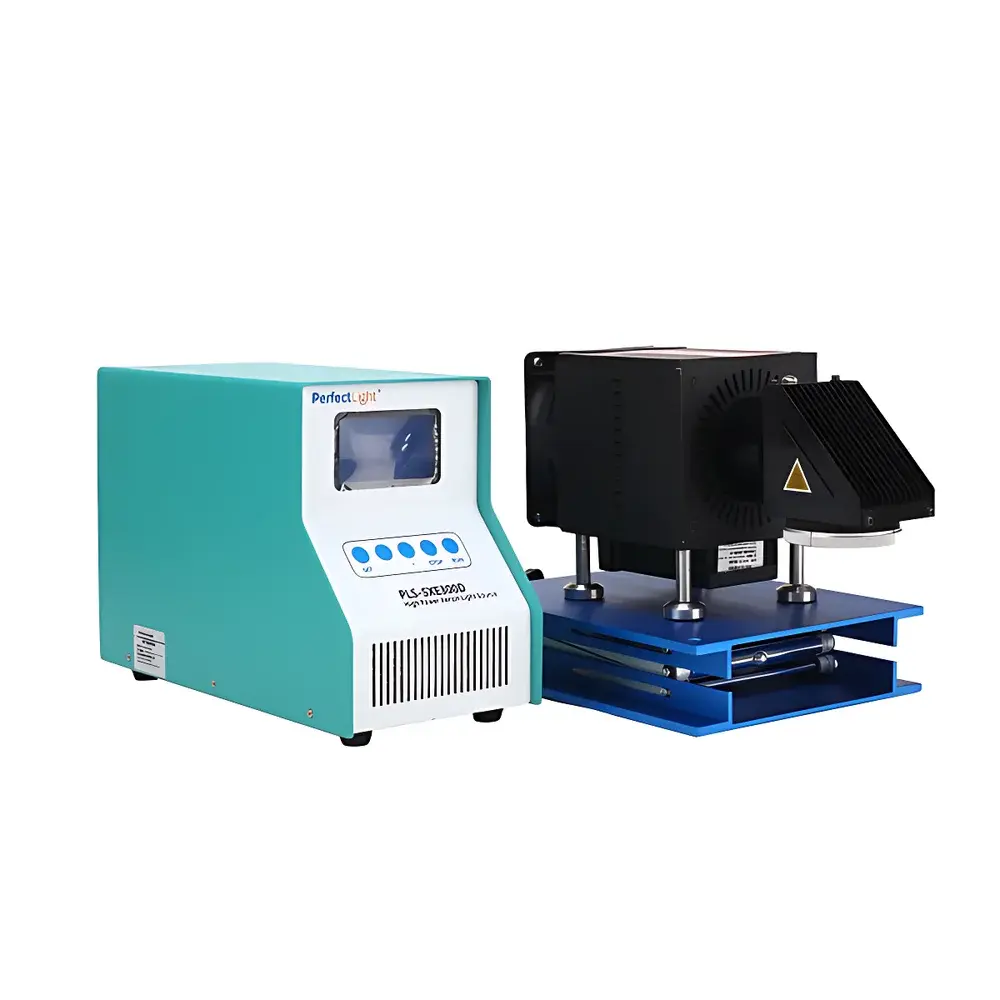
PerfectLight PLS-SXE300D / PLS-SXE300DUV Xenon Light Source
| Brand | PerfectLight |
|---|---|
| Origin | Beijing, China |
| Model | PLS-SXE300D / PLS-SXE300DUV Xenon Light Source |
| Light Source Type | Short-Arc Xenon Lamp |
| Illumination Mode | External Irradiation |
| Total Optical Power | 50 W |
| Spectral Range | 320–780 nm (extendable to 2500 nm) |
| Beam Divergence | Avg. 6° |
| Spot Diameter | Adjustable at 30–60 mm working distance |
| Long-Term Irradiance Stability | ≤ ±3% |
| Lamp Power | 300 W |
| Power Adjustment Range | 150–300 W |
| Power Supply Ripple | 200 mVp-p |
| Lamp Lifetime | >1000 h (under standard photocatalytic operating conditions) |
| Trigger Method | Integrated High-Voltage Ignition (Two-Stage, No High-Voltage Cabling) |
| Cooling Architecture | Patented Axial Forced-Air Heat Dissipation (Patent No. CN201320740323.5) |
| Safety Features | Fan Fault Protection, Post-Shutdown Fan Delay, Overcurrent/Overload Auto-Cut-off, Low-Voltage Control Cabling |
Overview
The PerfectLight PLS-SXE300D and PLS-SXE300DUV are high-stability, externally irradiating short-arc xenon light sources engineered for precision photonic applications in research laboratories and industrial R&D environments. These systems operate on the principle of broadband continuum emission from a high-pressure DC-excited xenon plasma arc, delivering spectrally stable output across the near-UV to visible spectrum (320–780 nm), with optional extension into the near-infrared up to 2500 nm using appropriate optical filtering or monochromator coupling. Designed specifically for demanding photochemical and photoelectrochemical workflows—including photocatalytic water splitting, CO2 reduction, and VOC degradation—the PLS-SXE300 series integrates a proprietary low-ripple power supply (<200 mVp-p), microprocessor-based digital lamp management, and thermally optimized mechanical architecture to ensure long-term radiometric reproducibility (≤±3% over extended irradiation periods). Unlike conventional mercury-based sources, xenon lamps provide continuous spectral output without sharp emission lines, enabling wavelength-selective experiments via external bandpass, longpass, or UV-cut filters—critical for mechanistic studies requiring defined photon energy input.
Key Features
- Stable DC-powered xenon arc lamp with digitally regulated current control and real-time LED digital amperage readout
- Patented axial forced-air cooling system (CN201320740323.5) ensuring uniform thermal management and extended lamp service life (>1000 h under typical photocatalytic irradiance conditions)
- Non-metallic lamp housing to mitigate electrical grounding risks and improve laboratory safety compliance
- Compact, space-efficient design with minimal footprint—optimized for integration into gloveboxes, reactor chambers, and custom optical benches
- Integrated two-stage high-voltage ignition: eliminates hazardous high-voltage cabling between power supply and lamp head; reduces EMI and improves system reliability
- Adjustable optical output: 150–300 W lamp power range with precise current limiting (21 A max) and programmable operation mode support
- Low-noise, low-ripple switching power supply (200 mVp-p) minimizing intensity fluctuation and improving signal-to-noise ratio in time-resolved measurements
Sample Compatibility & Compliance
The PLS-SXE300D/DUV is compatible with standard quartz cuvettes, flat-bottomed photoreactors, gas-phase flow cells, and custom-built PEC (photoelectrochemical) cells. Its external illumination geometry supports both top-down and side-illumination configurations, facilitating seamless integration with in situ spectroscopic monitoring (e.g., DRIFTS, UV-Vis absorption, or online GC-MS). The system conforms to IEC 61000-6-3 (EMC emissions) and IEC 61000-6-2 (immunity) standards. While not certified for medical or clinical use, its design adheres to GLP-aligned operational practices—including traceable lamp runtime logging, programmable exposure protocols, and hardware-enforced safety interlocks (fan failure detection, overcurrent cutoff, thermal shutdown)—making it suitable for auditable research environments governed by ISO/IEC 17025 or internal QA/QC frameworks.
Software & Data Management
The PLS-SXE300D/DUV operates in standalone mode with front-panel digital controls and LED current display. For automated workflows, it supports TTL-level external triggering and analog 0–5 V intensity modulation inputs, enabling synchronization with data acquisition systems (e.g., potentiostats, spectrometers, or gas chromatographs). Optional integration with PerfectLight’s PL-Link software suite allows remote parameter configuration, scheduled irradiation sequences, and timestamped lamp runtime logging—features aligned with FDA 21 CFR Part 11 requirements for electronic record integrity when paired with validated computing environments. All firmware updates are delivered via USB interface with version-controlled checksum verification.
Applications
- Photocatalytic Hydrogen/Oxygen Evolution: Standardized irradiation source for sacrificial and Z-scheme water splitting studies using TiO2, g-C3N4, MOFs, and perovskite-based catalysts
- CO2 Photoreduction: Enables controlled photon flux delivery for quantifying CH4, CO, and C2H4 evolution rates under simulated solar illumination
- VOC and Liquid Pollutant Degradation: Validated for formaldehyde, NOx, SOx, methylene blue, phenol, and benzene decomposition kinetics under UV–vis excitation
- Photoelectrochemical (PEC) Characterization: Compatible with three-electrode electrochemical cells for incident photon-to-current efficiency (IPCE) mapping and transient photocurrent analysis
- Optical Material Screening: Supports accelerated aging, photostability testing, and photochromic response evaluation under calibrated broadband irradiance
FAQ
What is the spectral output profile of the PLS-SXE300D/DUV?
It delivers a continuous broadband spectrum from 320 nm to 780 nm, with spectral continuity maintained up to 2500 nm when coupled with appropriate IR-transmissive optics and filters.
Can the lamp power be adjusted during operation?
Yes—power is continuously adjustable from 150 W to 300 W via front-panel controls or external analog voltage input, maintaining stable arc characteristics across the range.
Is the system compatible with vacuum or inert-atmosphere gloveboxes?
Yes—the non-metallic lamp housing and low-voltage control cabling allow safe integration into nitrogen- or argon-purged enclosures; optional quartz viewport adapters are available for sealed optical access.
What safety certifications does the unit meet?
It complies with IEC 61000-6-2/6-3 for electromagnetic compatibility and incorporates multiple hardware-level protections including fan-failure shutdown, overcurrent cutoff, and thermal derating—consistent with Class I laboratory equipment safety expectations.
How is lamp lifetime defined and verified?
Lifetime (>1000 h) is measured under standardized photocatalytic test conditions (300 W, 25 °C ambient, continuous operation), defined as the period during which total optical output remains within ±5% of initial calibration value at 400 nm.





