
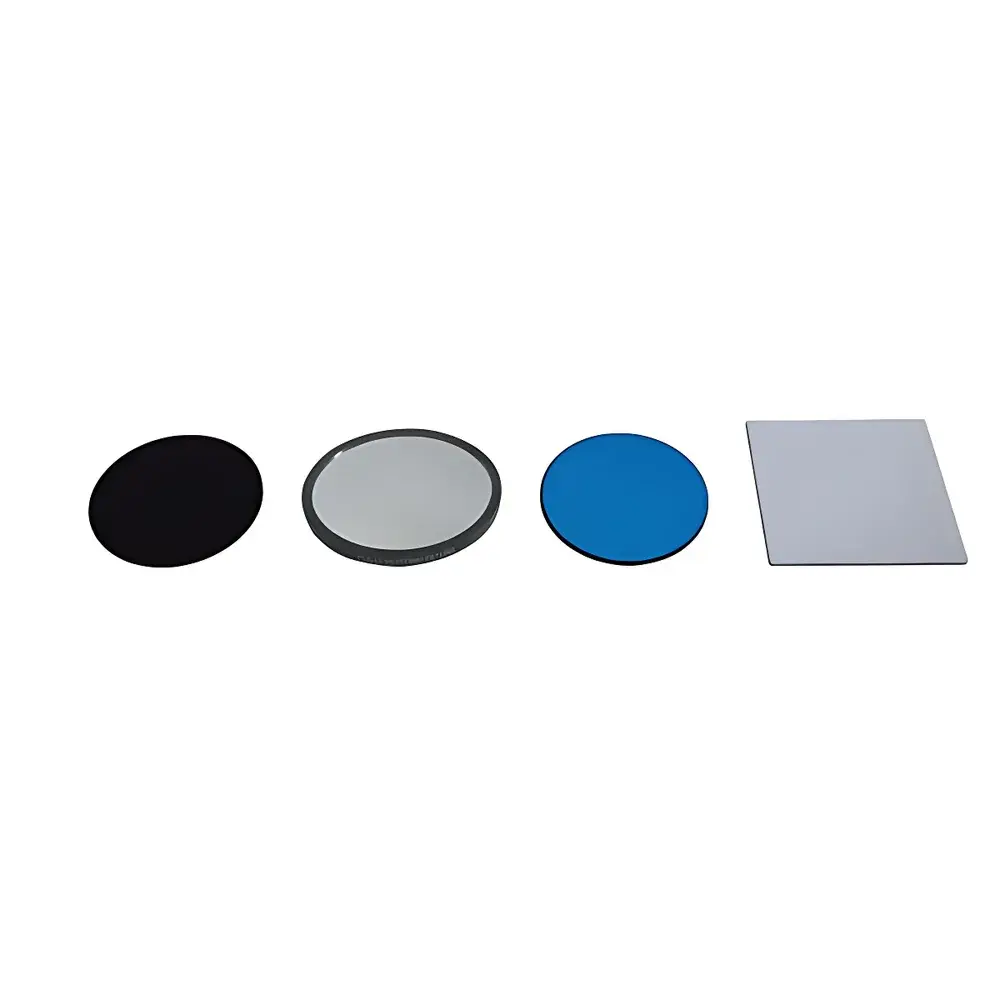
PerfectLight UVref Single-Wavelength, Bandpass & Cut-Off Optical Filters
| Brand | PerfectLight |
|---|---|
| Origin | Beijing, China |
| Model | UVref |
| Filter Type | Cut-On / Cut-Off, Bandpass, and Narrowband |
| Substrate Material | Fused Silica (Quartz) |
| Diameter | 63 mm |
| Clear Aperture | >57 mm |
| Spectral Range | 320–2500 nm |
| Optical Density (OD) @ Blocking Region | ≥4.0 (typ.) |
| Surface Quality | 20–10 scratch-dig |
| Parallelism | <3 arcsec |
| Coating Type | Hard Dielectric Multilayer |
| Incident Angle | 0° ± 2° (for specified spectral performance) |
| Compliance | ISO 9001-manufactured optical components |
| Application Domain | Laboratory-based NIR, UV-Vis, and FT-NIR spectroscopy systems |
Overview
PerfectLight UVref series optical filters are precision-engineered passive optical components designed for spectral selection and background suppression in laboratory-grade spectroscopic instrumentation. These filters operate on the principle of thin-film interference—multiple dielectric layers deposited onto high-purity fused silica substrates to achieve sharp spectral transitions, high transmission in the passband, and deep attenuation (>OD 4.0) in the blocking region. Unlike dispersive or scanning spectrometers, UVref filters enable fixed-wavelength or band-limited detection without moving parts, making them ideal for integration into compact, robust, and maintenance-free near-infrared (NIR) spectrometers, UV-Vis photometers, and custom optical sensor platforms. Their design adheres to fundamental radiometric constraints defined by the CIE and ISO 13695 standards for spectral transmittance characterization, ensuring traceable performance across the 320–2500 nm range.
Key Features
- Fused silica substrate with exceptional UV transparency and thermal stability (CTE ≈ 0.55 × 10⁻⁶ /°C), minimizing wavelength drift under ambient temperature fluctuations.
- Hard dielectric multilayer coating architecture optimized for 0° angle of incidence, delivering high reproducibility between production lots (Δλ₀.₅ < ±1.5 nm for bandpass variants).
- Four standardized cut-off configurations available: UVCUT 400 (cut-on at 400 nm), UVCUT 420 (cut-on at 420 nm), CUT 700 (cut-off at 700 nm), and CUT 800 (cut-off at 800 nm)—each validated per ISO 11385 for edge steepness (Δλ₁₀₋₉₀ < 15 nm).
- Clear aperture exceeding 57 mm ensures compatibility with standard 1-inch optical mounts and collimated beam paths in benchtop NIR systems.
- No moving parts or electronic drivers required—enabling passive integration into GLP-compliant analytical workflows where hardware validation simplicity is prioritized.
Sample Compatibility & Compliance
UVref filters are intended for use with transmitted-light spectroscopic configurations only (i.e., absorbance or reflectance measurements requiring collimated illumination and detector alignment). They are compatible with solid, liquid, and powdered samples when mounted in standardized filter wheels or fixed-path cuvette holders. All filters meet ISO 10110-7 surface quality specifications (20–10 scratch-dig) and undergo spectral verification using NIST-traceable calibrated spectrophotometers (PerkinElmer Lambda 1050+). While not standalone analytical instruments, UVref components support compliance with ASTM E1421 (standard practice for NIR quantitative analysis) and USP (spectrophotometric absorption filters) when integrated into validated instrument platforms.
Software & Data Management
As passive optical elements, UVref filters do not incorporate embedded firmware or data interfaces. Their spectral characteristics are documented in vendor-provided calibration reports—including full transmittance curves (320–2500 nm, 1 nm resolution), peak transmission values (typically >85% in passband), and blocking region OD profiles. These datasets are supplied in ASCII-compatible .csv format and may be imported directly into chemometric software environments such as Unscrambler X, MATLAB’s PLS Toolbox, or open-source libraries (e.g., scikit-learn + NumPy) for spectral preprocessing, baseline correction, and multivariate calibration model development. No FDA 21 CFR Part 11 functionality applies, as no audit trail, electronic signature, or user access control is associated with filter operation.
Applications
- Wavelength isolation in LED- or halogen-based NIR source modules for moisture, protein, and fat quantification in agricultural and pharmaceutical raw materials.
- Background rejection in UV-driven photocatalysis monitoring systems (e.g., TiO₂ degradation kinetics), where UVCUT 400 suppresses mercury-line interference below 400 nm.
- Reference channel conditioning in dual-beam NIR spectrometers to stabilize detector response against source intensity drift.
- Custom spectral windowing for portable handheld analyzers targeting specific functional group absorptions (e.g., O–H stretch at ~1450 nm, C–H first overtone at ~1700 nm).
- Calibration verification tools in metrology labs performing inter-instrument transfer function validation per ISO/IEC 17025 requirements.
FAQ
Are UVref filters suitable for use with laser sources?
Yes—provided pulse energy density remains below 0.5 J/cm² for nanosecond pulses and average power does not exceed 5 W/cm². Fused silica substrate and oxide-based coatings offer high laser-induced damage threshold (LIDT) certified per ISO 21254-1.
Can I request a custom cut-on/cut-off wavelength outside the four standard models?
Yes. PerfectLight offers OEM filter design services with lead times of 6–8 weeks; minimum order quantity applies. Custom specifications must include target edge wavelength, transition width, passband flatness tolerance, and blocking depth requirements.
Do UVref filters require recalibration after installation?
No. As passive, non-drift-prone components, they maintain stable spectral performance over time. However, periodic verification using a reference spectrophotometer is recommended every 12 months in regulated environments.
Is mounting hardware included with purchase?
Standard UVref filters ship with unmounted optics. Optional SM1-threaded lens tubes, retaining rings, and kinematic mounts are available separately under PerfectLight mechanical accessories catalog #MNT-UVREF.
How are spectral performance tolerances verified during manufacturing?
Each batch undergoes 100% spectral testing on a double-beam UV-Vis-NIR spectrophotometer calibrated daily against NIST SRM 2036 (certified transmittance standard). Raw data and certificate of conformance accompany shipment.




