
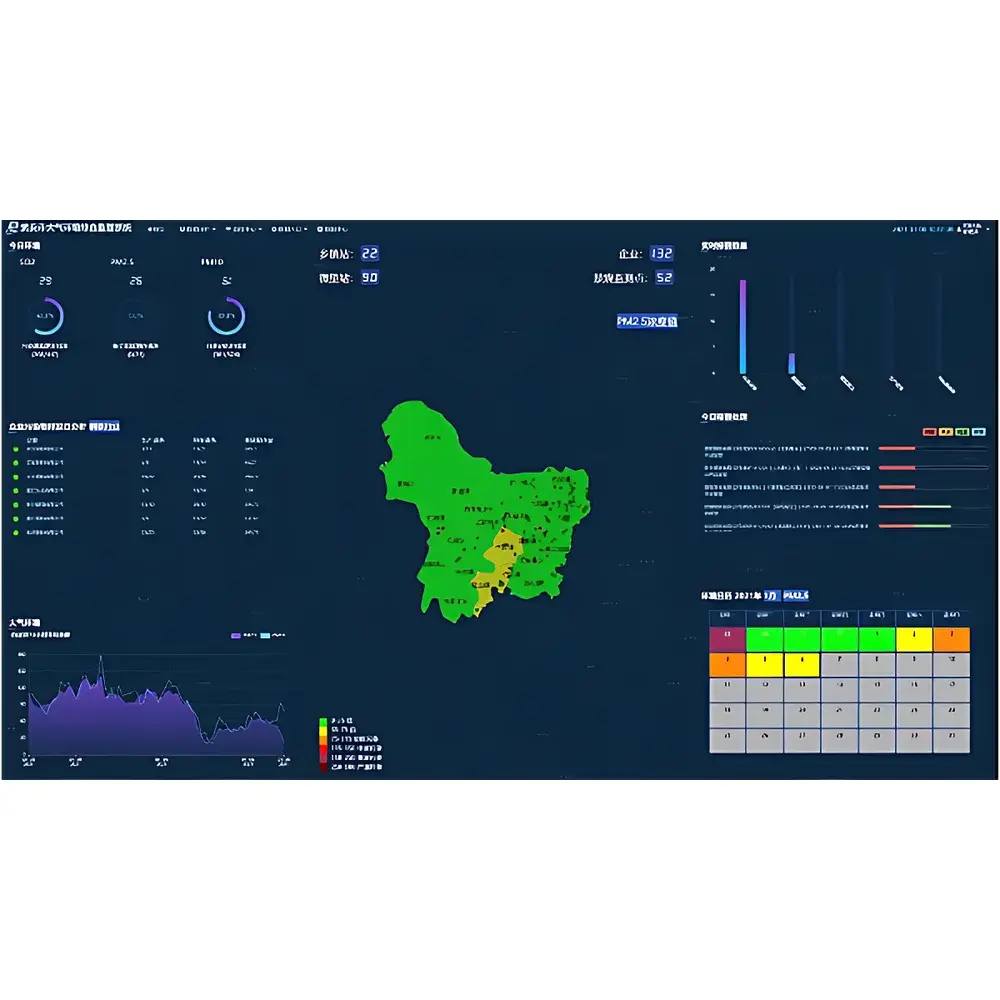
PERIC Atmospheric Environment Integrated Supervision Platform
| Brand | PERIC |
|---|---|
| Origin | Hebei, China |
| Manufacturer Type | Original Equipment Manufacturer (OEM) |
| Product Origin | Domestic (China) |
| Model | Customized Atmospheric Environment Integrated Supervision Platform |
| Pricing | Available upon Request |
Overview
The PERIC Atmospheric Environment Integrated Supervision Platform is a mission-critical environmental informatics infrastructure engineered for regulatory authorities, municipal ecological environment bureaus, and regional air quality management centers. Built on a service-oriented architecture (SOA), the platform implements multi-source data fusion from ground-based monitoring stations (PM2.5, PM10, SO2, NO2, O3, CO), remote sensing satellites (e.g., Sentinel-5P, GOCI), unmanned aerial vehicles (UAVs), mobile monitoring units, and Internet of Things (IoT)-enabled micro-sensors. It applies time-series analysis, spatial interpolation (IDW, Kriging), dispersion modeling (CALPUFF-compatible interface), and machine learning–driven pattern recognition to transform raw observational streams into actionable regulatory intelligence. The system operates under a unified metadata framework aligned with China’s *Environmental Information Standardization Specification* (HJ 720–2014) and supports interoperability with national platforms such as the China National Environmental Monitoring Network (CNEMN) and the Ministry of Ecology and Environment (MEE) Data Sharing Platform.
Key Features
- Multi-layered architecture compliant with e-Government IT infrastructure standards: presentation layer (web & mobile responsive UI), application layer (modular microservices), data layer (distributed time-series database + spatial database), and device layer (MQTT/CoAP-enabled sensor gateway)
- Real-time air quality index (AQI) calculation per GB 3095–2012 and dynamic source apportionment using Positive Matrix Factorization (PMF) and UNMIX algorithms
- Integrated early-warning engine supporting tiered alerts (Level I–IV) based on exceedance duration, spatial clustering, and meteorological persistence thresholds
- Fully configurable workflow engine for enforcement case management—linking monitoring anomalies to inspection dispatch, evidence upload (geotagged photos/videos), penalty documentation, and closure verification
- Role-based access control (RBAC) with audit trails meeting GB/T 22239–2019 (China’s Cybersecurity Level Protection 2.0) requirements
Sample Compatibility & Compliance
The platform ingests heterogeneous environmental data formats including EPA AQS, WMO BUFR, ISO 19115-compliant metadata, and proprietary sensor telemetry (Modbus TCP, LoRaWAN). All data ingestion pipelines undergo schema validation and automated QC/QA flagging (e.g., range checks, spike detection, calibration drift alerts). The system supports traceable data lineage from sensor to dashboard and complies with regulatory reporting mandates under the *Environmental Protection Law of the People’s Republic of China*, *Air Pollution Prevention and Control Action Plan*, and local air quality management regulations. For cross-departmental data sharing, it implements standardized APIs conforming to the *National Government Service Platform Interface Specification* (GB/T 38659–2020).
Software & Data Management
Data storage utilizes a hybrid architecture: time-series metrics are persisted in InfluxDB (optimized for high-write throughput), geospatial layers in PostGIS, and unstructured evidence files in encrypted object storage (S3-compatible). All analytical modules—including temporal trend decomposition, backward trajectory analysis (HYSPLIT integration), and emission inventory reconciliation—are containerized (Docker) and orchestrated via Kubernetes for scalability. The platform includes built-in GLP-aligned audit logging: every data modification, user login, report generation, or configuration change is timestamped, attributed, and immutable. Export functions support PDF/A-2, CSV, and XML formats compliant with archival requirements under GB/T 18894–2016 (Electronic Records Management).
Applications
- Regional air quality forecasting and emergency response coordination during heavy pollution episodes
- Source attribution analysis for industrial clusters, traffic corridors, and construction zones
- Performance evaluation of air pollution control policies (e.g., coal-to-gas conversion, VOCs reduction programs) via counterfactual modeling
- Public transparency portals with real-time AQI maps, historical trend dashboards, and complaint tracking modules
- Inter-agency collaboration hub linking生态环境 bureaus, urban management commissions, traffic police, and meteorological departments
FAQ
Does the platform support integration with third-party meteorological services?
Yes—it accepts GRIB2, NetCDF, and API-based feeds from national and commercial weather providers for boundary condition inputs in dispersion modeling.
Can historical monitoring data from legacy systems be migrated?
Yes—data migration tools support batch import with automatic unit conversion, timezone alignment, and QA flag mapping per HJ 212–2017 protocol.
Is the system validated for regulatory reporting to provincial MEE offices?
Yes—the reporting module generates pre-audited outputs compliant with Form HJ 972–2018 and supports digital signature via China’s certified CA infrastructure.
What level of cybersecurity certification does the platform hold?
The core deployment has passed Level 3 compliance assessment under China’s Cybersecurity Law and GB/T 22239–2019.
Is cloud-hosting supported, or is on-premise deployment mandatory?
Both models are supported: dedicated private cloud (VMware/OpenStack), government cloud (e.g., China Telecom CloudGov), or air-gapped on-premise installation with hardware security modules (HSM) for key management.
Related Products







