
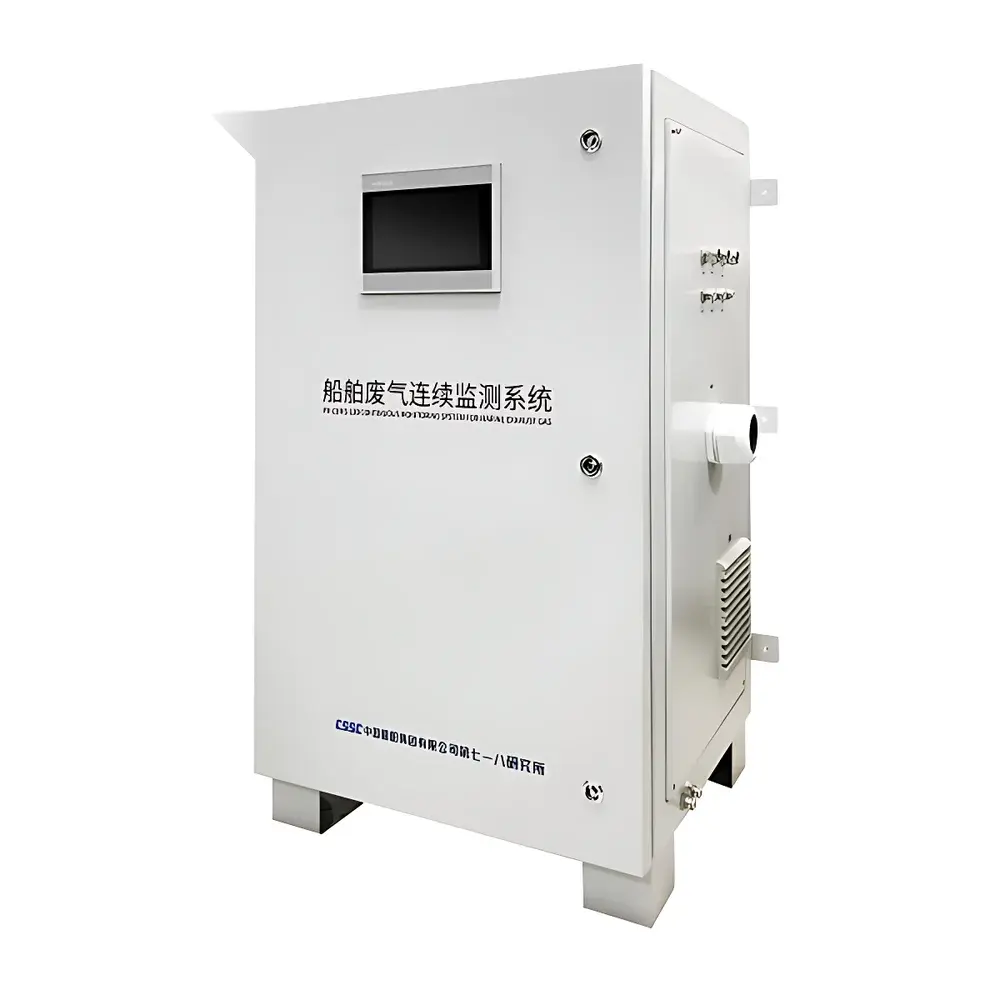
PERIC PR-CEMS-100 Marine Exhaust Continuous Emission Monitoring System (CEMS)
| Brand | PERIC |
|---|---|
| Model | PR-CEMS-100 |
| Origin | Hebei, China |
| Manufacturer Type | Original Equipment Manufacturer (OEM) |
| Regional Classification | Domestic (China) |
| Pricing | Available Upon Request |
| Measurement Principles | UV Differential Optical Absorption Spectroscopy (UV-DOAS), Non-Dispersive Infrared (NDIR), Electrochemical Sensing |
| Measured Gases | SO₂, NO, NO₂, CO, CO₂, O₂, CH₄ (optional) |
| Sample Flow Rate | 60–100 L/min |
| Response Time | ≤30 s |
| Accuracy | ≤±2% FS |
| Zero/ Span Drift | <±2% FS/week |
| S/C Ratio Calculation | Supported |
| Environmental Rating | Marine-grade (salt fog, vibration, acceleration/deceleration) |
| Compliance | MARPOL Annex VI, GB 15097–2016, GD01–2011 |
| Certifications | Recognized by Major Classification Societies (e.g., CCS, DNV, LR, ABS) |
| Output Interfaces | 4–20 mA analog, Modbus TCP/RTU |
| Optional Enclosure | Climate-controlled cabinet with HVAC |
Overview
The PERIC PR-CEMS-100 Marine Exhaust Continuous Emission Monitoring System is an integrated, type-approved solution engineered for real-time, regulatory-compliant measurement of gaseous pollutants in marine exhaust streams. Designed specifically for installation onboard commercial vessels—including container ships, bulk carriers, tankers, and cruise liners—the system employs a dual-conditioning architecture (cold-dry and hot-wet sampling paths) to ensure representative, interference-free gas analysis under dynamic maritime operating conditions. Core analytical methodologies include Ultraviolet Differential Optical Absorption Spectroscopy (UV-DOAS) for SO₂, NO, and NO₂; Non-Dispersive Infrared (NDIR) spectroscopy for CO, CO₂, and CH₄; and electrochemical or paramagnetic sensing for O₂. The system conforms to the stringent physical and functional requirements of IMO MARPOL Annex VI Regulation 13 and 14, as well as national standards GB 15097–2016 (Emission Limits and Measurement Methods for Exhaust Pollutants from Marine Diesel Engines) and GD01–2011 (Technical Specifications for Marine CEMS). Its modular architecture enables deployment in both retrofit and newbuild applications, supporting Tier III NOₓ compliance verification, sulfur cap enforcement (0.10% m/m in ECAs), and carbon intensity indicator (CII) reporting.
Key Features
- Marine-certified hardware: All critical components—including heated sampling probe (≥180 °C),伴热 sampling line (≥120 °C), corrosion-resistant filtration, and condensate management—meet IEC 60529 IP66 and ISO 8501-1 Sa2.5 surface preparation standards for offshore environments.
- Dual-mode sample conditioning: Configurable cold-dry (chilled mirror dew point control to −5 °C) and hot-wet (maintained above dew point throughout transport) pathways ensure optimal compatibility with UV-DOAS and NDIR analyzers.
- Automated diagnostics & maintenance support: Onboard self-test routines monitor probe clogging, pump vacuum loss, optical path contamination, and calibration gas pressure; fault status is relayed via discrete outputs and embedded HMI.
- Robust anti-interference design: UV-DOAS algorithms apply spectral deconvolution to resolve overlapping absorption features (e.g., NO₂/H₂O, SO₂/O₃), minimizing cross-sensitivity and delivering stable baselines over extended drift cycles.
- Classification society approval: Certified by China Classification Society (CCS), DNV, Lloyd’s Register (LR), and American Bureau of Shipping (ABS) per MSC.1/Circ.1491 and IMO MEPC.259(67) guidelines.
- Scalable configuration: Standard configuration covers SO₂, NOₓ, CO₂, O₂, and CO; optional modules extend capability to NH₃ (SCR slip), CH₄ (dual-fuel engines), and total hydrocarbons (THC).
Sample Compatibility & Compliance
The PR-CEMS-100 accommodates exhaust gas temperatures up to 400 °C and particulate loadings ≤100 mg/Nm³ (dry, 15 % O₂). It operates reliably across vessel operational profiles—from harbor maneuvering (low-load, high humidity) to open-sea cruising (high-load, elevated flue gas velocity). All gas measurements are traceable to NIST-certified reference standards and validated per ISO 14956:2002 (air quality—performance criteria for automated measuring systems) and EN 15267-3:2017 (QAL1 certification for CEMS). Data integrity complies with IMO’s mandatory data recording requirements under MARPOL Annex VI Regulation 19, including timestamped, tamper-evident storage of raw spectra, calibration logs, and maintenance events. The system supports audit-ready electronic records aligned with GLP principles and facilitates integration into vessel energy efficiency management systems (SEEMP Part II).
Software & Data Management
The embedded CEMS Control Unit runs a deterministic real-time OS (VxWorks-based) with redundant flash storage and write-protected firmware partitions. The web-accessible Human-Machine Interface (HMI) provides live concentration plots, alarm history, calibration scheduler, and remote diagnostic port access via TLS 1.2-secured Modbus TCP. All emission data—including second-by-second concentration values, flow-corrected mass rates (g/kWh), and rolling 1-hour averages—are exported in CSV/JSON format compliant with EU MRV (Regulation (EU) 2015/757) and IMO DCS (Data Collection System) reporting templates. Audit trails record user login/logout, parameter changes, and manual overrides with SHA-256 hashing—meeting foundational expectations for data governance under IMO 2023 CII verification protocols.
Applications
- Regulatory compliance monitoring for MARPOL Annex VI Emission Control Areas (ECAs) and global sulfur cap enforcement
- Onboard verification of scrubber performance (open-loop, closed-loop, hybrid) via pre- and post-scrubber SO₂ differential measurement
- Real-time NOₓ tier verification during sea trials and commissioning of selective catalytic reduction (SCR) or exhaust gas recirculation (EGR) systems
- Carbon accounting support: CO₂ mass flow calculation using stoichiometric relationships and continuous O₂ correction per ISO 8178-4
- Process optimization of dual-fuel (LNG/diesel) engines through CH₄ slip and THC monitoring
- Integration with shipboard automation networks (e.g., NMEA 2000, IEC 61162-450) for centralized dashboard visualization
FAQ
Does the PR-CEMS-100 meet IMO’s 2023 CII data collection requirements?
Yes. The system captures and time-stamps all required parameters—including fuel consumption, distance traveled, and CO₂ emissions—with sub-minute resolution and stores them in an encrypted, non-volatile memory partition accessible for DCS upload.
Can the system operate without shore-side connectivity?
Yes. All core measurement, logging, and alarm functions are fully autonomous; network connectivity is optional for remote diagnostics and data export.
What maintenance intervals are recommended for marine operation?
Filter replacement every 3 months; optical window cleaning every 6 months; full system calibration annually or after major engine overhauls—per manufacturer’s QM-CEMS-001 maintenance protocol.
Is third-party verification of measurement accuracy supported?
Yes. The system includes dedicated ports for certified span gas injection and reference analyzer intercomparison per ISO/IEC 17025-accredited laboratories.
How is salt corrosion mitigated in the sampling train?
All wetted components use ASTM A182 F22 alloy steel or Hastelloy C-276; probe internals feature ceramic-coated heating elements; condensate is neutralized and drained via pH-regulated separator.







