
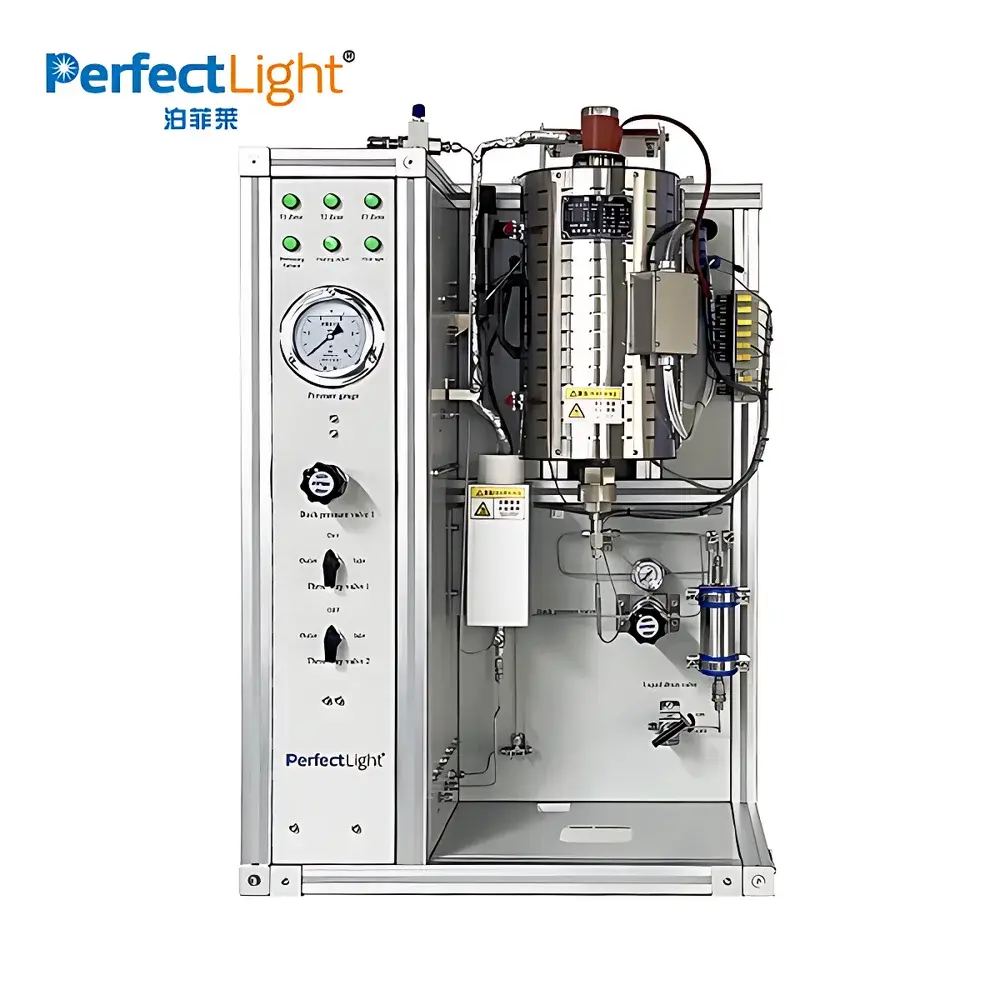
PerkinElmer PLR RVTF-PM Micro-Scale Gas-Solid Catalytic Reaction Evaluation System
| Brand | PerkinElmer (Note: “泊菲莱/PerfectLight” is a Chinese brand |
|---|---|
| Origin | Beijing, China |
| Model | PLR RVTF-PM |
| Reaction Pressure Range | 0.1 (gauge) – 5.5 MPa |
| Reaction Temperature Range | 180 – 1050 °C (externally controlled, stability ≤ ±1 °C) |
| Catalyst Bed Volume | 0.1 – 0.5 mL (bed height: 1–5 mm) |
| System Footprint | 900 × 600 × 1000 mm |
| Power Supply | 220 V AC / 16 A, ≤ 3 kW |
| Gas Inlets | 2 standard (expandable to 4), max flow 100 mL/min per channel |
| Backpressure Control | Integrated 6 MPa sensor (0.2% FS accuracy, 1 kPa resolution) |
| Reactor Type | Top-illuminated high-pressure photo-thermal fixed-bed reactor with quartz liner & light-guiding column |
| Heating Zone | Ceramic fiber furnace |
| Condensate Separator Volume | 60 mL |
| Total System Volume | ~200 mL |
| Optional Features | 100-segment flow programming, Wi-Fi-enabled remote monitoring & PLC firmware updates, intelligent IoT remote operation |
Overview
The PerkinElmer PLR RVTF-PM Micro-Scale Gas-Solid Catalytic Reaction Evaluation System is an integrated, benchtop-scale platform engineered for precise kinetic assessment, mechanistic investigation, and performance benchmarking of heterogeneous catalysts under rigorously controlled thermo-photochemical conditions. It operates on the principle of fixed-bed continuous-flow catalysis, where gaseous reactants pass through a defined catalyst bed under programmable temperature, pressure, and irradiation conditions. Unlike conventional thermal-only reactors, the PLR RVTF-PM uniquely supports dual-mode operation—pure thermal catalysis and synchronized photo-thermal catalysis—enabled by its top-illuminated optical architecture and thermally isolated quartz reaction zone. This design ensures minimal thermal gradient distortion during illumination, preserving spatial uniformity of both photon flux (UV–Vis–NIR, depending on lamp configuration) and temperature field (±1 °C stability across 180–1050 °C). The system is purpose-built for laboratories requiring reproducible, small-volume (<0.5 mL catalyst), high-pressure (up to 5.5 MPa gauge), and high-temperature reaction evaluation without sacrificing analytical fidelity or operational safety.
Key Features
- Compact benchtop footprint (900 × 600 × 1000 mm) optimized for shared laboratory environments and fume hood integration.
- Top-illuminated high-pressure photo-thermal reactor with fused quartz liner and integrated light-guiding column—enabling >92% optical coupling efficiency and uniform irradiance distribution across the catalyst bed.
- Externally controlled ceramic fiber heating furnace with PID-regulated thermal management; stable operation up to 1050 °C (quartz-compatible configuration recommended above 800 °C).
- Modular gas delivery subsystem: 2 standard mass flow-controlled inlets (expandable to 4), each supporting 0–100 mL/min (N₂-equivalent), with independent 100–240 °C trace heating for condensable feeds.
- Integrated backpressure regulation with 6 MPa full-scale pressure transducer (0.2% FS accuracy, 1 kPa resolution) and fail-safe rupture disc assembly.
- PLC-based control core with 7-inch HD touchscreen HMI, embedded Wi-Fi module, and secure remote access via TLS-encrypted MQTT protocol—supporting real-time parameter logging, alarm notification, and over-the-air firmware updates.
- Quick-release reactor flange design enabling sub-5-minute catalyst loading/unloading with no tools required—minimizing cross-contamination risk and downtime between experiments.
Sample Compatibility & Compliance
The PLR RVTF-PM accommodates powdered, pelletized, or monolithic catalysts within a 0.1–0.5 mL fixed bed (1–5 mm height), compatible with standard quartz or custom high-temp alloy liners. It supports reactive gas mixtures including H₂, CO, CO₂, CH₄, NH₃, NOₓ, O₂, VOCs, and steam—provided compatibility with wetted materials (316SS, quartz, Kalrez® seals) is verified. The system conforms to ISO 10872:2020 (catalyst testing terminology), ASTM D3241-22 (high-pressure reactor safety practices), and incorporates design elements aligned with FDA 21 CFR Part 11 requirements—including electronic audit trails, user-level access control, and immutable event logging for GLP/GMP-aligned research environments. All pressure-containing components are ASME BPVC Section VIII Division 1 rated and hydrostatically tested at 1.5× maximum operating pressure.
Software & Data Management
The embedded control software provides deterministic real-time sequencing via ladder logic and function block programming (IEC 61131-3 compliant). Users define multi-step protocols—including ramp/soak temperature profiles, segmented gas flow rates (up to 100 steps), pressure ramping sequences, and timed illumination cycles—with automatic interlock enforcement (e.g., lamp disable below minimum purge flow). Data is timestamped at 100 ms intervals and exported in CSV/Excel format with metadata headers (experiment ID, operator, calibration IDs, sensor serial numbers). Optional cloud synchronization enables centralized data archival, version-controlled method sharing across distributed labs, and automated report generation compliant with ISO/IEC 17025 documentation standards.
Applications
- Hydrogenation/dehydrogenation kinetics under elevated H₂ partial pressures (0.1–5.5 MPa).
- CO₂ hydrogenation to methanol or methane (Cu/ZnO/Al₂O₃, Ni-based systems).
- Low-temperature selective catalytic reduction (SCR) of NOₓ using NH₃ or hydrocarbons.
- Photocatalytic and photo-thermal oxidation of volatile organic compounds (VOCs) under simulated solar irradiation.
- Thermal cracking and reforming of light alkanes (C₁–C₄) over Pt/Al₂O₃ or zeolite catalysts.
- Fischer–Tropsch synthesis screening with syngas (H₂/CO) feed under industrially relevant P–T windows.
- In situ catalyst pretreatment (oxidation, reduction, sulfidation) and deactivation studies under controlled atmospheres.
- Methane dry reforming (CH₄ + CO₂ → 2CO + 2H₂) and oxidative coupling (OCM) with thermal/photo-thermal synergy analysis.
FAQ
Can the reactor operate in pure thermal mode without illumination?
Yes—the optical path is fully shuttered and thermally isolated; the system delivers identical temperature control performance with or without active irradiation.
Is the quartz reactor liner replaceable, and what is its maximum service temperature?
Standard fused quartz liners are rated to 1050 °C in inert or oxidizing atmospheres; custom sapphire or Inconel® liners are available for reducing or halogen-rich environments.
Does the system support real-time gas analysis integration?
Yes—standard 6 mm Swagelok® ports are provided for inline connection to GC, FTIR, or MS sampling lines; optional heated transfer lines (up to 200 °C) prevent condensation.
How is catalyst bed temperature measured, and is axial profiling supported?
A calibrated K-type thermocouple is embedded in the reactor wall adjacent to the catalyst bed; optional dual-point axial profiling (inlet/outlet) is available with custom thermowell integration.
What cybersecurity measures are implemented for remote access?
All remote sessions use WPA3-Enterprise Wi-Fi authentication, TLS 1.3 encryption, role-based permissions, and session timeout after 15 minutes of inactivity—fully auditable via Syslog export.
Related Products



