
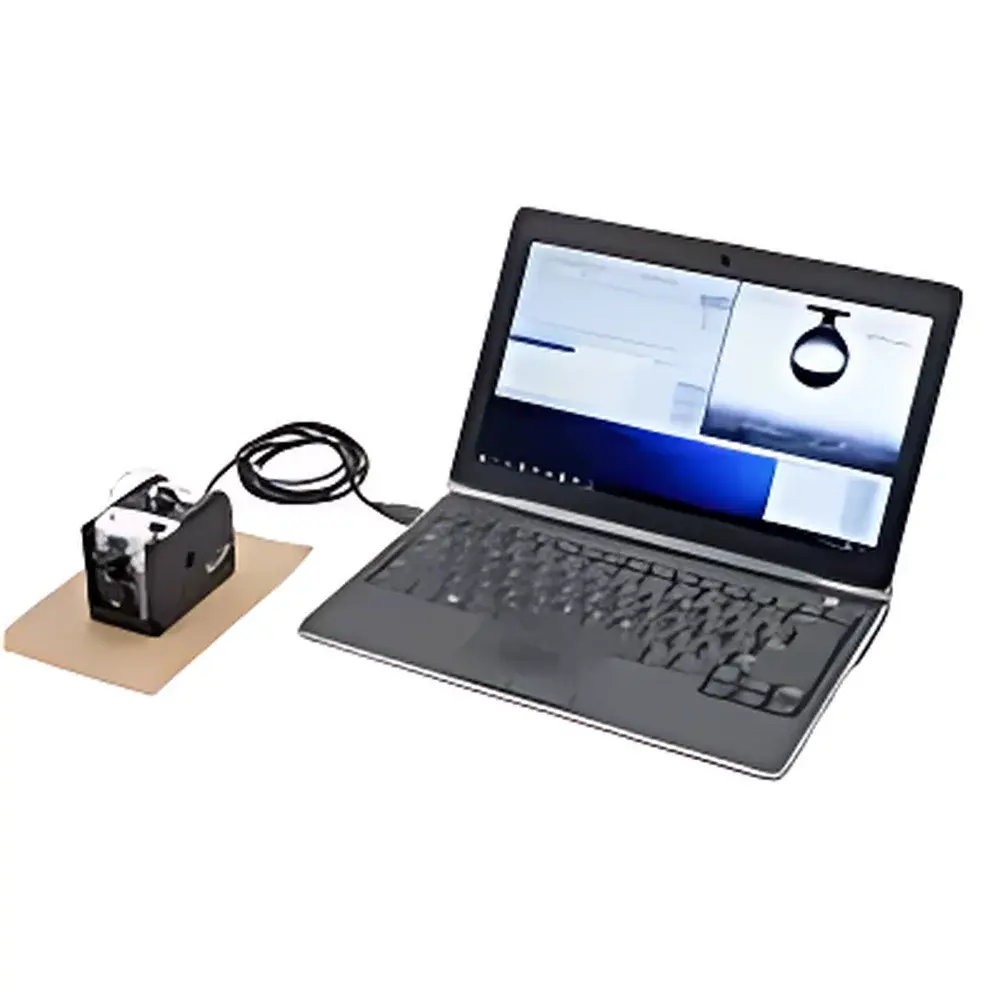
PGX+ Portable Contact Angle Goniometer by Ramé-Hart
| Origin | Guangdong, China |
|---|---|
| Manufacturer Type | Authorized Distributor |
| Origin Category | Domestic (China) |
| Model | 68-76 PGX+ |
| Quotation | Upon Request |
| Camera Resolution | 640 × 480 px |
| Frame Rate | 80 fps |
| Minimum Dispensed Volume | 0.5 µL |
| Contact Angle Range | 5°–180° |
| Accuracy | ±1° |
| Dimensions (L×W×H) | 90 × 55 × 90 mm |
| Compliance Standards | TAPPI T458, ASTM D-724, ASTM D-5946, GB/T 30447 |
Overview
The PGX+ Portable Contact Angle Goniometer is a compact, field-deployable optical tensiometer engineered for precise measurement of static and dynamic contact angles, surface energy of solids, and surface tension of liquids. Based on the sessile drop method, the instrument employs high-speed imaging and automated liquid dispensing to quantify interfacial interactions at the solid–liquid–air boundary. Its core architecture integrates a micro-volume syringe pump capable of reproducibly delivering droplets as small as 0.5 µL, coupled with an onboard 640 × 480 pixel CMOS camera operating at 80 frames per second. This enables robust time-resolved analysis of wetting kinetics—including advancing/receding contact angles, spreading dynamics, adsorption rate, and diffusion behavior—without requiring external optics or vibration-isolated tables. Designed for laboratory portability and on-site quality verification, the entire system—including calibration tools, spare tubing, dosing needle, and user manual—is housed in a rugged, airline-compliant carry case.
Key Features
- Integrated micro-pump dispensing system with sub-microliter precision (0.5 µL minimum volume), eliminating reliance on manual syringes or external pumps
- Onboard high-speed imaging (80 fps) at VGA resolution (640 × 480 px), enabling accurate frame-by-frame tracking of droplet evolution over time
- Dual operational modes: fully automated static contact angle measurement and dynamic mode for advancing/receding angle acquisition via continuous dispensing or withdrawal
- USB-powered plug-and-play interface compatible with Windows XP through Windows 10 (both 32-bit and 64-bit OS architectures)
- Self-contained hardware design—no additional frame grabbers, lenses, or PC-side drivers required beyond standard USB mass storage class support
- Compact footprint (90 × 55 × 90 mm) and integrated battery-free operation (powered via USB bus or optional external 5 V DC supply)
Sample Compatibility & Compliance
The PGX+ supports a broad range of solid substrates including polymers, metals, ceramics, coated papers, textiles, and thin films—provided surfaces are optically accessible and non-reflective enough for reliable edge detection. Liquid compatibility spans aqueous solutions, organic solvents, surfactant formulations, and low-viscosity oils. All measurements adhere to internationally recognized test protocols: TAPPI T458 (contact angle on paper and board), ASTM D-724 (surface wettability of paper), ASTM D-5946 (plasma-treated film surface energy), and GB/T 30447 (determination of contact angle for solid surfaces). The device’s ±1° angular accuracy and 5°–180° measurable range satisfy routine QC requirements under ISO/IEC 17025-accredited environments when used with traceable calibration standards.
Software & Data Management
The PGX+ is operated exclusively via the proprietary PGX+ software suite, which provides real-time image capture, automated droplet contour fitting using tangent and ellipse-based algorithms, and batch processing for multi-sample workflows. Surface energy calculations employ Owens–Wendt, Fowkes, Wu, and van Oss–Chaudhury–Good models, while surface tension determination uses the pendant drop method (via optional add-on module) or comparative calibration against reference liquids. All raw images, processed data, metadata (timestamp, operator ID, environmental notes), and exportable reports (PDF, CSV, Excel) are stored locally with full version control. Though not natively 21 CFR Part 11 compliant, the software supports audit trail logging and user-defined password protection—enabling alignment with GLP/GMP documentation practices when deployed within validated lab information management systems (LIMS).
Applications
- Quality control of plasma-, corona-, or flame-treated polymer films and foils in packaging and automotive industries
- Surface heterogeneity mapping of printed circuit board (PCB) substrates prior to solder mask application
- Characterization of hydrophobic/hydrophilic coatings on medical devices and surgical textiles
- Development and screening of anti-fouling or self-cleaning surfaces for architectural glass and solar panels
- Evaluation of inkjet printability and substrate absorbency in digital printing R&D
- Academic research in colloid and interface science, including surfactant adsorption kinetics and nanomaterial wettability
FAQ
Is the PGX+ suitable for measuring contact angles on rough or porous surfaces?
Yes—when combined with appropriate image preprocessing (e.g., background subtraction and edge enhancement), the system can reliably measure apparent contact angles on moderately rough or fibrous substrates such as filter papers or nonwovens, though intrinsic (Young’s) angle estimation requires complementary techniques like Wenzel or Cassie–Baxter modeling.
Does the system require regular recalibration?
A single geometric calibration using the included stainless-steel reference goniometer stage is performed during initial setup; no routine recalibration is needed unless mechanical impact or thermal shock occurs. Annual verification with certified angle standards is recommended for ISO/IEC 17025 compliance.
Can the PGX+ be used in regulated pharmaceutical manufacturing environments?
While the hardware and software do not ship with pre-validated IQ/OQ documentation, the platform has been successfully integrated into FDA-regulated settings where users perform internal validation per their SOPs—particularly for surface cleanliness verification of stainless-steel process equipment.
What is the typical lifetime of the integrated micro-pump tubing?
With proper maintenance (flushing after solvent use and replacement every 6–12 months under daily operation), the fluoropolymer tubing maintains volumetric consistency and leak-free performance across >10,000 dispense cycles.



