
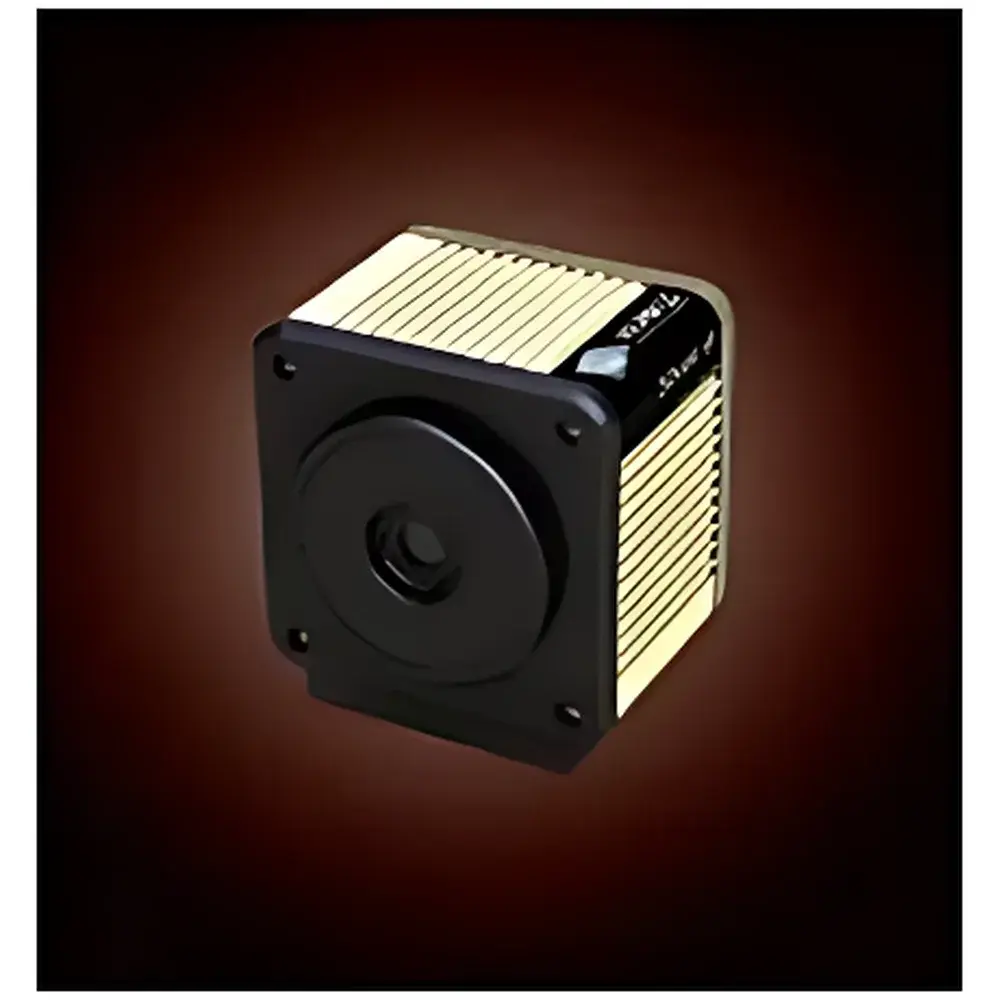
Phasics SID4 UV-HR High-Resolution Wavefront Sensor
| Brand | Phasics |
|---|---|
| Origin | France |
| Model | SID4 UV-HR |
| Wavelength Range | 190–400 nm |
| Aperture Size | 8.0 × 8.0 mm² |
| Spatial Resolution | 32 µm |
| Sampling Grid | 250 × 250 points |
| Phase Sensitivity (RMS) | 0.5 nm |
| Precision (RMS) | 10 nm |
| Frame Rate | >30 fps |
| Real-Time Processing Frequency | 1 fps |
| Dimensions (W×H×L) | 95 × 105 × 84 mm |
| Weight | 900 g |
Overview
The Phasics SID4 UV-HR is a high-resolution, quantitative wavefront sensor engineered for precise optical metrology in the deep ultraviolet (DUV) spectral range. Leveraging Phasics’ proprietary quadriwave lateral shearing interferometry (QLSI) — a non-scanning, single-shot phase retrieval technique — the instrument delivers direct, absolute wavefront measurements without reliance on iterative reconstruction or reference beams. Operating across 190–400 nm, it is uniquely suited for characterizing optics and optical systems used in semiconductor lithography, excimer laser applications, synchrotron beamlines, and UV-grade optical component certification. Unlike conventional Shack–Hartmann sensors, QLSI provides full-field, high-dynamic-range phase maps with intrinsic immunity to vibration and thermal drift, making it ideal for cleanroom-integrated metrology and in-situ alignment of UV optical trains.
Key Features
- Single-shot, real-time wavefront acquisition at >30 fps — enabling dynamic monitoring of UV laser beam evolution and thermal lensing effects
- 250 × 250 spatial sampling grid over an 8.0 × 8.0 mm² clear aperture — delivering diffraction-limited resolution down to 32 µm per pixel
- Sub-nanometer phase sensitivity (0.5 nm RMS) and 10 nm RMS repeatability — validated per ISO 10110-5 and ISO 21254 standards for surface quality and wavefront error quantification
- Monolithic, solid-state optical head with no moving parts — ensuring long-term stability and suitability for integration into vacuum-compatible or UHV environments (optional mounting flanges available)
- Native compatibility with UV-transmissive optics: fused silica windows, MgF₂-coated sensors, and DUV-optimized microlens arrays
- Compact form factor (95 × 105 × 84 mm, 900 g) — designed for integration into confined optical setups, including stepper illumination columns and EUV mask inspection stations
Sample Compatibility & Compliance
The SID4 UV-HR supports direct, non-contact measurement of reflective and transmissive optical surfaces — including photomasks, lithographic lenses, CaF₂ prisms, fused silica windows, and aspheric UV mirrors. Its 190–400 nm spectral response covers key industrial UV lines: ArF (193 nm), KrF (248 nm), and i-line (365 nm). The sensor complies with ISO 10110-5 (surface irregularity), ISO 14999-2 (interferometric testing of optical components), and ASTM E2750 (standard practice for wavefront sensing in laser systems). Data traceability meets GLP/GMP documentation requirements when paired with optional audit-trail-enabled software modules compliant with FDA 21 CFR Part 11.
Software & Data Management
Controlled via the Phasics WaveView™ software suite (Windows/Linux), the SID4 UV-HR provides native support for Zernike decomposition (up to 36 terms), PV/RMS wavefront error reporting, MTF/PSF simulation export, and ISO-compliant surface error mapping. Raw phase data is output in HDF5 and TIFF formats with embedded metadata (wavelength, exposure time, calibration timestamp). API access (C/C++, Python, MATLAB) enables integration into automated test benches and factory-floor SPC workflows. Optional WaveView-QA module adds automated pass/fail reporting against user-defined tolerances, statistical process control charts, and PDF report generation with digital signature support.
Applications
- Wavefront characterization of ArF and KrF excimer laser beams in lithography steppers and scanners
- In-process verification of UV optical coatings and anti-reflective layer uniformity
- Surface flatness and figure error assessment of CaF₂ and fused silica substrates (e.g., photomask blanks, projection optics elements)
- Alignment and aberration diagnosis of UV microscope objectives and beam delivery systems
- Development and validation of EUV-related metrology tools requiring DUV reference calibration
- Research in ultrafast UV pulse front tilt and spatio-temporal coupling analysis
FAQ
Is the SID4 UV-HR compatible with vacuum environments?
Yes — the optical head can be configured with CF-35 or KF-40 vacuum feedthroughs; standard operation pressure range extends from atmospheric to 10⁻⁶ mbar.
Does it require external calibration with a reference optic?
No — QLSI is self-referencing and factory-calibrated using NIST-traceable UV sources; periodic verification only requires a stable broadband DUV source.
Can it measure highly divergent or focused UV beams?
Yes — with optional relay optics or beam expanders, the system accommodates f/2 to f/20 input beams; telecentric adapters are available for collimated-only configurations.
What is the minimum measurable wavefront gradient?
The sensor resolves gradients down to 0.05 waves/mm (λ = 193 nm), sufficient for detecting sub-micron surface slope errors in precision optics.
Is real-time closed-loop correction possible?
Yes — via WaveView’s low-latency API (<5 ms round-trip latency), the sensor interfaces directly with deformable mirrors and piezo stages for adaptive optics feedback loops.




