
Phenom ChemiPhase Phase Identification & Quantification Software for Metal and Mineral Research
| Brand | Phenom |
|---|---|
| Origin | Netherlands |
| Model | ChemiPhase |
| Type | SEM-EDS Statistical Phase Analysis Software |
| Compliance | Designed for ASTM E1508, ISO 16700, and USP <1058> analytical instrument qualification frameworks |
Overview
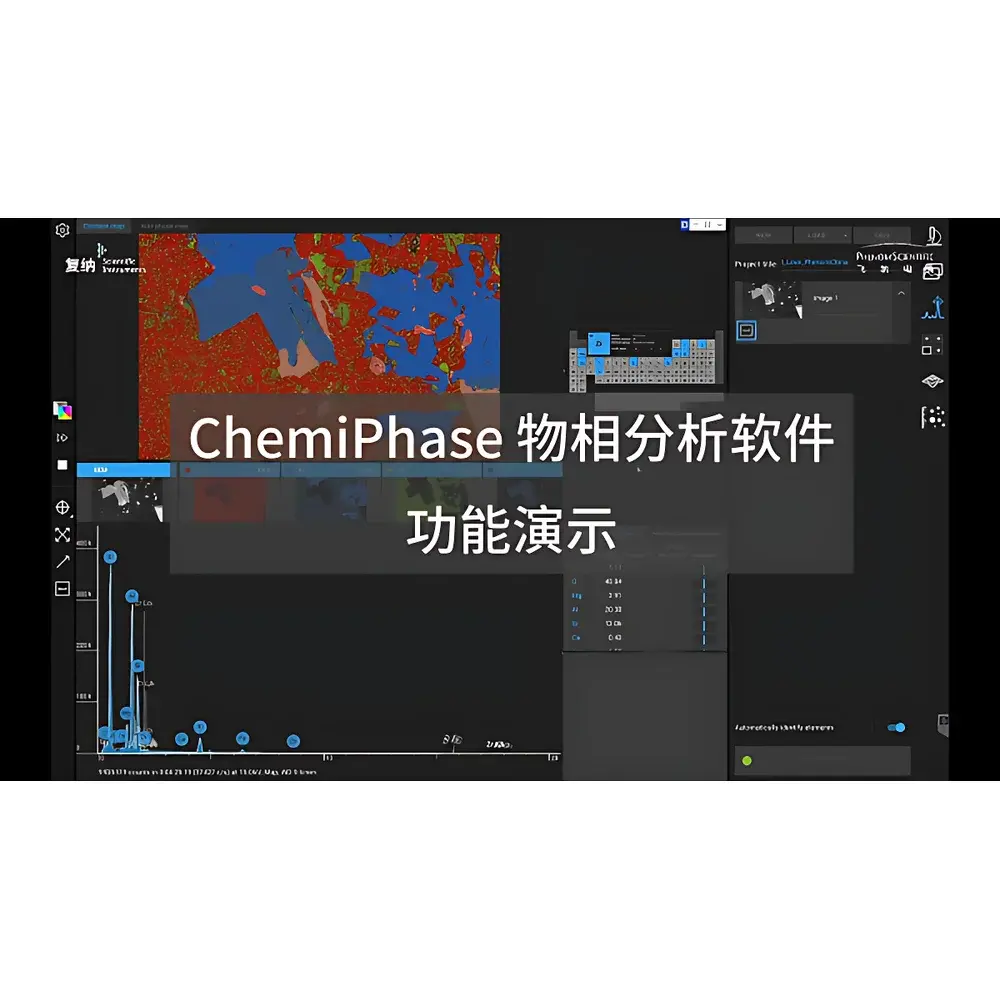
Phenom ChemiPhase is a statistically driven phase identification and quantification software module engineered exclusively for integration with the Phenom ChemiSEM platform—a benchtop scanning electron microscope (SEM) equipped with energy-dispersive X-ray spectroscopy (EDS). Unlike conventional EDS-based phase mapping that relies on manual thresholding or empirical elemental correlations, ChemiPhase applies multivariate statistical analysis to high-resolution, pixel-by-pixel EDS spectral datasets. It operates on the principle of probabilistic clustering: by modeling spectral variance across thousands of acquisition points, it identifies chemically distinct phases—regardless of atomic number proximity—and assigns each pixel a statistically validated probability of belonging to a specific phase. This approach overcomes fundamental limitations of backscattered electron (BSE) imaging contrast—especially in multi-component alloys (e.g., Ni–Cr–Fe–Mo systems) or fine-grained mineral assemblages (e.g., silicate–oxide–sulfide mixtures)—where compositional similarity leads to low BSE contrast and ambiguous phase boundaries.
Key Features
- Sub-minute automated phase identification: Completes full-field statistical clustering on typical metallographic or polished mineral sections in under 60 seconds, without user-defined region-of-interest selection.
- Element-agnostic initialization: Does not require prior elemental assignment; detects all detectable elements from raw EDS spectra—including trace constituents below 0.1 wt%—and incorporates them into phase modeling.
- Pixel-level phase attribution: Delivers quantitative area fraction data with single-pixel spatial resolution (down to 10 nm effective step size), enabling precise grain boundary analysis and inclusion statistics.
- Robust handling of spectral overlap: Uses principal component analysis (PCA) and non-negative matrix factorization (NMF) to deconvolve overlapping X-ray peaks (e.g., S Kα / Pb Mα, Ti Kβ / Ca Kα), ensuring accurate phase discrimination even when peak separation is insufficient for traditional peak-fit methods.
- Low-count resilience: Validated for reliable phase classification using as few as 10 X-ray counts per pixel—critical for beam-sensitive samples or rapid survey scans where dwell time is constrained.
- Reproducible output: Eliminates operator-dependent interpretation bias; identical input datasets yield identical phase maps across laboratories and users, supporting GLP/GMP-compliant workflows.
Sample Compatibility & Compliance
ChemiPhase is optimized for conductive and semi-conductive solid samples prepared via standard metallographic polishing or geological thin-sectioning protocols. It supports carbon-, chromium-, or gold-coated specimens without requiring charge compensation adjustments during acquisition. The software complies with analytical data integrity requirements outlined in FDA 21 CFR Part 11 (when deployed on validated Phenom ChemiSEM systems with audit-trail-enabled firmware), and its statistical methodology aligns with ASTM E1508 (Standard Guide for Quantitative Analysis by Energy Dispersive Spectroscopy) and ISO 16700 (Microbeam Analysis — Electron Probe Microanalysis — Guidelines for Quantitative Analysis). All phase identification reports include metadata logs detailing acquisition parameters, detector calibration status, and statistical confidence intervals per phase cluster.
Software & Data Management
ChemiPhase operates natively within the Phenom ChemiSEM software suite (v3.5+), leveraging its embedded Linux-based real-time acquisition engine. Processed results export in standardized formats: phase maps as 16-bit TIFF with embedded LUT metadata, quantitative tables as CSV/Excel-compatible files, and full spectral datasets in .SPC or .EMS formats for third-party validation. Audit trails record all processing steps—including PCA component selection, cluster initialization method, and convergence thresholds—with timestamped user authentication. For enterprise deployment, ChemiPhase supports network licensing and centralized configuration management via Phenom’s LabManager™ server interface, enabling version-controlled method templates across multiple instruments in QC labs or academic core facilities.
Applications
- Metallurgical failure analysis: Identification and volumetric quantification of intermetallics (e.g., Laves, sigma, or η phases) in stainless steels, superalloys, and aluminum weld zones.
- Mineralogical process optimization: Discrimination of economically relevant phases (e.g., hematite vs. goethite, chalcopyrite vs. bornite) in ore concentrates and tailings streams.
- Corrosion product characterization: Mapping of layered oxide/hydroxide phases (e.g., magnetite/maghemite ratios) on pipeline steels or nuclear fuel cladding.
- Recycled material verification: Detection of residual alloying elements (e.g., Sn, Sb, Bi) in secondary aluminum feeds and their association with brittle intermetallic networks.
- Geochronology support: Phase-specific U–Th–Pb signal isolation in zircon–monazite–xenotime assemblages for LA-ICP-MS target selection.
FAQ
Does ChemiPhase require prior knowledge of expected phases or elements?
No. It performs unsupervised clustering directly from acquired EDS spectra without pre-defined phase libraries or elemental constraints.
Can ChemiPhase distinguish phases with identical major elements but different stoichiometries?
Yes—provided sufficient spectral differentiation exists (e.g., FeO vs. Fe₂O₃ via O/Fe ratio variance), which ChemiPhase detects through multivariate spectral residuals.
Is offline processing supported?
Yes. Raw .SPC datasets can be exported and reprocessed on separate workstations using the standalone ChemiPhase Analysis Module (sold separately).
How does ChemiPhase handle beam-sensitive samples?
By enabling low-dose acquisition modes (e.g., 5 kV, 0.5 nA) and leveraging its high-sensitivity statistical engine, it achieves robust phase separation even with reduced X-ray counts per pixel.
What validation documentation is provided for regulated environments?
Phenom supplies IQ/OQ protocols, software verification reports per ASTM E2915, and a traceable calibration certificate for the integrated EDS detector—fully compatible with laboratory quality management systems.




