
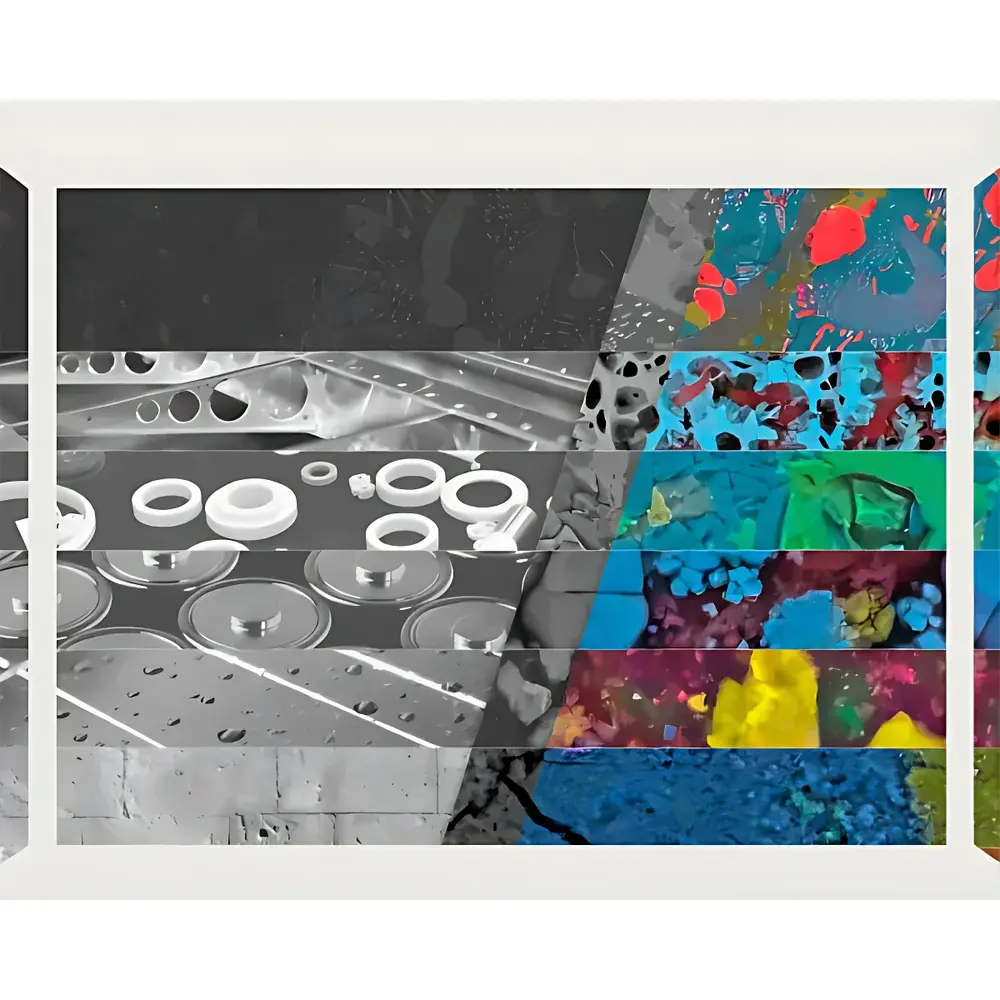
Phenom ChemiSEM Real-Time Elemental Mapping System
| Brand | Phenom |
|---|---|
| Origin | Netherlands |
| Model | ChemiSEM |
| Type | Integrated SEM-EDS Real-Time Quantitative Mapping Solution |
| Compliance | CE, ISO 9001 (Manufacturer), GLP-Compatible Data Acquisition |
Overview
The Phenom ChemiSEM Real-Time Elemental Mapping System is an integrated scanning electron microscopy (SEM) platform engineered for concurrent high-fidelity morphological imaging and quantitative energy-dispersive X-ray spectroscopy (EDS) analysis. Unlike conventional SEM-EDS workflows requiring sequential acquisition and post-hoc spectral deconvolution, ChemiSEM employs synchronized signal acquisition—simultaneously capturing backscattered electron (BSE) topography and characteristic X-ray photons at pixel level—enabling real-time overlay of quantitatively resolved elemental distribution maps onto live SEM images. This architecture eliminates temporal decoupling between structure and composition, significantly reducing analytical latency in failure analysis (FA), quality control (QC), and materials development. The system operates on a robust desktop SEM platform with optimized electron optics and a high-efficiency silicon drift detector (SDD), supporting routine analysis of conductive and non-conductive samples—including metals, ceramics, battery cathodes/anodes, thin-film coatings, cementitious matrices, and hydrated soft matter—without mandatory metal coating.
Key Features
- Real-Time Quantitative EDS Mapping: Proprietary spectral processing engine performs on-the-fly peak deconvolution, background subtraction, and matrix correction using fundamental parameter (FP) algorithms—delivering pixel-by-pixel quantitative elemental concentrations (wt% or at%) during acquisition.
- ChemiPhase™ Unsupervised Phase Identification: A data-driven clustering algorithm that autonomously segments spectra across the entire map without user-defined element constraints; identifies distinct phases based on full-spectrum similarity, enabling unbiased mineralogical classification (e.g., in geological thin sections) or multi-phase alloy characterization.
- Integrated Drift Compensation: Continuous positional tracking via cross-correlation of successive BSE frames enables dynamic geometric correction of EDS pixel coordinates during long-duration acquisitions (>30 min), preserving spatial fidelity at magnifications up to 100,000×.
- Simultaneous BSE/EDS Signal Fusion: Hardware-synchronized acquisition ensures strict spatial registration between topographic contrast and elemental signals—eliminating misregistration artifacts common in sequential mapping modes.
- Automated Spectral Deconvolution: Advanced iterative fitting handles overlapping peaks (e.g., S Kα/Pb Mα, Ti Kβ/V Kα) and low-intensity lines (e.g., trace O, C, F in oxides), minimizing false positives and improving detection limits for minor and trace constituents.
Sample Compatibility & Compliance
ChemiSEM supports direct analysis of diverse sample types: polished metallographic mounts, fractured battery electrodes, sputter-coated polymers, uncoated geological specimens, and environmental particulates. Non-conductive samples are analyzed under low-vacuum or charge-compensation mode without degradation of EDS performance. All data acquisition, processing, and reporting modules comply with GLP principles: full audit trail (user, timestamp, instrument parameters, calibration history), electronic signature support, and raw spectrum archiving in standard .emsa or .eds formats. While not FDA 21 CFR Part 11 certified out-of-the-box, the software architecture supports validation protocols required for regulated QC environments (e.g., ISO/IEC 17025 laboratories).
Software & Data Management
The Phenom Desktop Software Suite (v6.x+) provides a unified interface for acquisition, real-time visualization, and offline refinement. Maps are stored as multi-layer TIFFs with embedded metadata (accelerating voltage, working distance, dwell time, detector solid angle). Batch processing supports automated report generation (PDF/HTML) with customizable templates compliant with ASTM E1508 and ISO 16574 standards for quantitative microanalysis. Raw spectra and processed maps export to third-party tools (e.g., Thermo Avizo, Oxford AZtec) via standardized formats. Data integrity is enforced through write-once archive folders and SHA-256 checksum verification upon export.
Applications
- Failure analysis of solder joint voids, intermetallic growth, or delamination in PCB assemblies
- Quantitative phase fraction analysis in sintered ceramics and refractory composites
- Mapping Li/Ni/Mn/Co distribution gradients in NMC cathode particles
- Identifying contaminant sources (e.g., Al/Si/Ca-rich particles) in pharmaceutical excipients
- Mineral phase discrimination in petrographic thin sections without prior knowledge of expected chemistry
- Corrosion product layer characterization (e.g., Cr-depleted zones in stainless steels)
FAQ
Does ChemiSEM require external EDS hardware integration?
No—ChemiSEM is a fully integrated solution: the SDD detector, pulse processor, and spectral processing engine are factory-aligned and calibrated as a single subsystem.
Can ChemiSEM perform point-and-shoot quantitative analysis?
Yes—standard spot analysis with ZAF or φ(ρz) matrix corrections is available alongside mapping; all quantification adheres to IUPAC-recommended standards for EDS metrology.
Is spectral library matching supported?
While ChemiSEM prioritizes first-principles quantification, optional reference-based identification (using NIST SRM libraries) is available for rapid phase screening.
What vacuum requirements apply for non-conductive samples?
The system operates in variable-pressure mode (10–200 Pa) using water vapor or nitrogen gas, eliminating charging artifacts without carbon coating.
How is data reproducibility ensured across operators?
Standardized acquisition templates, automated calibration routines (including dead-time correction and gain stabilization), and locked instrument parameter sets enforce method consistency per ISO 13528 guidelines.





