
PHL Ultra-Large-Area WPA Residual Stress Analyzer
| Brand | Photonic Lattice |
|---|---|
| Origin | Japan |
| Model | Ultra-Large-Area WPA |
| Wavelengths | 523 nm, 543 nm, 575 nm |
| Retardation Measurement Range | up to 3500 nm |
| Optical Configuration | Custom-engineered wide-aperture circular polarized light source + wide-angle polarization-sensitive area sensor |
| Application Focus | In-line and lab-based birefringence/residual stress assessment of automotive laminated glass, architectural glazing, and large-format optical substrates |
Overview
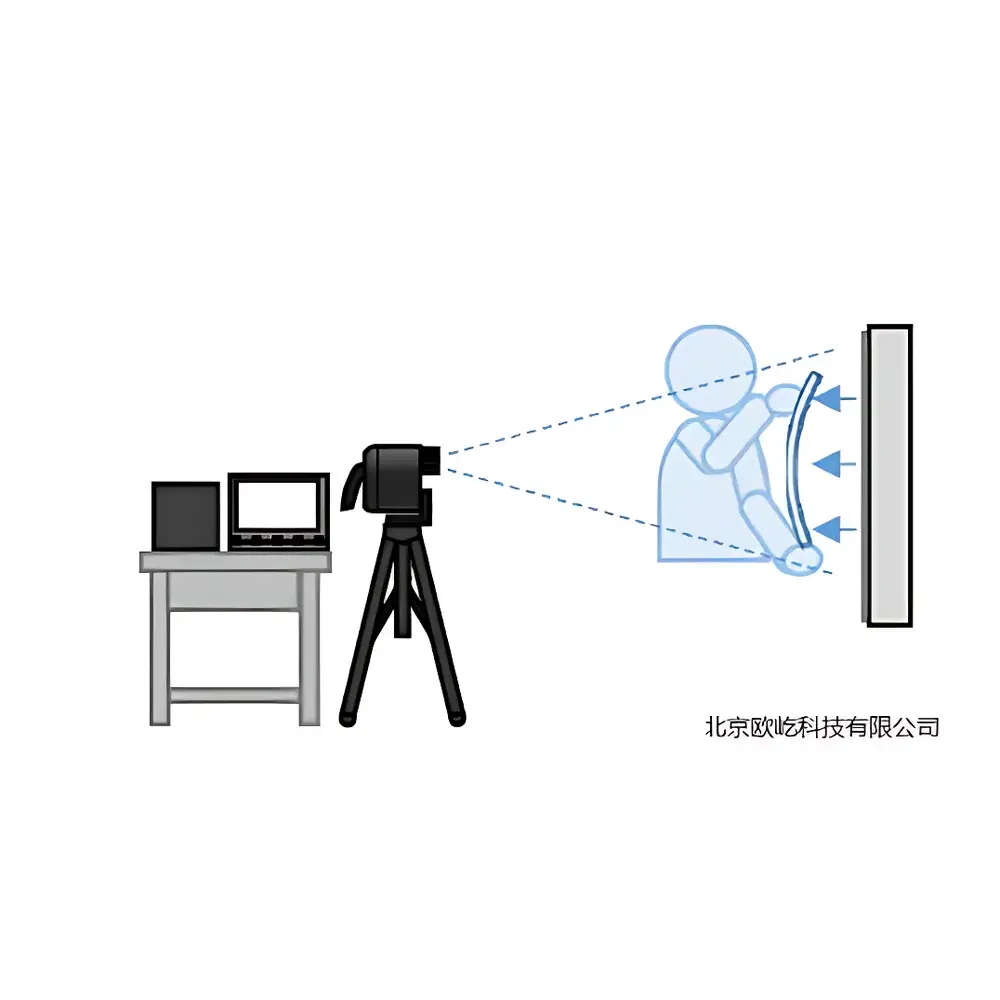
The PHL Ultra-Large-Area WPA Residual Stress Analyzer is a purpose-built optical measurement system engineered for quantitative, non-contact evaluation of birefringence and residual stress in large-format transparent materials—particularly automotive windshields, panoramic roofs, and architectural laminated glass panels exceeding 2,000 mm × 1,500 mm. Unlike conventional tabletop polariscopes or scanning-based retardation analyzers, the WPA employs a static, full-field acquisition architecture grounded in photoelasticity principles and wavelength-resolved Stokes polarimetry. It operates by illuminating the entire sample surface simultaneously with a custom-designed, uniform circularly polarized light field generated via high-stability laser diodes at three discrete wavelengths (523 nm, 543 nm, and 575 nm), enabling robust spectral deconvolution of stress-induced phase retardation even under variable thermal or mechanical loading conditions. The system delivers spatially resolved retardation maps with sub-nanometer sensitivity and micron-level lateral resolution across the full aperture—without mechanical scanning, stage movement, or time-consuming point-by-point rastering.
Key Features
- Full-field, single-shot acquisition using a wide-angle polarization-sensitive CMOS area sensor—eliminates motion artifacts and reduces measurement cycle time to under 3 seconds per panel.
- Triple-wavelength illumination (523 nm, 543 nm, 575 nm) supports dispersion-corrected retardation calculation and improves accuracy for multi-layered or thermally tempered glass structures.
- Retardation measurement range extends to ±3500 nm, covering both low-stress float glass (2000 nm).
- Modular optical head design allows customization of illumination aperture diameter (up to 2.4 m), beam uniformity (±1.5% RMS), and working distance (500–2000 mm) to match production line integration requirements.
- Thermally stabilized optical path and active polarization calibration ensure long-term repeatability (<0.8 nm 2σ over 8 hours) under factory ambient conditions (20–28 °C, 40–60% RH).
Sample Compatibility & Compliance
The WPA analyzer is validated for use with soda-lime-silica, borosilicate, aluminosilicate, and laminated polymer-glass composites commonly employed in Tier-1 automotive glazing. It accommodates curved surfaces with radii down to 500 mm (RMS deviation < 0.3 µm after geometric correction). All optical components comply with IEC 61000-6-2/6-4 for industrial electromagnetic compatibility. Data acquisition and reporting workflows support audit-ready documentation aligned with ISO 9001:2015 clause 8.5.2 (Identification and traceability) and ISO/IEC 17025:2017 clause 7.7 (Ensuring validity of results). Optional configuration includes GLP-compliant electronic signatures and 21 CFR Part 11–enabled audit trails via integrated software modules.
Software & Data Management
The proprietary WPA Control Suite v4.2 provides real-time visualization of retardation magnitude, fast-axis orientation, and stress tensor decomposition (via stress-optic coefficient mapping). Raw Stokes vector data is stored in HDF5 format with embedded metadata (wavelength, exposure time, sensor temperature, calibration timestamp). Batch analysis tools enable comparative evaluation across production lots, including statistical process control (SPC) charting (X̄–R, Cpk), defect clustering algorithms, and automated pass/fail thresholding per ASTM C148–22 Annex A1 (Standard Test Method for Photoelastic Determination of Residual Stress in Glass). Export options include CSV, TIFF (16-bit), and PDF reports compliant with internal QA templates.
Applications
- Residual stress profiling of automotive laminated windshields during tempering and lamination process validation.
- In-line quality gate inspection for OEM glazing suppliers to detect edge compression anomalies, interlayer delamination precursors, and thermal gradient-induced stress bands.
- R&D characterization of new glass compositions, anti-reflective coatings, and HUD-integrated substrates where localized birefringence impacts optical wavefront fidelity.
- Failure analysis of spontaneous glass breakage incidents via retrospective stress map reconstruction from archived samples.
- Calibration traceability for secondary standards used in accredited metrology labs performing EN 12150-1 and JIS R 3222–1 conformance testing.
FAQ
What is the maximum usable sample size supported by the standard WPA configuration?
Standard configurations accommodate panels up to 2400 mm × 1600 mm; custom optical heads are available for widths up to 3200 mm.
Does the system require external environmental control?
No—integrated thermal management and drift-compensated calibration routines permit stable operation in uncontrolled factory environments (20–28 °C, non-condensing humidity).
Can the WPA distinguish between intrinsic (manufacturing) and extrinsic (mounting-induced) stress?
Yes—by combining multi-wavelength retardation data with finite-element modeling (FEM) templates provided in the software, users can isolate contributions from thermal history versus mechanical constraint.
Is NIST-traceable calibration available?
Yes—Photonic Lattice offers annual calibration services with certificate traceable to NIST SRM 2089a (Birefringent Quartz Plate), including uncertainty budget per GUM (JCGM 100:2018).
How is data integrity maintained during long-term deployment?
All measurements include embedded cryptographic hashes, automatic version-stamped firmware logs, and optional blockchain-anchored audit trail export for regulatory submissions.





