
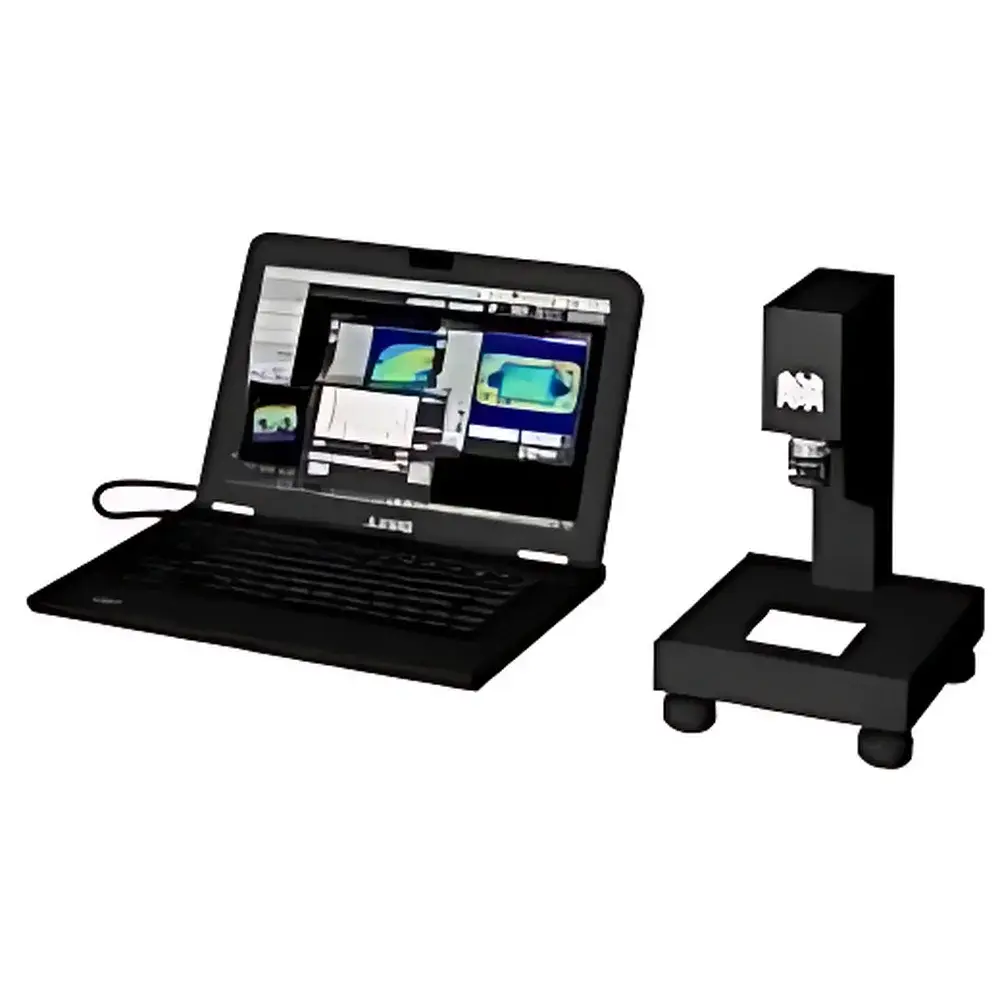
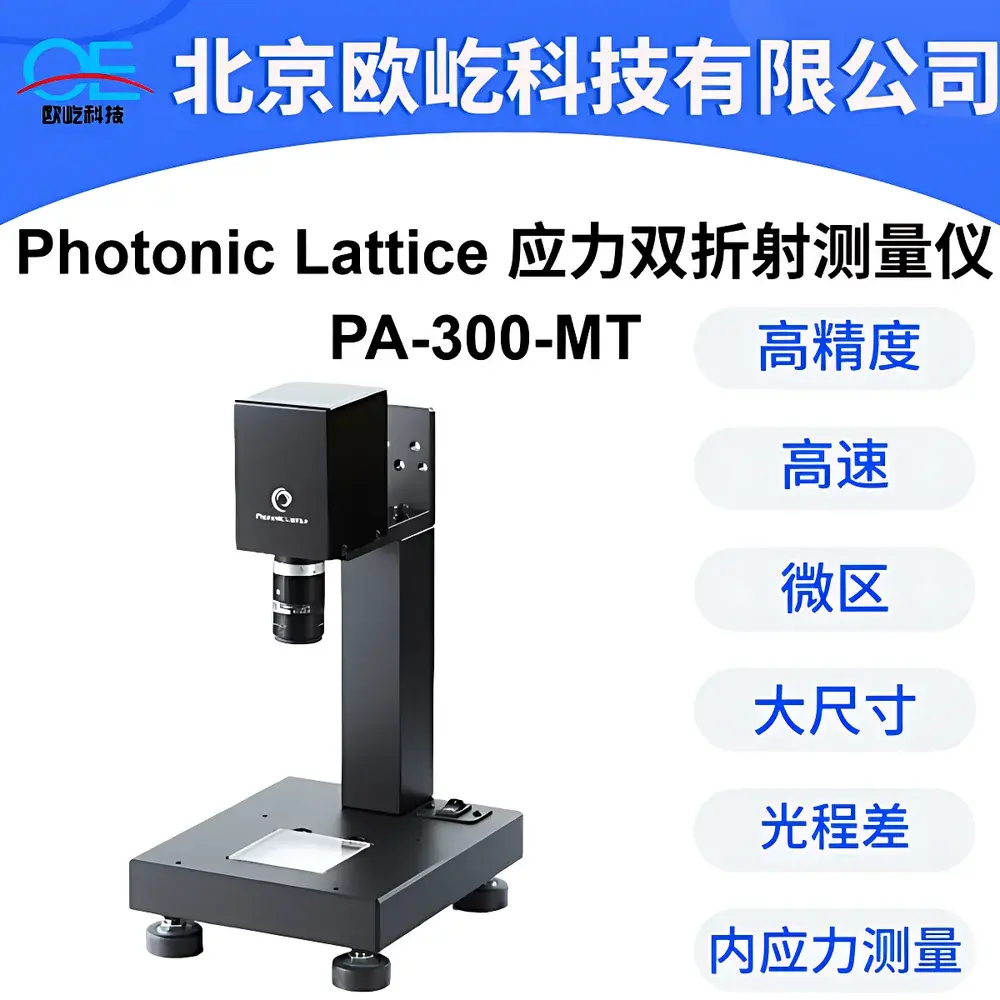
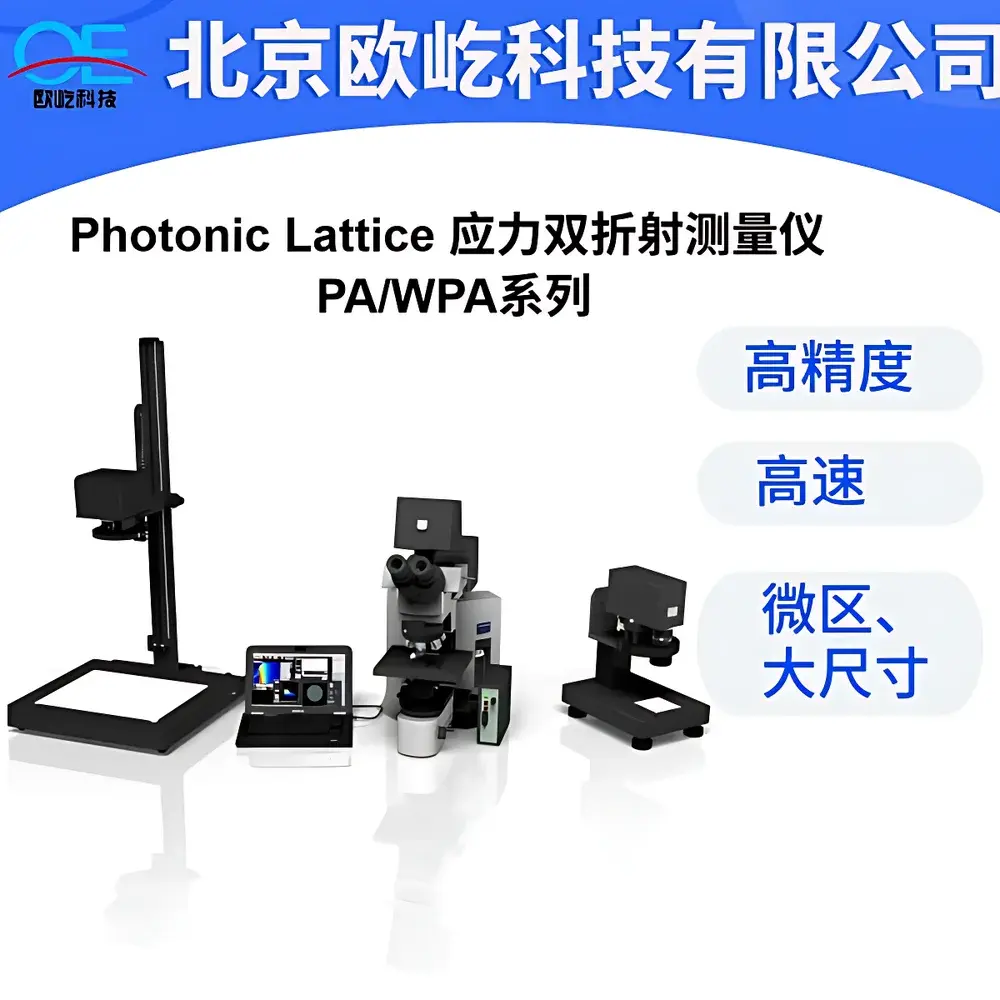
Photonic Lattice PA-300-MT Polarizing Stress Meter
| Brand | Photonic Lattice |
|---|---|
| Origin | Japan |
| Model | PA-300-MT |
| Measurement Wavelength | 520 nm |
| Birefringence Range | 0–130 nm |
| Minimum Resolution | 0.001 nm |
| Repeatability | <0.1 nm (σ) |
| Field of View (Standard) | 17.5 × 21 mm to 33 × 40 mm |
| Optional FOV | 6.3 × 7.5 mm |
| Polarization Camera Resolution | 2056 × 2464 pixels |
| Output Parameters | Retardation [nm], Slow Axis Orientation [°], Stress Conversion [MPa] (optional) |
Overview
The Photonic Lattice PA-300-MT Polarizing Stress Meter is a high-resolution, full-field birefringence imaging system engineered for quantitative residual stress evaluation in transparent and semi-transparent optical materials. Based on digital polarization camera technology and calibrated photoelastic principles, the instrument measures optical retardation (phase difference) and slow-axis orientation across the entire field of view in a single acquisition—without mechanical rotation of polarizers or wave plates. This eliminates motion-induced drift and alignment uncertainty inherent in scanning or rotating-element systems. Operating at a stabilized 520 nm LED illumination wavelength, the PA-300-MT delivers traceable, non-contact, and non-destructive assessment of internal stress distribution in precision optics, molded lenses, polymer films, glass substrates, and micro-optical components. Its design conforms to foundational metrological frameworks for optical stress analysis, supporting traceability to NIST-traceable standards through factory calibration reports and documented uncertainty budgets.
Key Features
- Single-shot full-field measurement: Captures retardation and axis orientation simultaneously over the entire FOV—no motorized stage or rotatable optics required.
- High spatial resolution: 2056 × 2464-pixel polarization-sensitive CMOS sensor enables sub-micron spatial sampling when paired with optional macro lenses.
- Measurement speed: Complete acquisition and calculation in ≤3 seconds per frame—ideal for inline QA/QC or high-throughput R&D screening.
- Robust optical architecture: Solid-state polarization optics eliminate wear-prone rotating filter mechanisms, ensuring long-term stability and minimal maintenance.
- Multi-parameter output: Direct export of retardation (nm), slow-axis angle (°), and optionally stress-equivalent values (MPa) using user-defined material-specific stress-optic coefficients.
- Modular FOV configuration: Standard lens supports 17.5 × 21 mm to 33 × 40 mm fields; optional 6.3 × 7.5 mm macro lens enables high-magnification analysis of micro-lenses and small-diameter optical fibers.
Sample Compatibility & Compliance
The PA-300-MT accommodates flat, curved, or slightly tilted transparent samples up to 50 mm in thickness, including BK7, fused silica, sapphire, polycarbonate, PMMA, cyclic olefin copolymer (COC), and specialty optical glasses. Sample mounting requires no vacuum chuck or adhesive—gravity-based or low-pressure clamping suffices. The system complies with ISO 11146-1 (laser beam profiling metrology foundations), ASTM F2738 (standard practice for measuring birefringence in optical plastics), and supports documentation workflows aligned with GLP and GMP environments. Calibration certificates include uncertainty statements per ISO/IEC 17025 requirements, and raw image data retains embedded metadata (exposure time, gain, temperature, lens ID) for audit readiness.
Software & Data Management
Controlled via Windows-based Photonic Lattice Analysis Suite (PLAS), the PA-300-MT offers real-time visualization, batch processing, region-of-interest (ROI) statistics, cross-sectional line profiles, and false-color mapping with customizable LUTs. Software modules include Lens Analysis Mode (for radial symmetry correction in spherical lenses), Comparative Overlay (for pass/fail thresholding against reference parts), and External Trigger Interface (TTL-compatible) for synchronization with conveyor belts or robotic handlers. All measurement results are saved in HDF5 format with embedded metadata, enabling seamless integration into LIMS or MES platforms. Audit trail functionality records operator ID, timestamp, software version, and parameter changes—supporting compliance with FDA 21 CFR Part 11 where electronic signatures and data integrity controls are mandated.
Applications
- Residual stress mapping in injection-molded optical lenses prior to coating or assembly.
- Quality verification of tempered glass displays and cover lenses for consumer electronics.
- Process development feedback for annealing cycles in fused silica optics manufacturing.
- Failure analysis of delamination or edge fracture in bonded optical stacks.
- Material qualification of bio-compatible polymers used in ophthalmic devices and endoscopic optics.
- Research-grade birefringence characterization in chiral metamaterials and liquid crystal alignment layers.
FAQ
What is the measurement principle behind the PA-300-MT?
It employs division-of-amplitude polarimetry (DOAP) using a monolithic micro-retarder array integrated directly onto the sensor surface, enabling simultaneous acquisition of four polarization states per pixel.
Can the system measure curved or aspheric surfaces?
Yes—within depth-of-field limits of the selected lens; curvature-induced phase errors are mitigated by built-in geometric distortion correction and optional Z-height compensation via external profilometer input.
Is stress conversion (nm → MPa) standardized or user-configurable?
Stress conversion is fully user-definable via input of material-specific stress-optic coefficient (C-value); default libraries include common optical glasses and thermoplastics per ISO 7884 and ASTM D4092.
Does the system support automated reporting for ISO/IEC 17025 accreditation?
Yes—PLAS generates PDF reports with embedded calibration IDs, uncertainty statements, operator logs, and digital signatures compliant with ILAC P14 guidelines.
What environmental conditions affect measurement stability?
Ambient temperature fluctuations >±1°C/hour may impact LED wavelength stability; operation within 20–25°C ±0.5°C is recommended for sub-0.1 nm repeatability.





