
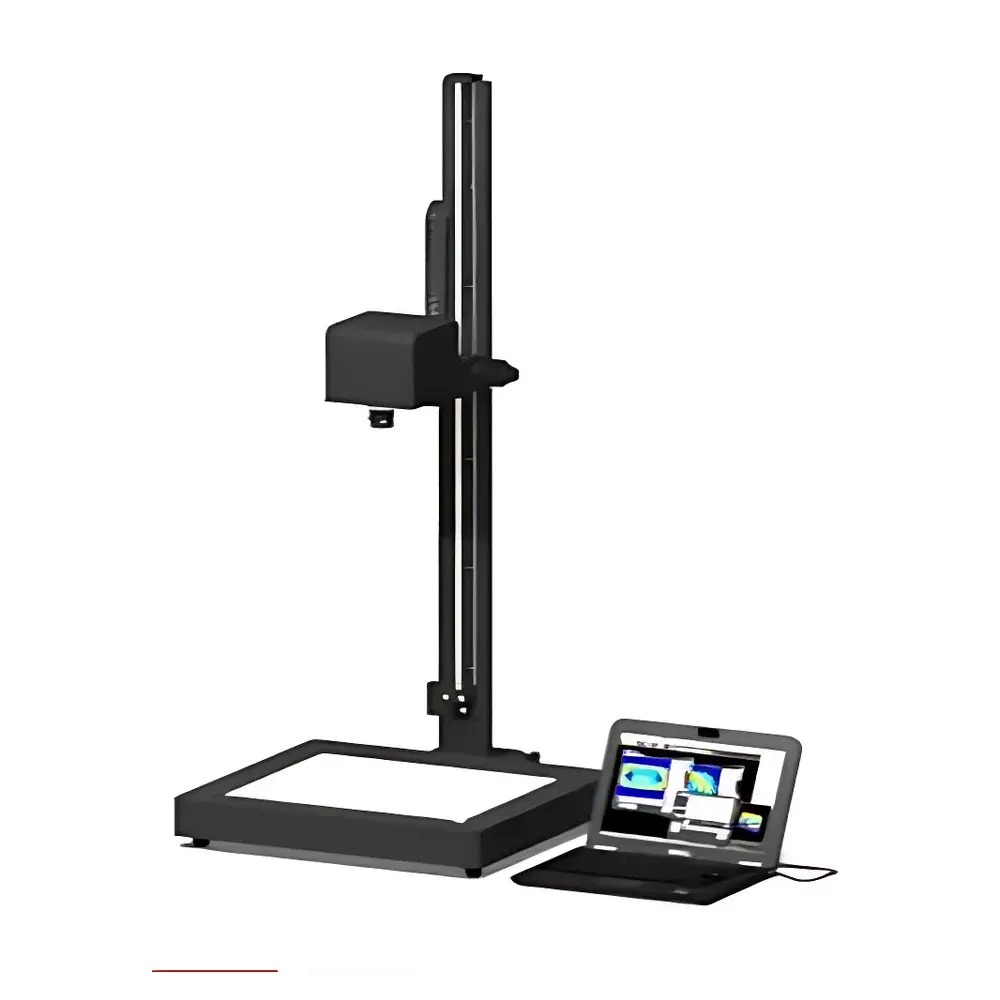
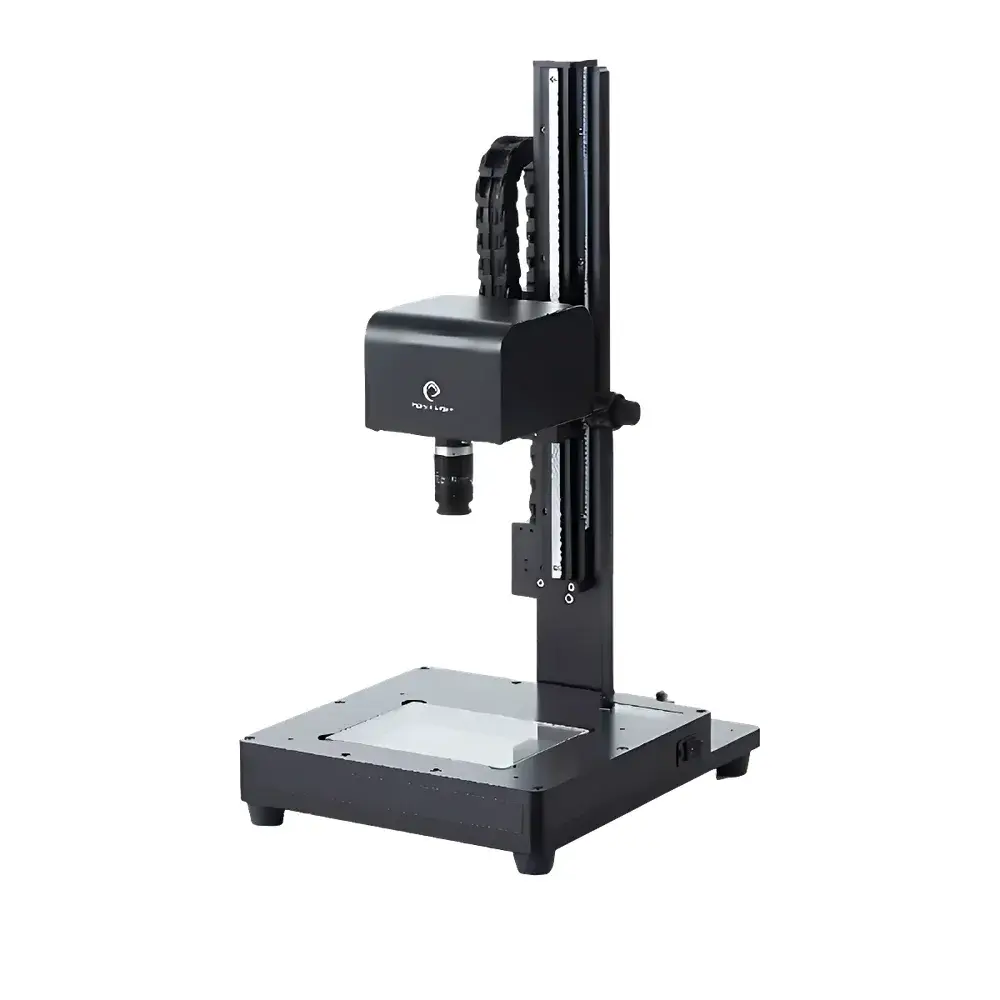
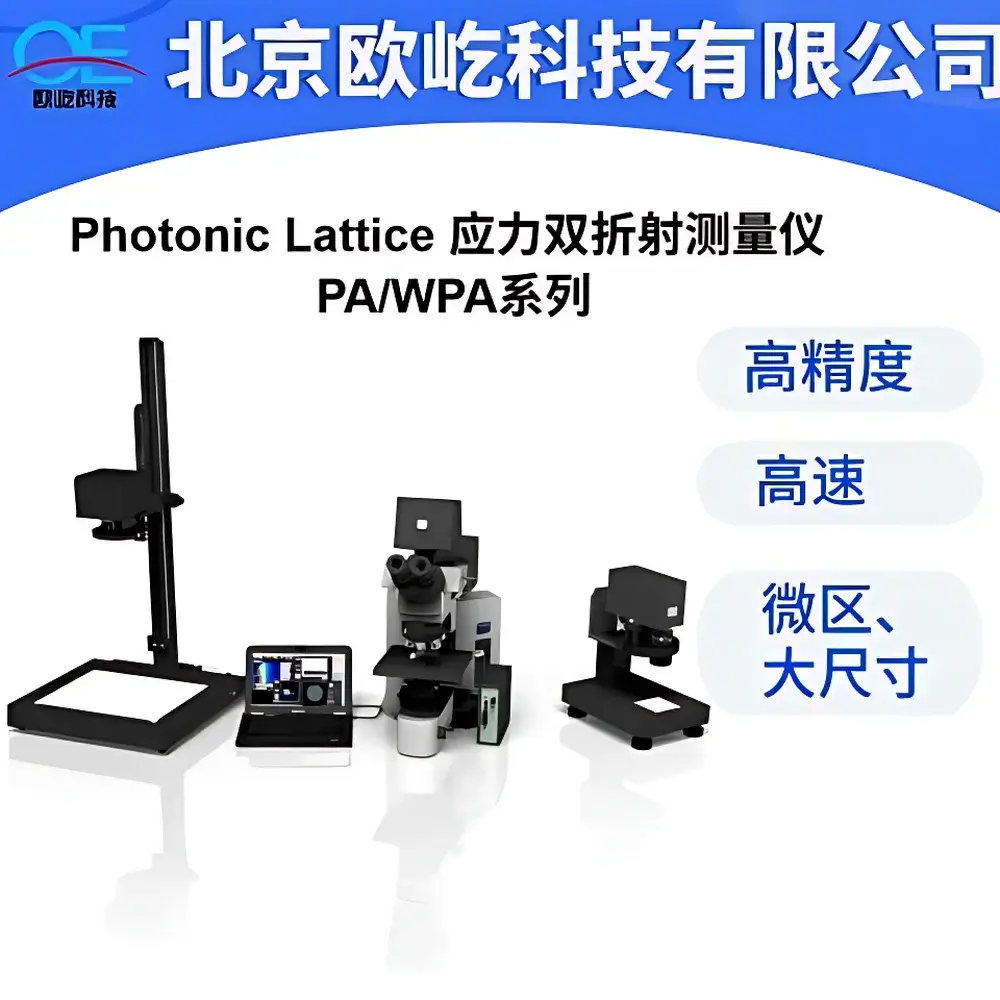
Photonic Lattice PA-300-L Photoelastic Stress Analyzer
| Brand | Photonic Lattice |
|---|---|
| Origin | Japan |
| Model | PA-300-L |
| Measurement Range | 0–130 nm |
| Wavelength | 520 nm |
| Minimum Resolution | 0.001 nm |
| Repeatability | <0.1 nm (σ) |
| Field of View (Standard) | 40×48 mm to 240×320 mm |
| Camera Resolution | 2056×2464 pixels |
| Output Parameters | Retardation (nm), Fast Axis Orientation (°), Stress Conversion (MPa, optional) |
Overview
The Photonic Lattice PA-300-L Photoelastic Stress Analyzer is a high-speed, full-field quantitative polarimetric imaging system engineered for non-contact, real-time measurement of optical retardation and fast-axis orientation in transparent and semi-transparent materials. It operates on the principle of photoelasticity—leveraging birefringence induced by internal mechanical stress—and employs a patented photonic crystal polarizer array integrated with a high-resolution monochrome polarization camera. Unlike conventional rotating-retarder or sequential-polarization systems, the PA-300-L captures all four Stokes parameters simultaneously within a single exposure, eliminating motion artifacts and enabling sub-3-second acquisition per full field. Its 520 nm LED illumination source is optimized for sensitivity to stress-induced phase shifts in optical glasses, fused silica, sapphire, silicon carbide (SiC), and chemically strengthened display substrates—including smartphone cover glass and precision lens blanks.
Key Features
- Single-shot, full-field polarization imaging using a fixed photonic crystal polarizer array—no moving parts, no motorized filter wheels, and zero mechanical wear.
- 2056 × 2464 pixel scientific CMOS sensor delivering spatially resolved retardation maps with 0.001 nm minimum resolution and <0.1 nm repeatability (σ) under controlled thermal conditions.
- Configurable field of view: standard lenses support 40×48 mm up to 240×320 mm; optional expansion optics enable high-magnification analysis down to 7×8.4 mm FOV for micro-scale defect mapping.
- Real-time calculation of retardation (nm), fast-axis angle (°), and—when calibrated—quantitative stress distribution (MPa) via built-in photoelastic coefficient libraries for common optical materials (e.g., BK7, SF11, Gorilla Glass, SiC).
- Robust architecture designed for integration into production environments: IP52-rated enclosure, passive thermal stabilization, and industrial Ethernet (GigE Vision) interface for synchronized triggering and data streaming.
Sample Compatibility & Compliance
The PA-300-L accommodates flat, curved, and laminated samples ranging from 3 mm diameter micro-lenses to A4-format (210×297 mm) glass substrates, with thicknesses from 0.1 mm to 25 mm. Sample placement requires no vacuum chuck or adhesive mounting—only stable, vibration-isolated positioning on the stage. The system complies with ISO 11146-1 (laser beam profiling standards, adapted for polarization metrology), ASTM F382-22 (standard specification for surgical implant materials, referencing birefringence limits), and supports GLP/GMP-aligned workflows through audit-trail-enabled software logging. Optional stress calibration kits include NIST-traceable reference plates certified for retardation uniformity (±0.05 nm across 25 mm aperture).
Software & Data Management
Control and analysis are performed via PA-Studio software—a Windows-based application supporting both standalone operation and automated integration via TCP/IP or LabVIEW SDK. Core modules include Real-Time Analysis Engine (for live retardation visualization), Lens Evaluation Suite (with Zernike decomposition and edge-stress gradient mapping), and Batch Comparison Tool (enabling statistical comparison of up to 100 datasets using histogram overlays, scatter plots, and delta-maps). All raw polarization images and processed results are saved in HDF5 format with embedded metadata (timestamp, exposure, lens ID, operator tag). Software supports FDA 21 CFR Part 11 compliance when deployed with network-authenticated user roles, electronic signatures, and immutable audit logs for regulated manufacturing environments.
Applications
- Quality assurance of molded optical lenses: detection of residual molding stress, asymmetry in injection paths, and thermal quenching gradients.
- In-line monitoring of chemical strengthening processes for alkali-aluminosilicate cover glass—quantifying compressive stress layer depth and magnitude via retardation-to-stress conversion.
- Failure analysis of SiC wafers and sapphire substrates: identifying crystallographic defects, wafer bow-induced birefringence, and epitaxial strain fields.
- R&D validation of anti-reflective and hard-coating durability: measuring stress evolution before/after abrasion, humidity cycling, or thermal shock testing.
- Calibration and certification of polarizing components: waveplate retardation uniformity, polarizer extinction ratio mapping, and depolarization assessment in broadband optics.
FAQ
What is the maximum sample thickness the PA-300-L can measure?
The system is optimized for transmission-mode measurement of samples between 0.1 mm and 25 mm thick. For thicker or highly scattering materials, optional near-infrared illumination modules (780 nm) may be specified to improve penetration depth.
Can the PA-300-L measure curved surfaces?
Yes—provided curvature radius exceeds 50 mm and surface roughness remains below Ra 0.05 µm. Spherical aberration correction is applied in software using user-defined radius-of-curvature input.
Is stress conversion included as standard or optional?
Stress conversion (MPa) is an optional software module requiring material-specific photoelastic coefficients. Pre-loaded libraries cover 12 common optical glasses and ceramics; custom coefficients may be imported via CSV.
Does the system require external environmental control?
For metrology-grade repeatability (<0.1 nm), ambient temperature stability within ±0.5 °C over measurement duration is recommended. The instrument includes internal thermal drift compensation algorithms but does not integrate active climate control.
How is traceability maintained for production audits?
Each measurement file embeds device serial number, firmware revision, calibration certificate ID, and timestamped operator login. Full audit trail export (CSV/JSON) is available for regulatory submission under ISO 9001 or IATF 16949 frameworks.




