
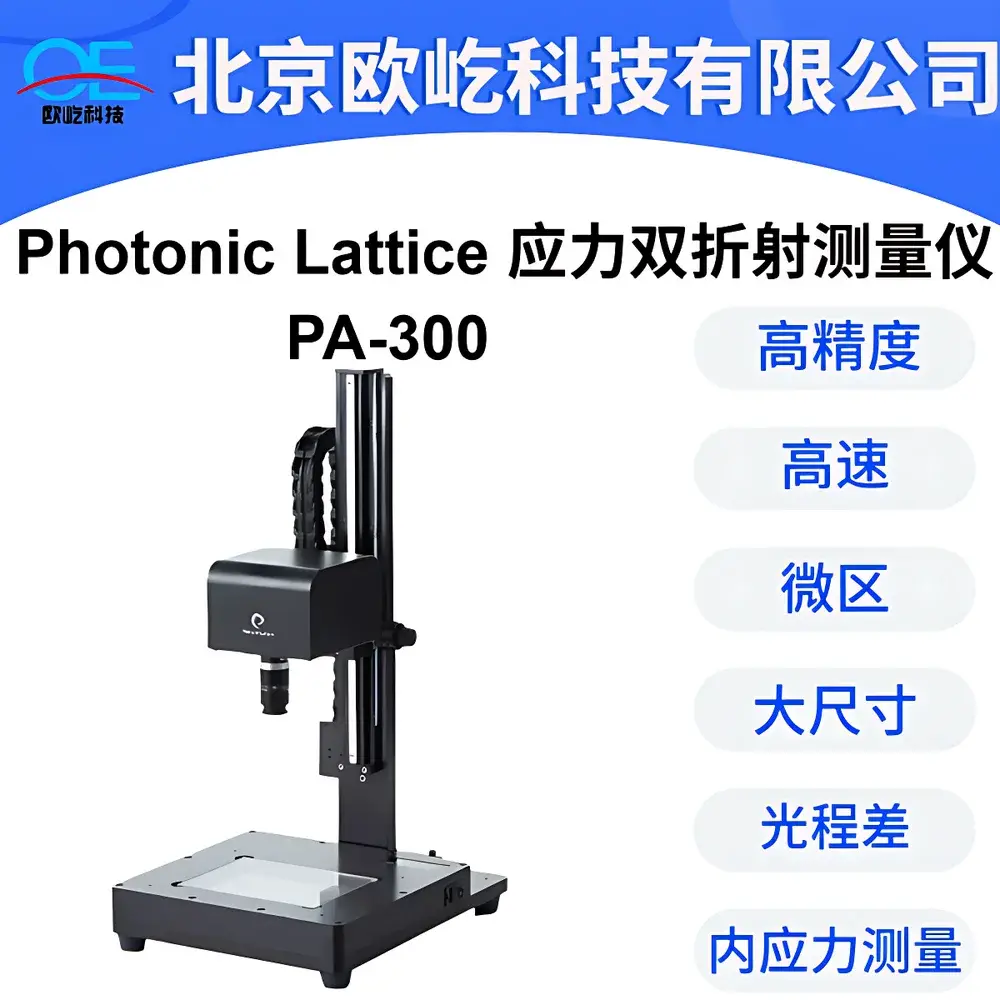
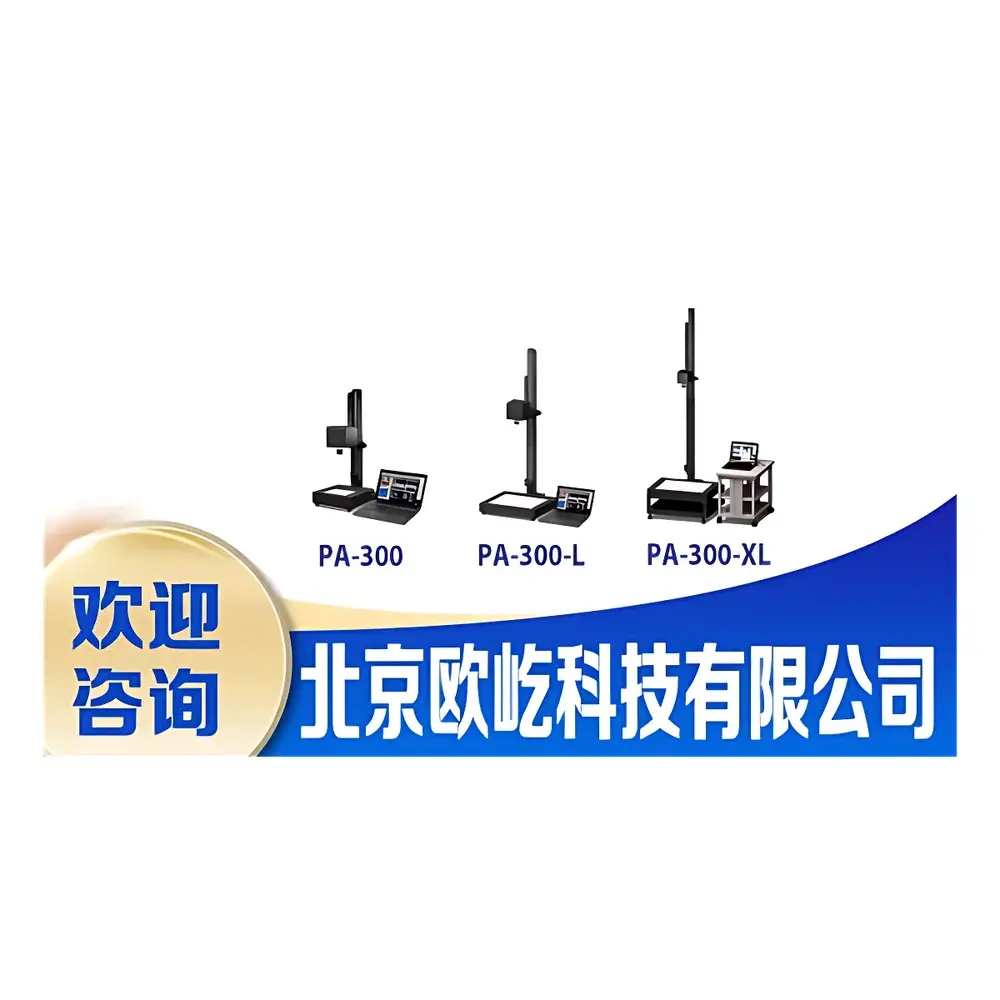
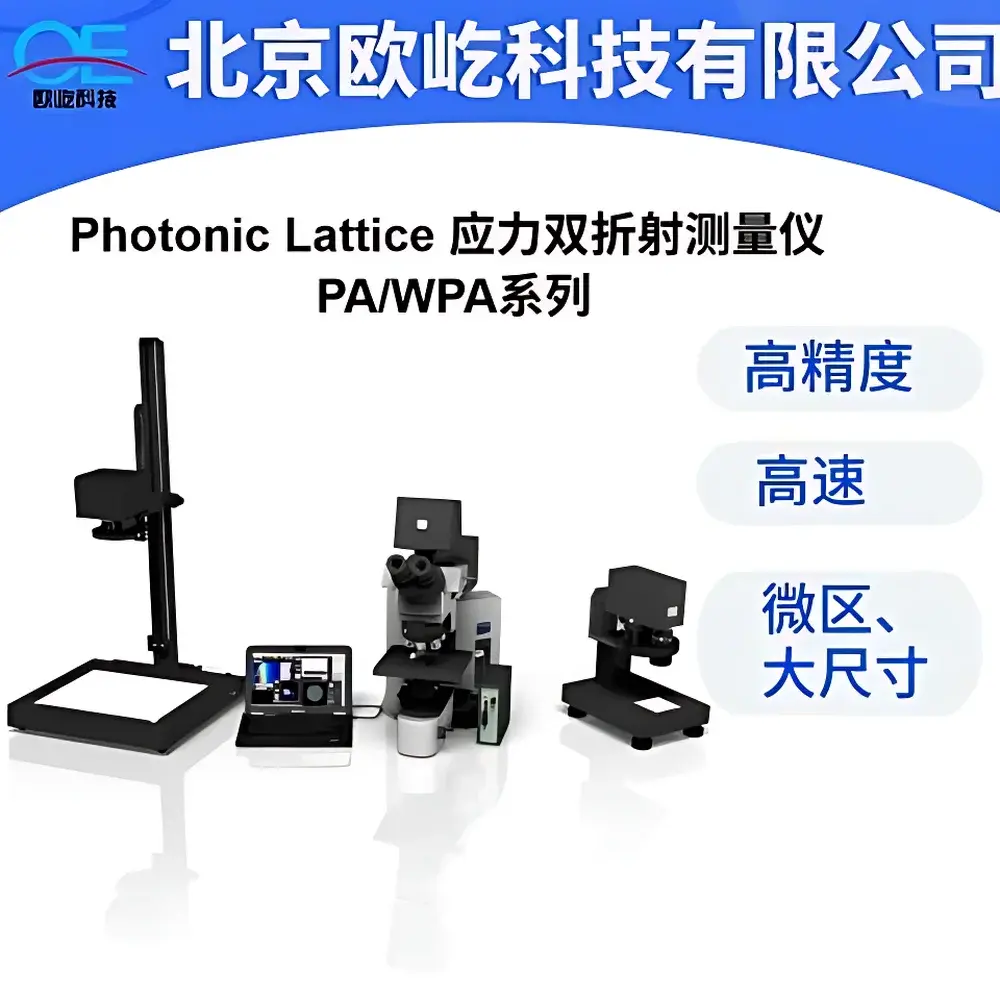
Photonic Lattice PA Series Polarizing Stress Meter
| Brand | Photonic Lattice |
|---|---|
| Origin | Japan |
| Manufacturer Status | Authorized Distributor |
| Product Origin | Imported |
| Model | PA Series |
| Price | USD 13,800 (approx.) |
Overview
The Photonic Lattice PA Series Polarizing Stress Meter is a high-precision optical measurement instrument engineered for quantitative evaluation of stress-induced birefringence in transparent, isotropic materials. Based on the principle of polarized light interference and calibrated photoelastic analysis, the system captures full-field retardation distribution by measuring phase delay (optical path difference) and fast-axis orientation across the sample surface. Unlike conventional crossed-polarizer setups that yield qualitative contrast, the PA Series employs a proprietary photonic crystal-based polarization image sensor—developed in-house by Photonic Lattice, Inc.—to deliver pixel-level quantitative data with nanometer-scale resolution in optical path difference (OPD). It is specifically optimized for low-birefringence materials such as fused silica, optical glass (e.g., BK7, SF6), sapphire substrates, silicon carbide (SiC) wafers, and lithium niobate crystals—materials where residual stress at sub-MPa levels critically impacts wavefront fidelity, laser damage threshold, and bonding integrity.
Key Features
- Full-field, non-contact stress birefringence mapping in a single acquisition—no scanning or mechanical translation required
- Integrated polarization image sensor with 5-megapixel resolution, enabling spatially resolved measurement of retardation (nm), azimuth angle (°), stress magnitude (MPa), and stress birefringence coefficient (nm/mm)
- Real-time visualization of stress vector fields, including principal stress direction and magnitude gradients
- Multi-dimensional analysis modes: point-wise interrogation, line-profile extraction, 2D heatmaps, and pseudo-3D surface stress topography generation
- Automated calibration routines traceable to NIST-certified retardation standards; supports user-defined reference materials
- Rugged optical architecture with temperature-stabilized illumination and vibration-damped imaging platform for laboratory and cleanroom deployment
Sample Compatibility & Compliance
The PA Series accommodates flat, parallel-faced transparent samples ranging from 5 mm × 5 mm up to 300 mm × 300 mm (depending on model variant), with thicknesses from 0.1 mm to 50 mm. It is compatible with polished, coated, or uncoated substrates—including AR-coated optics and ion-exchanged glass—and tolerates minor surface imperfections without compromising measurement fidelity. The system meets ISO 11146-1:2019 (laser beam parameters) and ASTM E1782-21 (residual stress measurement in transparent solids) guidelines. Data acquisition and reporting support GLP/GMP-compliant workflows, including electronic signatures, audit trails, and metadata embedding per FDA 21 CFR Part 11 requirements when integrated with validated software environments.
Software & Data Management
Control and analysis are performed via PL-StressView™—a Windows-based application developed by Photonic Lattice. The software provides intuitive workflow navigation, batch processing for production-line QC, and export options for CSV, TIFF (with embedded metadata), HDF5, and MATLAB-compatible .mat files. All measurements include timestamp, environmental conditions (ambient temperature/humidity logged via optional sensors), operator ID, and instrument calibration status. Raw polarization images are preserved for reprocessing; version-controlled analysis scripts enable method reproducibility across laboratories. Optional API integration allows linkage with MES/SPC systems for real-time statistical process control.
Applications
- Quality assurance of optical components: lens blanks, prisms, windows, and laser gain media
- In-process monitoring of annealing uniformity in fused quartz and borosilicate glass manufacturing
- Residual stress characterization of semiconductor-grade sapphire and SiC substrates prior to epitaxial growth
- Failure analysis of bonded wafers and opto-mechanical assemblies exhibiting unexpected depolarization or wavefront distortion
- R&D validation of stress-engineered photonic devices, including waveguide arrays and polarization-maintaining fibers
- Calibration verification of photoelastic modulators and liquid crystal variable retarders
FAQ
What physical quantity does the PA Series directly measure?
It measures optical path difference (retardation) in nanometers and fast-axis orientation in degrees—both derived from Stokes parameter analysis of transmitted polarized light.
Can it measure curved or non-planar surfaces?
No—it requires planar, parallel surfaces for accurate through-transmission measurement; concave/convex optics require custom collimated-path adapters (available as optional accessories).
Is calibration required before each use?
A quick verification using the built-in reference plate is recommended before critical measurements; full recalibration is advised every 6 months or after mechanical shock.
Does the system comply with ISO/IEC 17025 requirements for accredited testing labs?
Yes—when operated with documented SOPs, certified reference standards, and maintained calibration records, the PA Series supports ISO/IEC 17025:2017 clause 6.4 (equipment) and 7.7 (uncertainty estimation) compliance.
How is stress magnitude (MPa) calculated from retardation data?
Using the material-specific stress-optic coefficient (C), where σ = Δ / (C·t); Δ is retardation (nm), t is thickness (mm), and C is provided in MPa⁻¹·nm·mm⁻¹ (e.g., 2.2 for BK7 glass).



