
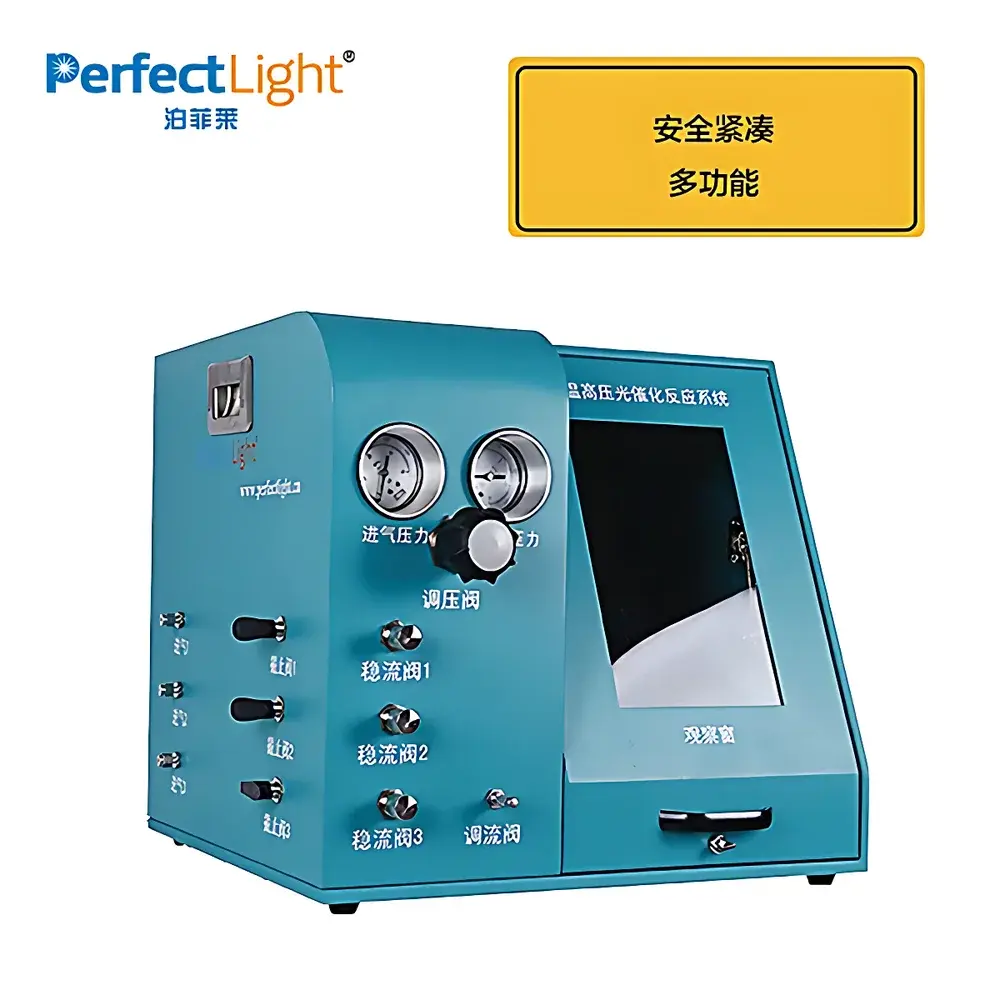
Photoreduction Reactor – Photochemical System by PerfectLight
| Brand | PerfectLight |
|---|---|
| Origin | Beijing, China |
| Model | PLR-50 |
| Reaction Volume | 50 mL (customizable: 25/100 mL) |
| Operating Temperature | RT+10°C to 300°C (up to 380°C transient) |
| Operating Pressure | 1–10 MPa |
| Gas Inlets | 3 independent channels |
| Total Gas Flow Range | 1–60 mL/min |
| Safety Relief Valve Setpoint | Adjustable up to 7 MPa |
| Integrated High-Pressure Gas Mixing Chamber | 1 L |
| Flow Monitoring | Electronic Soap Film Flowmeter (10–60 mL/min) |
| Optical Window | Thick-wall fused quartz, UV–Vis–NIR transparent (190–2500 nm) |
| Safety Enclosure | Integrated blast-resistant cabinet with interlocked access |
Overview
The PerfectLight PLR-50 Photoreduction Reactor is an engineered benchtop photochemical reaction system designed for controlled, high-fidelity investigation of heterogeneous photocatalytic processes under elevated temperature and pressure. It operates on the principle of differential and integral photoreactor configurations—enabling precise kinetic analysis of surface-mediated reactions where photon absorption, charge carrier generation/separation, and interfacial redox steps are critically coupled to thermodynamic and transport conditions. Unlike conventional batch photoreactors, the PLR-50 integrates gas-phase mass flow control, thermal management, and broadband optical access into a single safety-certified platform—making it suitable for mechanistic studies of CO₂ photoreduction, selective organic transformations, and high-pressure photocatalytic water splitting under industrially relevant conditions.
Key Features
- Triple independent gas inlet system with dual-stage precision pressure regulation (secondary pressure stabilizer + secondary mass flow controller) for reproducible stoichiometric control of multi-component reactive atmospheres (e.g., CO₂/H₂/O₂ mixtures).
- Fused quartz optical window (≥15 mm thickness) transmitting across 190–2500 nm, compatible with xenon arc lamps, LED arrays, and tunable monochromatic sources for action spectrum analysis.
- High-temperature/pressure reaction chamber rated to 380°C peak and 10 MPa operating pressure, with real-time digital monitoring of internal temperature and pressure via calibrated industrial-grade transducers.
- Integrated 1 L high-pressure gas mixing reservoir ensuring stable composition delivery over extended experiments (>48 h continuous operation at 30 mL/min total flow).
- Electronic soap film flowmeter (10–60 mL/min range) installed at reactor outlet for traceable, low-uncertainty volumetric flow verification—compliant with ISO 5167-3 guidelines for laminar flow calibration.
- Full-enclosure safety cabinet with mechanical interlock, pressure-relief burst disc (adjustable setpoint up to 7 MPa), and emergency venting path—designed in accordance with EN 14470-1 for flammable gas handling in laboratory environments.
Sample Compatibility & Compliance
The PLR-50 accommodates solid photocatalysts (powders, immobilized films, monoliths) and liquid-phase suspensions (colloidal TiO₂, g-C₃N₄ dispersions) within its 50 mL stainless-steel reaction zone. Catalyst loading is optimized for differential conversion regimes (<10% per pass), supporting Langmuir–Hinshelwood and Eley–Rideal kinetic modeling. The system meets ASTM E2500-13 requirements for equipment qualification in photochemical research and supports GLP-compliant data acquisition when paired with validated software (see below). All wetted parts comply with ASTM F899 stainless steel specifications; quartz components meet SEMI F72 purity standards for semiconductor-grade optical materials.
Software & Data Management
Data acquisition is performed via a dedicated USB-connected interface module logging temperature, pressure, flow rate, and lamp power (if integrated radiometer equipped) at user-defined intervals (1 s–10 min resolution). Raw data export formats include CSV and HDF5, enabling direct import into MATLAB, Python (Pandas/NumPy), or OriginLab for kinetic fitting. Audit trails—including operator ID, timestamped parameter changes, and system error logs—are retained locally and support FDA 21 CFR Part 11 compliance when deployed with optional electronic signature modules and networked time-server synchronization.
Applications
- Quantitative CO₂ photoreduction to CH₄, CO, or C₂₊ hydrocarbons under simulated solar illumination and pressurized CO₂/H₂ feeds.
- Kinetic evaluation of VOC abatement (formaldehyde, NOₓ, SOₓ) on TiO₂-, WO₃-, or BiVO₄-based catalysts at sub-ppm inlet concentrations.
- Thermally assisted photocatalytic water splitting using tandem absorber systems (e.g., Si/BiVO₄, GaInP₂/Cu₂O) under >1 MPa O₂/H₂ partial pressures.
- In situ DRIFTS-coupled photoreaction studies requiring simultaneous gas dosing, heating, and IR-transparent optical access (via optional side-port adapter).
- Photoelectrochemical (PEC) compatibility testing with integrated counter/reference electrode ports (available as PLR-50-PEC configuration).
FAQ
What is the maximum allowable working pressure for long-term continuous operation?
The reactor is rated for continuous operation at ≤7 MPa; 10 MPa is specified as short-term (≤30 min) test pressure per ASME B31.3 process piping guidelines.
Can the system be used with corrosive gases such as H₂S or Cl₂?
Yes—when configured with Hastelloy C-276 internal components and fluorosilicone O-rings (optional upgrade); standard configuration uses 316L SS and Viton seals, suitable for CO₂, H₂, O₂, N₂, and inert blends.
Is UV–Vis–NIR spectral irradiance calibration supported?
Calibration-ready mounting points accept NIST-traceable reference photodiodes and integrating spheres; spectral irradiance mapping requires external spectroradiometer integration (e.g., Ocean Insight QE Pro).
How is catalyst deactivation monitored during extended runs?
By periodic GC/TCD/FID analysis of effluent streams combined with in-line pressure drop tracking across the catalyst bed—both accessible via standardized sampling ports and pressure taps per ISO 4020.
Does the system support automated sequential gas switching?
Yes—via optional programmable solenoid manifold (PLR-MV3) controlled through the same acquisition software, enabling multi-step reaction protocols (e.g., purge–adsorption–irradiation–desorption cycles).



