
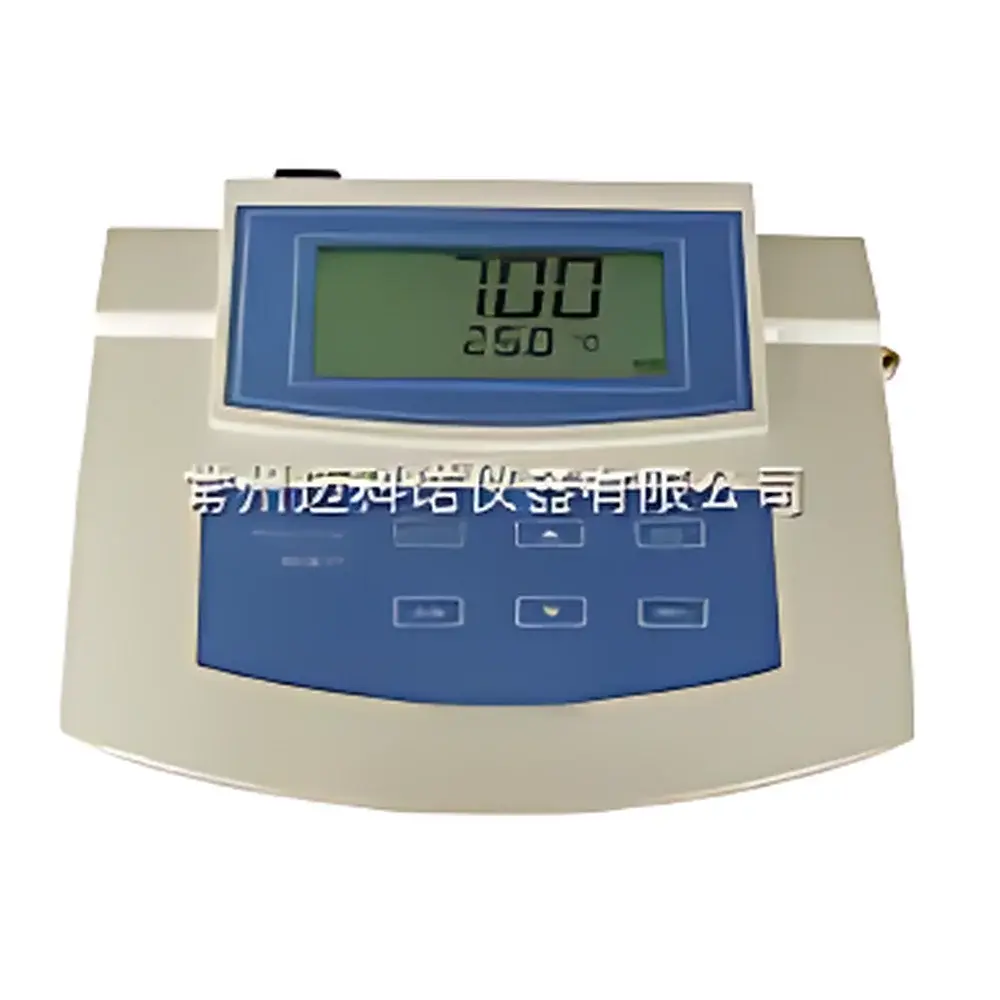
PHS-2C Benchtop pH Meter
| Key | Accuracy Class: 0.02 |
|---|---|
| pH Range | 0.00–14.00 pH |
| mV Range | ±1800 mV (auto-polarity) |
| Resolution | 0.01 pH / 1 mV / 0.1 °C |
| Temperature Compensation | 0.0–60.0 °C |
| Input Impedance | ≥1 × 10¹² Ω |
| Input Current | ≤1 × 10⁻¹² A |
| Basic Error (pH) | ±0.01 pH (electronic unit), ±0.02 pH ±1 digit (full instrument) |
| Repeatability | ≤0.01 pH ±1 digit |
| Stability | ±0.01 pH ±1 digit / 3 h |
| Dimensions (L×W×H) | 200 × 210 × 70 mm |
| Weight | 1.0 kg |
| Power Supply | AC 220 V |
| Operating Environment | 5–40 °C, RH ≤85%, no strong magnetic fields or vibration |
Overview
The PHS-2C Benchtop pH Meter is a precision electrochemical instrument engineered for reliable, routine measurement of hydrogen ion activity in aqueous solutions. Based on the potentiometric principle—measuring the potential difference between a pH-sensitive glass electrode and a stable reference electrode—the PHS-2C delivers calibrated, traceable pH values aligned with internationally recognized electrochemical standards (e.g., ISO 3696, ASTM D1293). Its dual-display LCD with blue backlight simultaneously presents either pH and temperature, or mV and temperature, enabling real-time correlation of thermally compensated readings without mode switching. Designed for fixed-lab environments, the unit features a robust analog front-end with ultra-high input impedance (>1 × 10¹² Ω) and sub-picoampere input current (<1 × 10⁻¹² A), minimizing loading effects on high-impedance electrodes and ensuring stability across extended measurement cycles.
Key Features
- Dual-parameter digital display: Simultaneous readout of pH/mV and temperature (°C) on a high-contrast blue-backlit LCD
- Class 0.02 accuracy per Chinese national standard JJG 119–2018 (equivalent to IEC 60746-2:2019 Class 0.02), verified via certified buffer calibration at 25 °C
- Automatic polarity detection for mV measurements (±1800 mV range), supporting redox (ORP) analysis when paired with a platinum or Ag/AgCl ORP electrode
- Manual and automatic temperature compensation (0.0–60.0 °C) using integrated NTC thermistor; temperature compensation error ≤ ±0.01 pH
- High-precision analog signal conditioning with <0.01 pH electronic unit basic error and ≤0.01 pH ±1 digit repeatability
- Stable operation over 3 hours (drift ≤ ±0.01 pH ±1 digit), validated under controlled laboratory conditions per GLP-compliant protocols
- Compact benchtop form factor (200 × 210 × 70 mm, 1.0 kg) optimized for space-constrained QC labs and teaching laboratories
Sample Compatibility & Compliance
The PHS-2C is intended exclusively for aqueous-phase measurements and is compatible with standard combination pH electrodes (e.g., 201-type, 231-type), ORP electrodes, and generic ion-selective electrodes (ISEs) requiring high-impedance input. It meets the electrical safety requirements of GB/T 28290–2012 (equivalent to IEC 61010-1) and conforms to electromagnetic compatibility (EMC) specifications per GB/T 18268.1–2010. While not FDA 21 CFR Part 11–certified out-of-the-box, its analog output architecture and deterministic measurement logic support integration into auditable quality systems when used with documented calibration procedures, logbook entries, and periodic verification against NIST-traceable buffers (e.g., pH 4.01, 7.00, 10.01 at 25 °C). It is routinely deployed in environmental monitoring (EPA Method 9040C), industrial wastewater testing, and academic chemistry instruction where ISO/IEC 17025–aligned uncertainty budgets are maintained manually.
Software & Data Management
The PHS-2C operates as a standalone hardware meter with no embedded firmware-based data logging or USB connectivity. All measurements are displayed in real time and must be recorded manually or interfaced externally via optional analog voltage output (if retrofitted) or third-party RS-232 adapters (not included). For regulated environments, users implement paper-based or electronic lab notebooks (ELN) to document calibration dates, buffer lot numbers, electrode IDs, ambient conditions, and raw readings—ensuring full traceability per GLP and ISO/IEC 17025 clause 7.7. The instrument’s stability and repeatability characteristics enable straightforward uncertainty estimation using Type A (repeatability) and Type B (calibration certificate, temperature compensation error) components in accordance with GUM (JCGM 100:2008).
Applications
- Routine pH verification in municipal water treatment and effluent discharge compliance (per local environmental protection bureau requirements)
- Quality control of buffer solutions, reagents, and culture media in pharmaceutical and biotech manufacturing
- Teaching fundamental electrochemistry concepts—including Nernst equation derivation, liquid junction potentials, and electrode response kinetics—in undergraduate analytical chemistry labs
- Field-deployable backup unit for portable pH meters during calibration cross-checks in environmental sampling campaigns
- Supporting ion-selective measurements (e.g., F⁻, Cl⁻, NH₄⁺) when coupled with appropriate ISEs and ionic strength adjusters (ISA)
FAQ
What calibration standards are recommended for daily use?
NIST-traceable pH buffer solutions at 25 °C: pH 4.01 (potassium hydrogen phthalate), pH 7.00 (phosphate), and pH 10.01 (borax). Two-point calibration (pH 4.01 and 7.00) is sufficient for most routine applications.
Can the PHS-2C measure non-aqueous samples?
No. The instrument is designed and validated only for aqueous electrolyte solutions. Non-aqueous or low-ionic-strength samples require specialized electrodes and alternative measurement protocols outside this device’s specification.
Is temperature compensation mandatory for accurate pH readings?
Yes. The Nernst slope varies with temperature (≈−0.198 mV/pH/°C at 25 °C); uncorrected measurements introduce systematic bias exceeding ±0.2 pH above 10 °C deviation from calibration temperature.
How often should the instrument be recalibrated?
Before each batch of measurements, after electrode replacement, and whenever ambient temperature shifts >5 °C—consistent with ISO 7027 and CLSI EP21-A guidelines for clinical and environmental labs.
Does the PHS-2C support GLP-compliant audit trails?
Not natively. Full GLP compliance requires external documentation of calibration history, operator identity, sample ID, and environmental conditions—typically managed via paper logs or validated ELN systems.





