
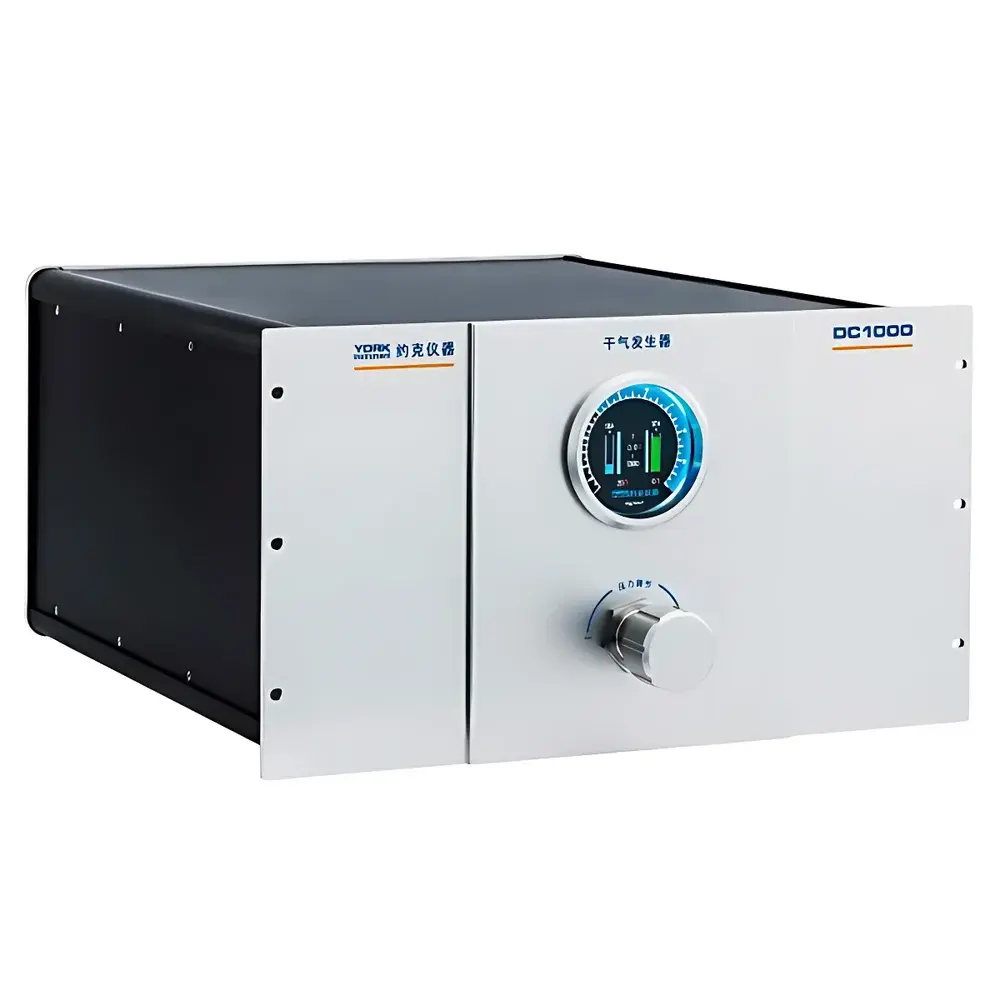
PhyMetrix DC1000 Desiccant Air Generator
| Brand | PhyMetrix |
|---|---|
| Origin | USA |
| Model | DC1000 |
| Output Pressure | 0.3 MPa (recommended) |
| Dew Point | < −80 °C (dp) |
| Inlet Pressure | ≥ 0.8 MPa |
| Operating Temperature | 5–40 °C |
| Storage Temperature | −40–50 °C |
| Electrical Supply | AC 220 V ±10%, 50 Hz |
| Dimensions | 485 × 500 × 260 mm (W × D × H) |
| Weight | 20 kg |
| Inlet/Outlet Fitting | 1/4" Swagelok |
Overview
The PhyMetrix DC1000 Desiccant Air Generator is an engineered solution for continuous on-site production of ultra-dry compressed air, specifically designed to support precision dew point calibration systems, moisture-sensitive analytical instrumentation (e.g., FTIR, CRDS, cavity ring-down spectrometers), and controlled-environment test chambers. It operates on the principle of pressure swing adsorption (PSA), utilizing dual-bed molecular sieve architecture to selectively remove water vapor from a compressed air feed stream. Unlike cryogenic or membrane-based dryers, PSA technology delivers stable, season-independent dew points below −80 °C (dp) without reliance on consumable gases such as bottled nitrogen or liquid nitrogen—eliminating supply chain dependencies, logistical overhead, and long-term operational cost volatility. The unit accepts standard industrial-grade compressed air (≥ 0.8 MPa inlet pressure) and delivers conditioned air at a regulated output pressure of 0.3 MPa, optimized for compatibility with ISO 8573-1 Class 1 (−70 °C dp) and Class 0 (−80 °C dp) applications.
Key Features
- Dual-bed PSA system with automatic valve sequencing ensures uninterrupted dry air output with < −80 °C dew point performance across ambient temperatures from 5 °C to 40 °C
- Integrated color LCD interface with analog-style pressure gauge visualization displays real-time inlet pressure, outlet pressure, and internal bed status (adsorption/regeneration phase)
- Self-diagnostic firmware with audible and visual fault alerts for low inlet pressure, high temperature, or adsorbent saturation—enabling proactive maintenance planning
- True maintenance-free operation: no oil, no moving parts beyond solenoid valves, and no scheduled replacement of desiccant within normal service life (typical molecular sieve service interval exceeds 2 years under continuous 24/7 operation)
- Compact footprint (485 × 500 × 260 mm) and lightweight aluminum enclosure (20 kg) facilitate integration into laboratory benches, mobile calibration carts, or ISO-classified cleanroom utility zones
- 1/4″ Swagelok stainless-steel inlet and outlet fittings ensure leak-tight, corrosion-resistant gas path integrity compliant with ASTM F2219 and ISO 10500 standards for high-purity gas delivery
Sample Compatibility & Compliance
The DC1000 is compatible with all standard laboratory and industrial compressed air sources meeting ISO 8573-1:2010 Class 4 (solid particles ≤ 15 µm, oil content ≤ 5 mg/m³, water content ≤ 1000 ppmv at 7 bar). It does not require pre-filtration beyond standard coalescing and particulate filtration; however, installation downstream of a refrigerated dryer is recommended where ambient humidity exceeds 80% RH to extend molecular sieve longevity. The generator complies with IEC 61000-6-2 (immunity) and IEC 61000-6-4 (emissions), carries CE marking per EU Machinery Directive 2006/42/EC, and meets UL 61010-1 requirements for laboratory electrical equipment safety. Its stable dew point output supports trace moisture validation in accordance with ISO/IEC 17025:2017 clause 7.8.2 (uncertainty of measurement) and supports GLP-compliant dew point calibrations per ISO 16272:2015.
Software & Data Management
While the DC1000 operates as a standalone hardware platform with no embedded microprocessor-based data logging, its analog-style pressure and status indicators are fully compatible with external SCADA or LabVIEW-based monitoring systems via optional 4–20 mA analog outputs (available as field-upgrade module). All operational parameters—including inlet pressure threshold alarms and regeneration cycle timing—are configurable through front-panel menu navigation. Audit trails are maintained manually via operator logbooks per FDA 21 CFR Part 11 Annex 11 guidelines when used in regulated environments; digital data acquisition requires integration with validated third-party DAQ hardware and software.
Applications
- Dew point calibrator support: primary dry gas source for chilled mirror hygrometers (e.g., Michell Easidew, Vaisala DM70) and capacitance-based reference standards
- Carrier gas conditioning for gas chromatography (GC) and gas chromatography–mass spectrometry (GC–MS) systems requiring sub-ppb moisture control
- Zero-air generation for environmental air quality analyzers (e.g., NOₓ, SO₂, O₃ monitors per EPA Method 205)
- Humidity chamber purge gas in accelerated aging and reliability testing (JEDEC JESD22-A119, MIL-STD-810H)
- Reference gas humidification systems where precise, low-drift dry base gas is essential for NIST-traceable RH generation
FAQ
What compressed air quality is required for optimal DC1000 performance?
The unit requires ISO 8573-1 Class 4 compressed air (≤ 1000 ppmv water vapor at 7 bar, ≤ 5 mg/m³ oil, ≤ 15 µm particles). A coalescing filter and refrigerated dryer upstream are strongly advised in high-humidity environments.
Can the DC1000 be operated continuously for 24/7 applications?
Yes—its dual-bed PSA architecture enables indefinite continuous duty cycle with automatic alternation between adsorption and regeneration phases.
Is routine desiccant replacement necessary?
No. Molecular sieve beds are rated for ≥ 18,000 hours of operation under typical lab conditions; replacement is only required upon confirmed performance degradation verified by independent dew point verification.
Does the unit comply with FDA or ISO 13485 requirements?
The DC1000 itself is not a medical device but supports ISO 13485-certified processes when integrated into validated systems; its construction materials (316L SS fittings, food-grade elastomers) and CE/UL certifications align with QSR and Annex I essential requirements.
How is output pressure regulated and stabilized?
A precision stainless-steel diaphragm regulator maintains constant 0.3 MPa output regardless of upstream pressure fluctuations, with built-in overpressure relief per ASME B31.9.



