
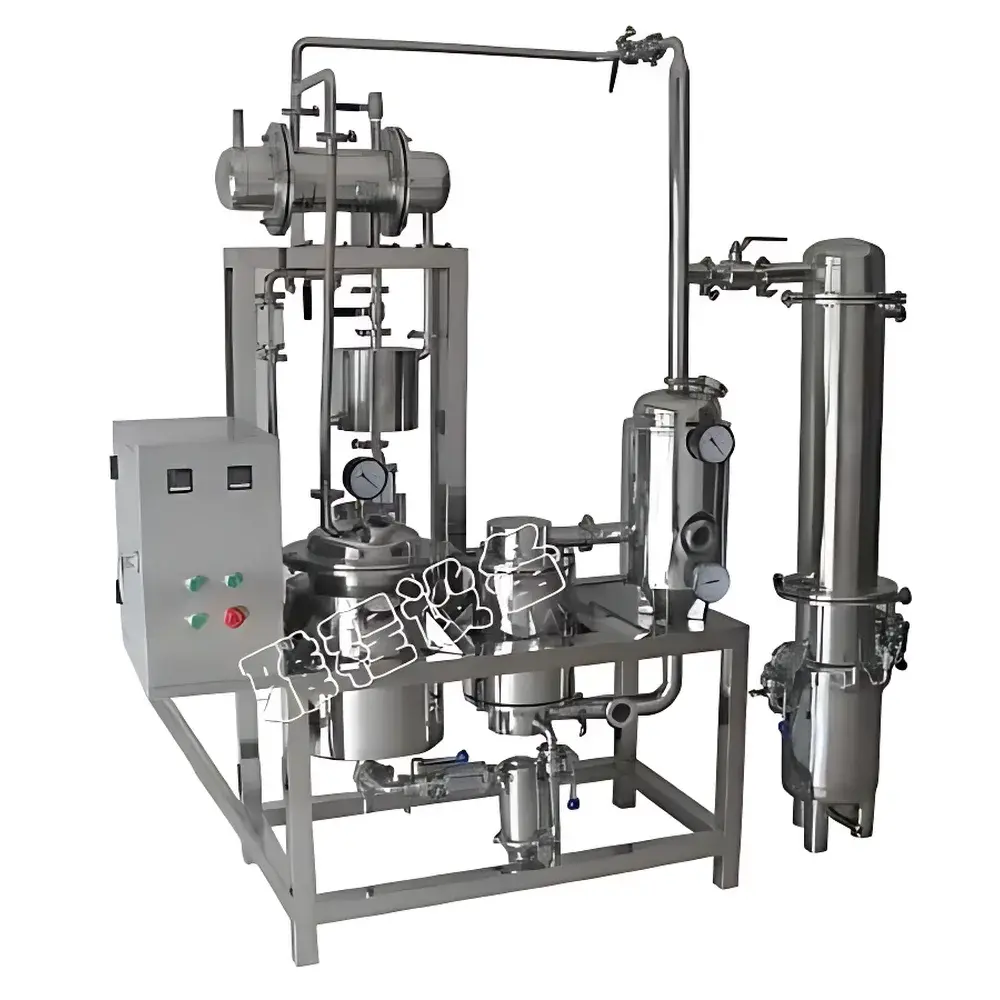
Pilotech YC-020 Bench-Scale Multifunctional Extraction and Concentration System
| Brand | Pilotech |
|---|---|
| Origin | Shanghai, China |
| Manufacturer | Yes |
| Type | Domestic |
| Model | YC-020 |
| Price | USD 7,700 (FOB Shanghai) |
| Extraction Vessel Volume | 25 L |
| Batch Feed Capacity | 0.3–5 kg |
| Minimum Feed | 0.3 kg |
| Evaporation Rate (Water) | 4–6 kg/h |
| Vacuum Degree (Evaporator Chamber) | –0.08 MPa |
| Temperature Control Accuracy | ±2 °C |
| Heating Power | 4.5 kW @ 380 V |
| Cooling Water Consumption | 1 t/h @ < 0.3 MPa |
| Construction Material | SUS304 Stainless Steel |
| Overall Dimensions | 1500 × 800 × 1900 mm |
| Footprint | ~2.4 m² |
Overview
The Pilotech YC-020 Bench-Scale Multifunctional Extraction and Concentration System is an integrated, closed-loop laboratory-scale unit engineered for process development and pilot-scale validation of solid–liquid extraction and subsequent concentration workflows. It operates on fundamental principles of heat-assisted percolation, reflux condensation, and thin-film evaporation under controlled thermal and pressure conditions. Designed for R&D laboratories in pharmaceutical, nutraceutical, herbal medicine, food science, and analytical chemistry sectors, the system supports aqueous, alcoholic, and organic solvent-based extractions—including ethanol, methanol, acetone, and ethyl acetate—while maintaining full containment of volatile components. Its modular architecture enables sequential or parallel execution of static maceration, dynamic reflux extraction, vacuum-assisted concentration, and solvent recovery—all within a single stainless-steel fluidic circuit compliant with current Good Manufacturing Practice (cGMP) and Good Laboratory Practice (GLP) facility design expectations.
Key Features
- Integrated dual-function platform combining extraction, concentration, and solvent recovery in one compact footprint (~2.4 m²), minimizing cross-contamination risk and operational complexity.
- SUS304 stainless steel construction throughout all wetted parts—including extraction vessel, evaporator, condensers, collectors, and piping—ensuring corrosion resistance, cleanability, and compatibility with USP Class VI solvents.
- Thermostatically controlled jacketed extraction vessel (25 L capacity) with ±2 °C temperature stability; heating via external导热油 (thermal oil) circulation system eliminates internal pressure hazards during flammable solvent handling.
- Dedicated reflux train comprising vertical condenser, coolant-cooled reflux cooler, and oil–water separator for selective recovery of volatile aromatic fractions from botanical matrices.
- Externally mounted forced-circulation evaporator with adjustable vacuum control (down to –0.08 MPa), enabling low-temperature concentration to preserve thermolabile compounds; achievable density range: 1.10–1.38 g/mL.
- Self-contained solvent recovery loop including dedicated condenser, cooler, and collection tank—capable of operating under both atmospheric and reduced-pressure conditions.
- Full instrumentation suite: digital temperature controllers, vacuum gauges, flow indicators, pressure relief valves, and safety interlocks aligned with IEC 61000-6-2/6-4 electromagnetic compatibility standards.
Sample Compatibility & Compliance
The YC-020 accommodates heterogeneous solid feedstocks—including dried herbs, tea leaves, fruit pomace, fungal biomass, and powdered botanicals—with batch loading flexibility from 0.3 kg to 5 kg. It complies with material contact requirements outlined in FDA 21 CFR Part 11 (when paired with validated data logging software), ISO 9001:2015 manufacturing controls, and ASTM E2656–22 guidelines for laboratory-scale extraction equipment qualification. All seals meet EPDM/FKM specifications for solvent resistance; surface finish meets Ra ≤ 0.8 µm per ASME BPE-2022 for pharmaceutical-grade surfaces. The system supports IQ/OQ documentation packages upon request and is suitable for GLP-regulated preclinical phytochemical studies.
Software & Data Management
While the base configuration features analog instrumentation and manual valve operation, optional digital upgrade kits include programmable logic controller (PLC)-based automation with HMI touchscreen interface (Siemens SIMATIC S7-1200 compatible). Data acquisition supports time-stamped logging of temperature, pressure, flow, and vacuum parameters at 1-second intervals. Export formats include CSV and PDF reports compliant with ALCOA+ principles (Attributable, Legible, Contemporaneous, Original, Accurate, Complete, Consistent, Enduring, Available). Audit trail functionality satisfies FDA 21 CFR Part 11 requirements when deployed with electronic signature modules and role-based access control.
Applications
- Development of standardized extraction protocols for active pharmaceutical ingredients (APIs) from traditional Chinese medicinal herbs (e.g., glycyrrhizin from licorice root, berberine from Coptis chinensis).
- Optimization of ethanol/water co-solvent ratios for polyphenol recovery from green tea or grape marc.
- Process validation of vacuum concentration steps prior to lyophilization or spray drying in biopharmaceutical downstream processing.
- Solvent recycling studies supporting green chemistry initiatives—particularly for acetone or ethyl acetate recovery in natural pigment isolation.
- Teaching applications in university-level pharmaceutical engineering and food process technology laboratories.
- Pre-formulation studies requiring small-batch reproducibility across multiple extraction modalities (static soak, reflux, percolation).
FAQ
What is the maximum allowable operating pressure for the extraction vessel?
The YC-020 extraction vessel is designed for atmospheric and sub-atmospheric operation only; it is not rated for positive pressure service beyond 0.1 MPa gauge.
Can the system be used with chlorinated solvents such as dichloromethane?
Yes—provided all elastomeric components (gaskets, diaphragms) are upgraded to FKM (Viton®) specification and cooling water temperature is maintained below 25 °C to prevent hydrolysis.
Is validation support available for GMP-compliant installations?
Yes. Pilotech provides URS templates, FAT/SAT protocols, and IQ/OQ documentation frameworks aligned with Annex 15 and WHO TRS 986 requirements.
How is cleaning-in-place (CIP) performed?
The system supports manual CIP using hot water (≤80 °C) or 1% NaOH solution circulated through the entire loop at ≥1.5 m/s velocity; validation of residue limits follows ICH Q5C and PDA Technical Report No. 29.
Does the unit include explosion-proof electrical components?
Standard configuration uses general-purpose enclosures; ATEX Zone 2 or Class I Div 2 explosion-proof variants are available upon request with certified motors, sensors, and junction boxes.



