
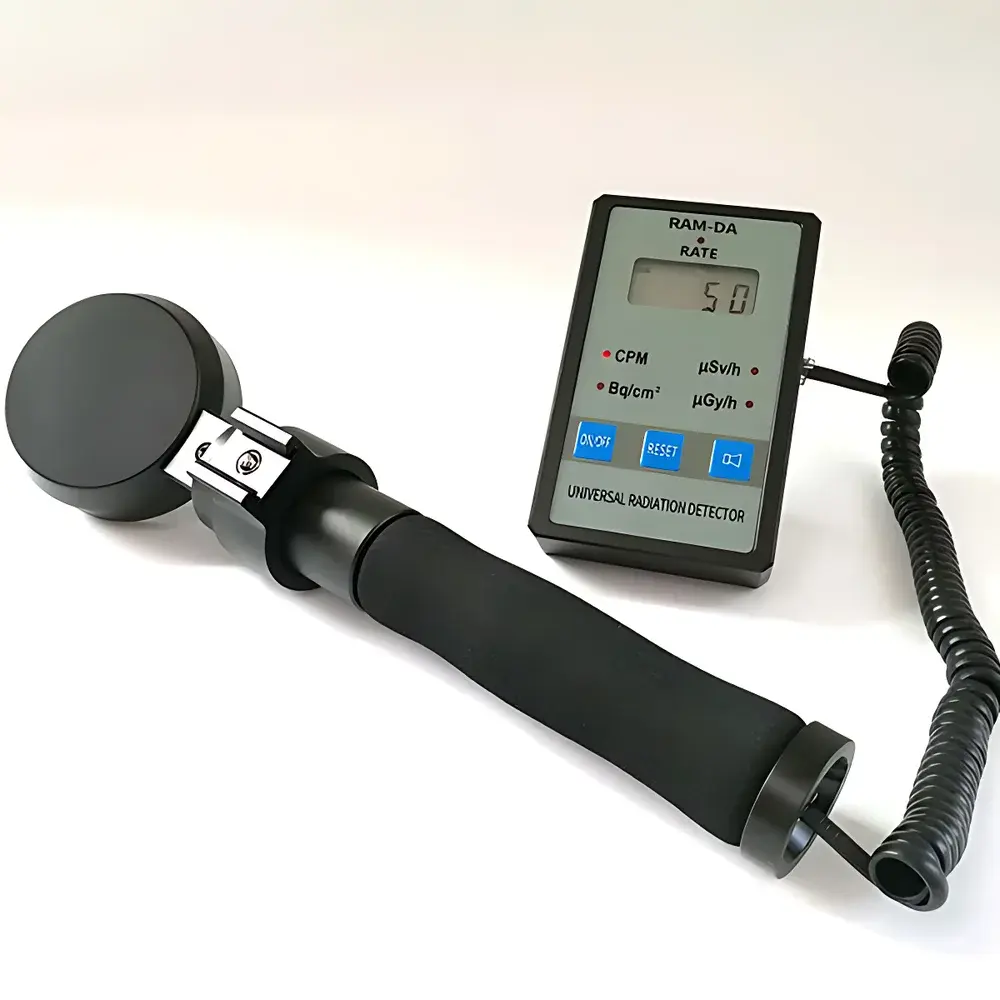

PKSAIR RAM-DA Portable Multi-Mode Radiation Detector
| Brand | PKSAIR |
|---|---|
| Origin | Beijing, China |
| Model | RAM-DA |
| Instrument Type | Portable Dose Rate & Surface Contamination Monitor |
| Radiation Types Detected | Alpha (α), Beta (β), Gamma (γ), and X-rays |
| Measurement Range | 0.01–1,000 µSv/h or 0.01–1,000 µGy/h |
| Sensitivity | 342 CPM/µSv/h (Cs-137) |
| Detector | External 1.77" (45 mm) Flat Mica-Window GM Tube |
| Energy Response | 25 keV – 3 MeV (±15%) |
| Detection Efficiency (⁹⁰Sr/⁹⁰Y β) | 54% |
| Surface Sensitivity (⁹⁰Sr/⁹⁰Y β) | 500 CPM/Bq·cm⁻² |
| Intrinsic γ Dose Rate Error | ≤10% |
| Angular Response (¹³⁷Cs) | ≤15% |
| Background Reading | ~60 CPM |
| Accuracy | ±10% |
| Display Update Rate | 1 Hz (adaptive averaging over 6 s baseline, shortened at high count rates) |
| Operating Environment | 0–50 °C, 40–95% RH (non-condensing) |
| Dimensions (Host) | 75 × 120 × 25 mm |
| Dimensions (Detector + Handle) | 75 × 285 × 30 mm |
| Weight | 0.9 kg |
| Power | Internal 7.4 V Li-ion battery (≈100 h continuous operation) |
Overview
The PKSAIR RAM-DA is a field-deployable, dual-function radiation measurement system engineered for rapid-response environmental and occupational monitoring. It integrates two distinct operational modes—surface contamination assessment (α/β) and ambient dose rate quantification (X/γ)—within a single, ruggedized platform. The instrument operates on the principle of gas ionization detection: incident radiation interacts with the fill gas inside the external flat mica-window Geiger-Müller (GM) tube, generating discrete electrical pulses proportional to ionizing events. Its 45 mm active diameter and ultra-thin mica window (1.4–2.0 mg/cm² density) enable efficient detection of low-penetrating α and β particles while maintaining adequate response across the diagnostic X-ray and gamma energy range (25 keV to 3 MeV). Designed in accordance with IEC 60846-1:2014 (radiation protection instrumentation — dose rate meters) and aligned with ANSI N42.33-2022 (portable radiation detection instrumentation), the RAM-DA supports compliance-driven workflows in nuclear medicine labs, decommissioning sites, transport safety inspections, and regulatory environmental surveys.
Key Features
- Modular architecture with hot-swappable external detector—host automatically identifies connected probe type and configures measurement parameters accordingly
- Dual-mode operation: real-time switching between surface contamination mode (displayed in CPS, CPM, or Bq/cm²) and dose rate mode (µSv/h or µGy/h)
- High-efficiency 45 mm flat GM tube with mica window optimized for α/β sensitivity (54% efficiency for ⁹⁰Sr/⁹⁰Y; 500 CPM/Bq·cm⁻² surface sensitivity)
- Adaptive averaging algorithm—default 6-second moving average updated every second, dynamically shortening at elevated count rates to preserve temporal resolution
- Metal-cased host and detector housing ensure mechanical robustness and EMI shielding in industrial or field environments
- Integrated handle-mount clamp enables stable one-handed operation during scanning or spot measurements
- Configurable audible alarm (buzzer) and visual pulse indicator—both user-disableable for silent operation in sensitive settings
- Low-power design supporting ≈100 hours of continuous use on a single 7.4 V lithium-ion charge
Sample Compatibility & Compliance
The RAM-DA is validated for direct surface scanning of diverse substrates—including concrete, stainless steel, plastic, fabric, skin, and ceramic—without requiring sample preparation or calibration correction factors for routine screening. Its angular response (≤15% deviation at ±60° for ¹³⁷Cs) ensures reliable readings across non-perpendicular orientations common in field surveys. While not certified for primary dosimetry under ISO 4037 or IEC 61526, the instrument meets functional performance criteria outlined in IAEA Safety Guide RS-G-1.8 (Application of the System of Radiological Protection) for area monitoring and contamination screening. It supports GLP-aligned documentation through timestamped data logging (when paired with optional PC interface software) and provides traceable response to reference sources including ¹³⁷Cs, ⁹⁰Sr/⁹⁰Y, and ²⁴¹Am. Device firmware includes factory calibration coefficients stored in non-volatile memory, accessible for audit purposes.
Software & Data Management
The RAM-DA operates autonomously without mandatory software dependency; however, optional USB-C connectivity enables bidirectional communication with PKSAIR’s proprietary PC application (Windows 10/11 compatible). This software supports export of time-stamped measurement logs in CSV format, customizable report generation (including pass/fail thresholds per ISO 7503-1 for surface contamination), and firmware updates. All logged entries include detector ID, measurement mode, units, timestamp (RTC-synchronized), and environmental conditions (if external sensor input is enabled). The system does not implement FDA 21 CFR Part 11 electronic signature functionality but maintains full audit trail capability—each data record contains immutable creation metadata and cannot be edited post-acquisition. No cloud upload or remote telemetry is embedded; data sovereignty remains fully under user control.
Applications
- Rapid identification of localized alpha/beta surface contamination on PPE, lab benches, transport containers, or decommissioned equipment
- Screening of construction materials (granite, tiles, concrete) for naturally occurring radioactive material (NORM) activity
- Environmental baseline surveys at landfill sites, uranium tailings, or legacy mining areas
- Verification of shielding integrity around industrial X-ray systems (e.g., NDT cabinets, baggage scanners)
- Field assessment of radium-226 in groundwater samples via evaporation residue analysis
- Monitoring airborne particulate radioactivity deposition on filters or swipe samples
- Post-incident verification of decontamination efficacy following radiological dispersal device (RDD) scenarios
- Consumer product screening—including vintage ceramics, glassware, and gemstones—for elevated K-40, U-series, or Ra-226 content
- Long-term ambient gamma dose rate trending in residential or occupational zones adjacent to nuclear facilities
FAQ
Can the RAM-DA distinguish between alpha and beta emissions in mixed fields?
No—it does not perform spectral discrimination. Alpha and beta measurements are conducted in dedicated modes using geometric and energy-dependent detection efficiency corrections applied during firmware processing.
Is the detector suitable for neutron detection?
No. The standard GM tube is insensitive to neutrons. Neutron-capable configurations require separate thermal/epithermal probes (e.g., He-3 proportional counters), which are available as custom-order options.
What is the minimum detectable surface activity for beta emitters?
Under typical background conditions (~60 CPM), the practical lower limit is approximately 0.1 Bq/cm² for ⁹⁰Sr/⁹⁰Y using 10-second integration, per ISO 7503-1 detection limit methodology.
Does the instrument support external power supply during extended deployments?
Yes—micro-USB port accepts 5 V DC input, enabling concurrent charging and operation without battery drain.
How often does the unit require recalibration?
Annual calibration against traceable reference sources (e.g., NIST-traceable ¹³⁷Cs or ²⁴¹Am) is recommended for regulatory compliance; factory calibration remains valid for 12 months under normal operating conditions.
Related Products







