
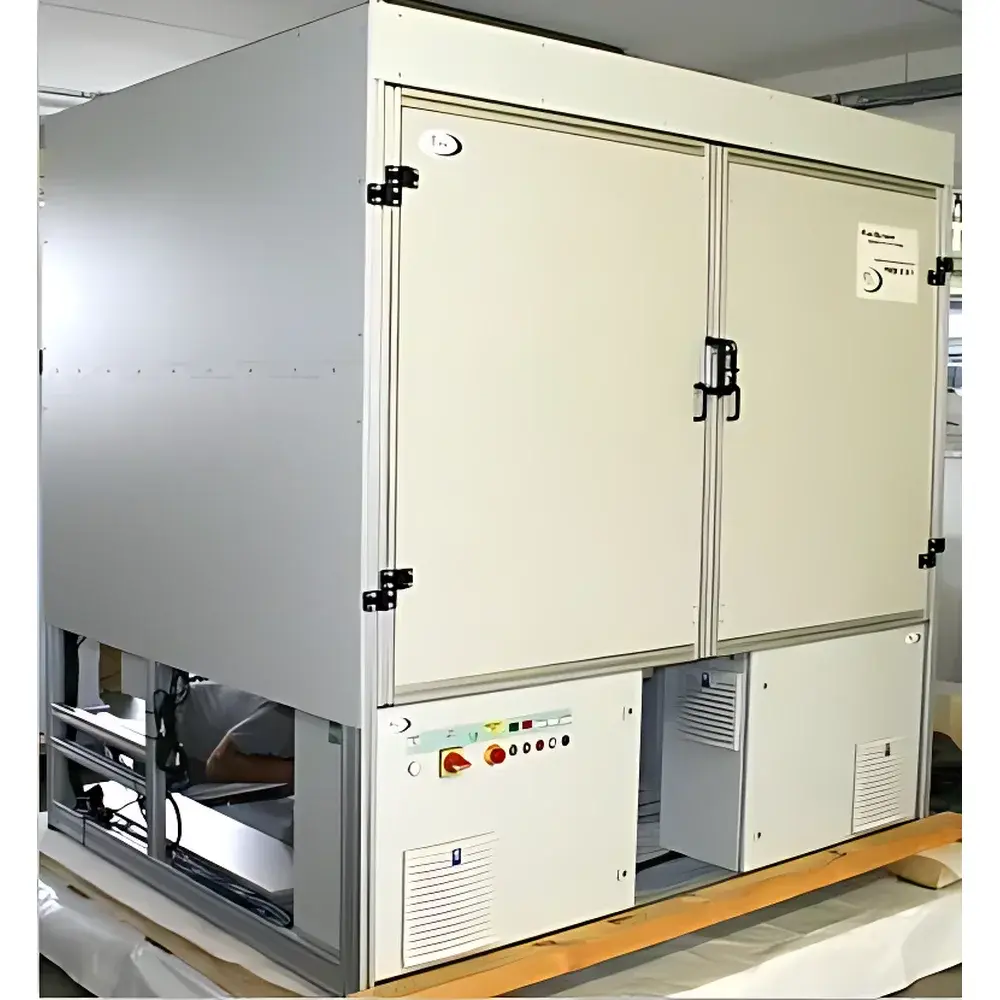
PlantScreen RGB Chlorophyll Fluorescence and True-Color Imaging System
| Brand | PSI (Photosynthesis Systems, Czech Republic) |
|---|---|
| Origin | Czech Republic |
| Model | PlantScreen RGB |
| Imaging Area | 1500 × 3225 px (X×Y) |
| Max Plant Height | 1250 px |
| Z-Axis Load Capacity | 30 kg |
| Fluorescence Camera | 1392 × 1040 px, 35 × 875 px FOV |
| RGB Camera | 2560 × 1920 px, CMOS 1/2", 2.2 µm pixel size |
| Excitation Wavelengths | 618 nm (measuring light), dual-wavelength (orange + white) actinic light, white saturating flash (up to 3600 µmol/m²/s), 735 nm NIR |
| Fluorescence Parameters | Fo, Fm, Fv, Fo’, Fm’, Fv’, Ft, Fv/Fm, Fv’/Fm’, ΦPSII, NPQ, qN, qP, Rfd, etc. |
| RGB Morphometric Parameters | Leaf Area, Solidity, Perimeter, Eccentricity, Roundness, Medium Leaf Width Index, Slenderness of Leaves (SOL), Circle Diameter, Convex Hull Area, Centroid, Internodal Distance, Growth Height, 3D Max Height/Width, Relative Growth Rate, Leaf Angle, Node Leaf Count, Greening Index, Color Segmentation Metrics |
| Motion Control | X/Y/Z axes with ±1 mm (X/Y), ±5 mm (Z) positioning accuracy |
| Power Supply | 3×230/220 VAC, 50/60 Hz |
| Dimensions | 5000 × 3750 × 230 px (L×W×H) |
| Weight | ~400 kg |
Overview
The PlantScreen RGB Chlorophyll Fluorescence and True-Color Imaging System is a fully automated, high-resolution phenotyping platform engineered for non-invasive, quantitative physiological and morphological analysis of intact plants under controlled or semi-controlled environments. Developed by PSI (Photosynthesis Systems) in the Czech Republic, the system integrates dual-modality imaging—pulse-amplitude modulated (PAM) chlorophyll fluorescence and high-fidelity RGB true-color imaging—within a single XYZ programmable gantry. Its operational principle relies on spatially resolved, time-synchronized acquisition of photochemical efficiency (via chlorophyll a fluorescence kinetics) and structural morphology (via pixel-accurate color segmentation and geometric feature extraction). Designed for longitudinal, high-throughput studies, it enables four-dimensional data capture: spatial (X, Y, Z), temporal (timestamped acquisition), and parametric (multi-layer physiological and morphological descriptors). The system complies with experimental reproducibility standards required for GLP-aligned plant stress physiology, ecotoxicology, and pre-breeding trait validation.
Key Features
- Integrated XYZ robotic gantry with precision motion control: X-axis travel up to 2525 px (±1 mm accuracy), Y-axis up to 1800 px (±1 mm), Z-axis vertical range 0–1225 px (±5 mm), supporting payloads up to 30 kg—enabling stable imaging of large pots, multi-tier trays, or soil microcosms.
- World’s largest single-frame chlorophyll fluorescence imager (35 × 875 px field of view), optimized for uniform excitation using 618 nm measuring light and calibrated white/orange actinic illumination, with saturating flashes up to 3600 µmol/m²/s and integrated 735 nm near-infrared reference channel.
- High-sensitivity RGB imaging module featuring a 2560 × 1920 CMOS sensor (1/2″ format, 2.2 µm pixel pitch), illuminated by four high-intensity white LEDs; all images are georeferenced with synchronized X-Y-Z coordinates and timestamp (YYYY-MM-DD-HH-MM-SS-Pos_X_Y_Z.bmp).
- Comprehensive fluorescence parameterization: calculates over 25 standardized PAM-derived metrics—including Fo, Fm, Fv/Fm (maximum quantum yield), ΦPSII (effective quantum yield), NPQ (non-photochemical quenching), qP/qN (photochemical/non-photochemical quenching coefficients), and Rfd (fluorescence decay ratio)—all traceable to established biophysical models (e.g., van Kooten & Snel, 1990; Klughammer & Schreiber, 2008).
- Automated morphometric quantification engine: extracts 17+ validated structural descriptors per plant, including leaf area, solidity, eccentricity, roundness, convex hull area, centroid position, internodal distance, 3D height/width, relative growth rate (RGR), leaf angle distribution, and node-specific leaf count—all derived from sub-pixel-accurate binary segmentation and skeletonization algorithms.
- Fully configurable measurement protocols via intuitive graphical interface; supports user-defined sequences with conditional triggers (e.g., time-of-day, environmental thresholds), password-protected access, emergency stop, and hardware interlocks compliant with IEC 61000-6-2/6-4 EMC standards.
Sample Compatibility & Compliance
The PlantScreen RGB accommodates a broad spectrum of plant material—from Arabidopsis thaliana seedlings in 96-well plates to mature rice or tomato plants grown in 10-L pots—without mechanical disturbance. Its open-chamber design permits integration with climate-controlled growth cabinets or greenhouse modules (optional environmental monitoring add-ons available). All optical and mechanical components meet CE marking requirements for laboratory equipment (2014/30/EU EMC Directive, 2014/35/EU LVD Directive). Data acquisition workflows support audit-trail generation, metadata embedding (EXIF + custom XML headers), and export formats compatible with FAIR data principles (CSV, HDF5, TIFF). While not certified for GMP production environments, its architecture aligns with FDA 21 CFR Part 11 expectations for electronic records when deployed with validated IT infrastructure and procedural SOPs.
Software & Data Management
The proprietary PlantScreen Control & Analysis Suite provides unified control of hardware, protocol scheduling, real-time visualization, and batch processing. Raw fluorescence and RGB image stacks are stored with embedded spatial-temporal metadata. Batch analysis pipelines apply consistent thresholding, noise reduction (Gaussian + median filtering), and region-of-interest (ROI) assignment across hundreds of samples. Export options include tabular reports (Excel/CSV), statistical summaries (ANOVA-ready), and publication-grade figures (vector EPS/PDF). Software supports direct integration with third-party platforms such as R (via readr and EBImage packages), Python (OpenCV, scikit-image), and MATLAB for advanced multivariate modeling (PCA, PLS-DA) or deep learning-based trait classification.
Applications
- High-throughput phenotyping in forward/reverse genetics and genome-wide association studies (GWAS), particularly for photosynthetic efficiency QTL mapping.
- Abiotic stress screening (drought, salinity, heat, heavy metals) via dynamic NPQ kinetics and early morphometric deviations (e.g., reduced solidity, altered leaf angle distribution).
- Ecotoxicological assessment: quantifying sublethal phytotoxic effects of pesticides, nanoparticles, or industrial effluents using combined ΦPSII decline and greenness index degradation.
- Crop breeding pipelines: objective selection of drought-resilient lines based on sustained Fv/Fm under progressive water deficit or accelerated senescence profiling via RGB-based canopy greenness decay rates.
- Soil seed bank characterization: non-destructive germination tracking and seedling vigor scoring across mixed-species assemblages using time-lapse RGB + fluorescence co-registration.
- Biodiversity and functional trait studies: scaling morphological diversity indices (e.g., leaf shape PCA space) across phylogenetically divergent species under common-garden conditions.
FAQ
What is the maximum sample throughput per day?
Throughput depends on protocol complexity and plant number; typical configurations acquire full fluorescence + RGB datasets for 48–96 individual plants per hour, enabling >1,000 measurements per 24-hour cycle with unattended operation.
Can the system be integrated with environmental control units?
Yes—standard RS-485 and Ethernet interfaces allow bidirectional communication with commercial growth chambers (e.g., Conviron, Snijders) for synchronized light, temperature, and humidity modulation during imaging sequences.
Is calibration traceable to international standards?
Fluorescence intensity is normalized to internal reference standards; spectral irradiance is characterized per ISO 17025-accredited procedures at PSI’s metrology lab. RGB color fidelity is validated using NIST-traceable X-Rite ColorChecker targets.
Does the software support multi-user role-based access?
Yes—administrator, operator, and viewer roles can be assigned with granular permissions for protocol editing, data export, and system configuration.
What maintenance is required for long-term operational stability?
Annual optical recalibration and gantry lubrication are recommended; LED lifetimes exceed 20,000 hours; camera sensors undergo factory-level dark-frame correction every 6 months via remote diagnostic upload.
Related Products





