
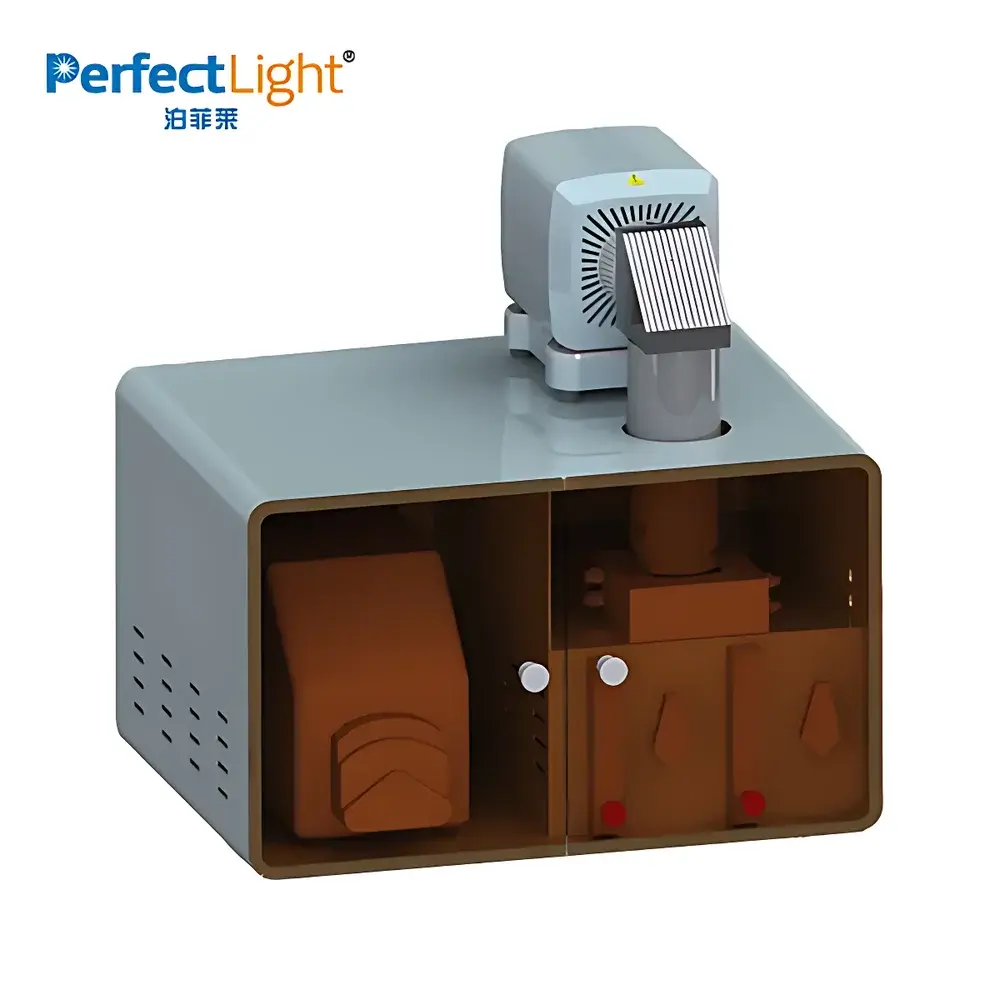
PLR-100 Plate-Type Microchannel Continuous Flow Photoreactor
| Brand | PerfectLight |
|---|---|
| Model | PLR-100 |
| Reactor Type | Plate-type microchannel continuous flow photoreactor |
| Light Source Wavelength Range | 255–760 nm (multi-wavelength selectable) |
| Light Source Geometry | Planar LED array |
| Light Source Lifetime | >10,000 h |
| Adjustable Unit Power | 10–120 W |
| Temperature Control Range | −20 to +80 °C |
| Reaction Volume per Channel | 5 mL or 10 mL (configurable) |
| Reaction Phases Supported | Gas–liquid, liquid–liquid, liquid–solid |
| Gas–Liquid Channel Configuration | 3 liquid channels + 1 dedicated gas channel |
| Liquid Flow Rate Range | 1.5–8.5 mL/min |
| Gas Flow Rate Range | 4–20 mL/min |
| Flow Regime | Taylor (slug) flow optimized for interfacial mass transfer |
| In-line Monitoring | Fiber-optic UV-Vis spectrometer for real-time effluent absorbance profiling |
| Dimensions (W × D × H) | 810 × 600 × 500 mm |
| Compliance | Designed for lab-scale process intensification under GLP-aligned operation |
Overview
The PLR-100 Plate-Type Microchannel Continuous Flow Photoreactor is an engineered platform for precise, scalable photochemical synthesis under controlled flow conditions. Based on Couette-type laminar flow principles within parallel-plate microchannels, it enables high surface-area-to-volume ratio irradiation and efficient photon delivery to reaction mixtures. Unlike batch photochemistry—where light penetration depth, thermal gradients, and mixing inefficiencies limit reproducibility—the PLR-100 delivers uniform irradiance across the entire fluid cross-section via a planar, high-stability LED array. Its modular plate architecture supports consistent residence time distribution (RTD), critical for kinetic studies and photoredox catalysis where quantum yield and photon flux directly govern product selectivity. The system is specifically designed for laboratory validation of continuous photoprocesses prior to pilot-scale implementation, with compatibility for radical-mediated transformations initiated by UV or visible light—including C–C bond formation, C–heteroatom coupling, and solar-simulated photocatalytic oxidation.
Key Features
- Plate-based microchannel geometry enabling rapid heat and mass transfer, with integrated Peltier-based temperature control (−20 to +80 °C) for exothermic/endothermic photoreactions.
- Multi-wavelength, spectrally tunable LED source (255–760 nm) with independent power regulation (10–120 W per unit), supporting both narrowband excitation and broad-spectrum solar simulation.
- Dedicated gas–liquid manifold design: three parallel liquid channels co-fed with one centralized gas channel to generate stable Taylor (slug) flow—maximizing interfacial area while minimizing back-mixing and channel clogging.
- In-line fiber-optic UV-Vis spectrometer for real-time monitoring of reaction progress via time-resolved absorbance spectra (e.g., decay of photoinitiator, emergence of chromophoric intermediates).
- Expandable architecture: multiple PLR-100 units can be operated in parallel for reaction screening or scale-out without re-optimization of individual channel hydraulics.
- Electrochemical integration port: optional electrode interface for combined photoelectrocatalytic workflows (e.g., paired photoredox/electrosynthesis).
Sample Compatibility & Compliance
The PLR-100 accommodates heterogeneous and multiphase reaction systems—including slurries containing solid photocatalysts (e.g., TiO₂, g-C₃N₄), immiscible solvent pairs (e.g., acetonitrile/water), and gas-dosed substrates (e.g., O₂, CO, H₂). All wetted surfaces are constructed from chemically resistant materials (316L stainless steel, fused silica, PFA-lined tubing) compatible with common organic solvents, acidic/basic media, and halogenated reagents. The reactor meets mechanical and electrical safety requirements per IEC 61010-1 and is configured for use in ISO/IEC 17025-accredited laboratories. While not certified as GMP-compliant out-of-the-box, its digital logging, parameter traceability, and audit-ready data export support GLP documentation and FDA 21 CFR Part 11–aligned validation when deployed with compliant software extensions.
Software & Data Management
The PLR-100 operates via a dedicated Windows-based control interface that synchronizes pump actuation, temperature setpoints, light intensity, and spectral acquisition at millisecond resolution. All operational parameters—including flow rates, temperature profiles, irradiance values, and real-time absorbance traces—are timestamped and stored in HDF5 format for traceability. Export options include CSV, MATLAB .mat, and JSON for integration into LIMS or electronic lab notebooks (ELN). The software enforces user role-based access control and maintains immutable audit trails for critical parameters—essential for method transfer and regulatory submissions. Optional API access enables integration with third-party automation platforms (e.g., Opentrons, ChemSpeed) for closed-loop reaction optimization.
Applications
- Photocatalytic C–H functionalization using Ir/Ru polypyridyl complexes or organic dyes under visible light.
- Photoinduced electron transfer (PET) reactions requiring strict oxygen exclusion and precise photon dosing.
- Solar-driven water oxidation or CO₂ reduction model studies with suspended semiconductor catalysts.
- Continuous-flow photo-Fries rearrangement, [2+2] cycloadditions, and Norrish-type cleavages.
- Process intensification of high-value pharmaceutical intermediates where photolysis replaces stoichiometric oxidants.
- Reaction mechanism elucidation via stopped-flow spectrokinetics coupled with in-line detection.
FAQ
Can the PLR-100 be used for reactions requiring inert atmosphere control?
Yes—integrated gas manifolds and pressure-regulated back-pressure regulators allow full inertization (N₂, Ar) and controlled gas stoichiometry during operation.
Is the optical path length adjustable for different absorbance ranges?
No—the 5 mm fixed-path fiber-optic probe is calibrated for standard flow-cell absorbance quantification; alternative probe geometries require custom integration.
Does the system support automated wavelength scanning during a single run?
Not natively—the LED array is configured for static wavelength selection per experiment; dynamic spectral sweeps require external monochromator coupling.
What maintenance is required for long-term reliability?
Annual calibration of temperature sensors and flow meters is recommended; LED output is monitored automatically and flagged if deviation exceeds ±3% of nominal intensity.
Can reaction slurries with particles >50 µm be processed?
Not advised—maximum recommended particle size is 20 µm to prevent channel occlusion; inline filtration (0.45 µm PTFE) is strongly recommended for heterogeneous suspensions.



