
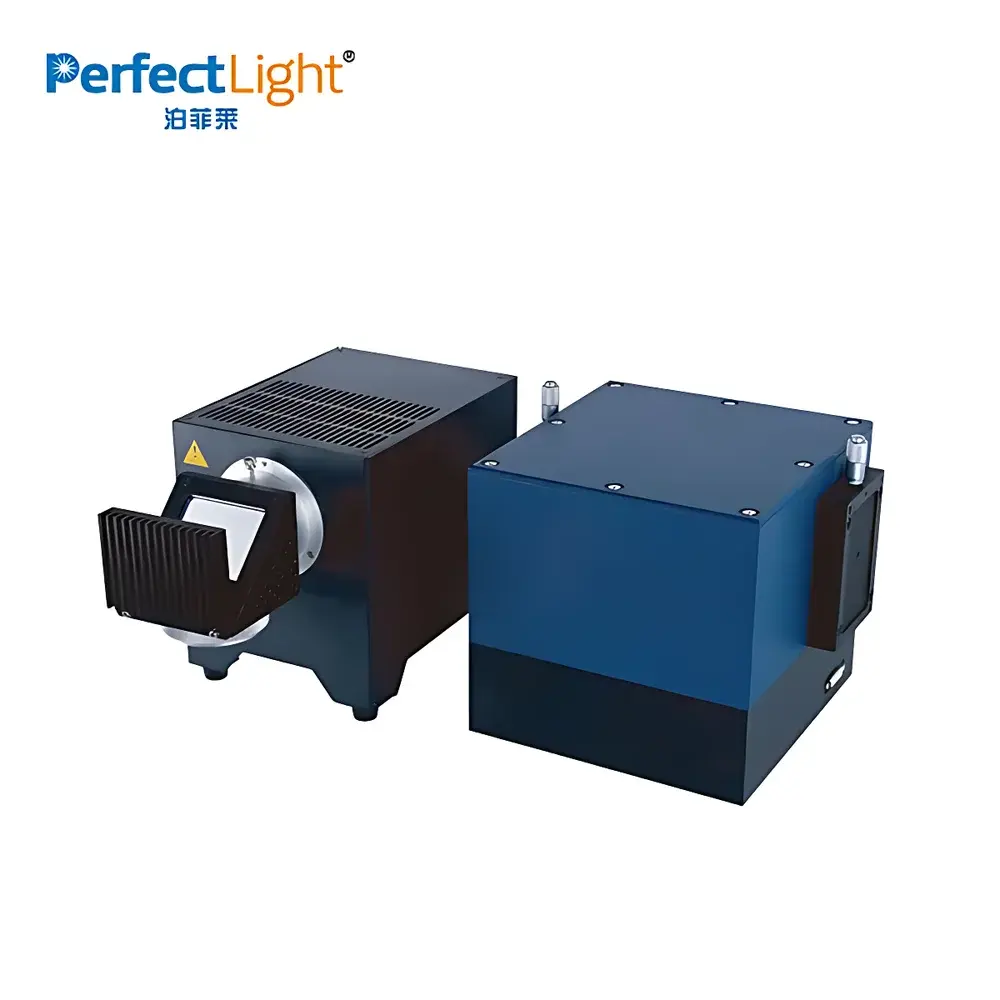
PLS-AL150300 Tunable Monochromatic Light Source
| Brand | PerfectLight |
|---|---|
| Origin | Beijing, China |
| Light Source Type | Xenon Lamp |
| Illumination Mode | External Irradiation |
| Focal Length | 150 mm |
| f-number | f/2.5 |
| Stray Light Level | 5×10⁻⁴ |
| Wavelength Step Resolution | 1 nm |
| Grating Type | Imported Dual Grating |
| Grating Active Area | 45×45 mm² |
| Groove Density | 2400 lines/mm (multiple options available) |
| Blaze Wavelengths | 300 nm & 780 nm |
| Output Wavelength Range | 350–750 nm |
| Slit Width Adjustment | 0.01–3 nm (continuous manual) |
| Optional Motorized Filter Wheel | 4-position, anti-secondary-diffraction filters |
Overview
The PLS-AL150300 Tunable Monochromatic Light Source is a high-performance, research-grade optical instrument engineered for precision wavelength selection in photoelectrochemical (PEC), photovoltaic, and quantum efficiency studies. Based on a double-grating monochromator architecture coupled with a stabilized 300 W xenon arc lamp, it delivers spectrally pure, continuously tunable output across the visible spectrum (350–750 nm). Its optical design incorporates aberration-corrected optics and optimized beam path geometry to minimize chromatic distortion and maximize throughput. The system operates on the principle of angular dispersion via ruled diffraction gratings—where incident broadband light is spatially separated by wavelength and isolated through a variable entrance/exit slit assembly. This enables rigorous control over spectral bandwidth (0.01–3 nm), critical for reproducible action spectrum measurements and wavelength-resolved photocurrent quantification.
Key Features
- Double-grating monochromator configuration with two independently selectable blazed gratings (300 nm and 780 nm), ensuring optimal efficiency across UV–VIS range
- High stray-light suppression (<5×10⁻⁴), achieved through optimized baffling, blackened internal surfaces, and grating alignment precision—essential for low-signal detection in quantum yield experiments
- 150 mm focal length and f/2.5 optical speed balance resolution, throughput, and compact footprint for integration into gloveboxes or optical tables
- Manual continuous slit adjustment (0.01–3 nm) allows fine-tuning of spectral bandwidth to match detector responsivity and sample absorption characteristics
- Motorized 4-position filter wheel (optional) equipped with anti-secondary-diffraction interference filters to eliminate higher-order spectral contamination
- Robust mechanical architecture with calibrated wavelength drive mechanism offering 1 nm step resolution and repeatability within ±0.2 nm over extended operation
Sample Compatibility & Compliance
The PLS-AL150300 is compatible with standard electrochemical cells (e.g., three-electrode PEC reactors), microfluidic photoreactors, integrating spheres for absolute quantum efficiency calibration, and custom-built optical mounts using SM1-threaded or kinematic interfaces. Its external irradiation geometry supports in situ illumination of solid-state electrodes, thin-film devices, and liquid-phase reaction systems without optical coupling constraints. The system complies with general laboratory safety standards for Class 3B optical radiation (IEC 60825-1) and includes interlocked housing and shutter mechanisms. While not certified to ISO/IEC 17025, its wavelength accuracy and repeatability support GLP-aligned experimental protocols; traceable calibration certificates for grating position and slit width are available upon request.
Software & Data Management
The PLS-AL150300 operates via RS232 or USB interface and is compatible with third-party control platforms including LabVIEW, MATLAB, and Python-based automation scripts (PySerial, PyVISA). A vendor-provided Windows application enables full parameter scripting: wavelength sweeps, dwell time per step, slit width sequences, and synchronized filter wheel positioning. All operational parameters—including lamp hours, grating selection, slit setting, and wavelength timestamp—are logged in CSV format for auditability. For regulated environments, users may implement 21 CFR Part 11-compliant electronic signatures and audit trails via integrated LIMS or ELN systems, though native FDA compliance is not embedded in firmware.
Applications
- Wavelength-dependent incident photon-to-current efficiency (IPCE) mapping of dye-sensitized, perovskite, and tandem solar cells
- Quantum yield determination in heterogeneous photocatalysis (e.g., water splitting, CO₂ reduction) under monochromatic excitation
- Action spectrum analysis of photoactive biological systems (e.g., photosynthetic membranes, optogenetic probes)
- Calibration of spectroradiometers and reference photodetectors across the visible band
- Time-resolved photocurrent spectroscopy when synchronized with potentiostats and digital delay generators
- Optical characterization of luminescent materials via excitation-emission matrix (EEM) acquisition
FAQ
What is the typical spectral bandwidth at 1 nm slit setting?
At 1 nm nominal slit width and 500 nm center wavelength, the measured full-width-at-half-maximum (FWHM) is approximately 1.2 nm, verified using a NIST-traceable reference laser line.
Can this system be used with fiber-optic coupling?
Yes—standard SMA905 or FC/PC fiber adapters (optional) allow flexible beam delivery; however, coupling efficiency varies with NA and core diameter, and must be characterized per setup.
Is lamp intensity stabilization included?
No active feedback intensity stabilization is built-in; users should employ external neutral density filters or closed-loop power meters for irradiance control during long-duration scans.
How often does the xenon lamp require replacement?
Under normal operation (≤8 h/day), the 300 W xenon lamp maintains stable output for ~1,000 hours; output decay beyond ±5% deviation from initial radiance warrants recalibration or replacement.
Are grating alignment tools provided for user maintenance?
Yes—a collimated He–Ne alignment laser and adjustable mirror mount kit are included for periodic grating optimization, following procedures outlined in the technical manual.




