
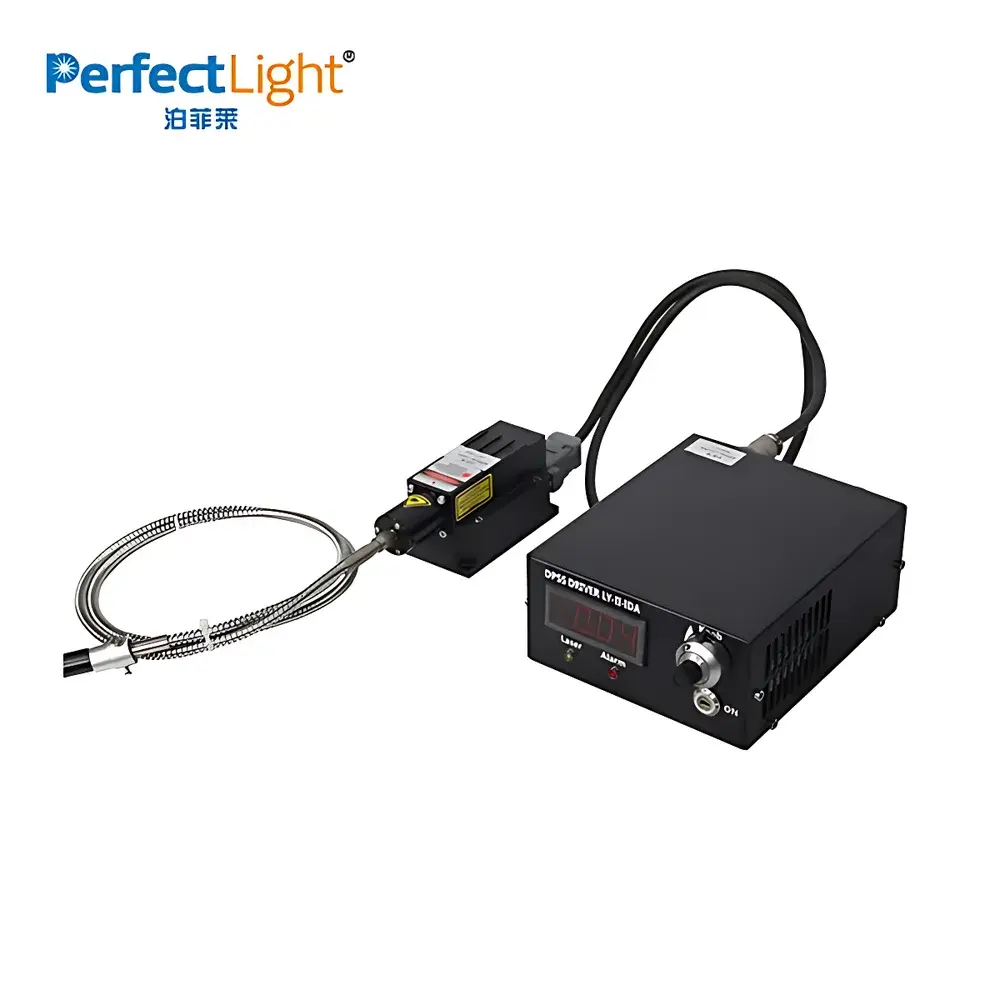
PLS-LD Laser Light Source
| Brand | PerfectLight |
|---|---|
| Origin | Beijing, China |
| Manufacturer Type | Authorized Distributor |
| Product Origin | Domestic (China) |
| Model | PLS-LD Laser |
| Light Source Type | Monochromatic Diode Laser |
| Irradiation Mode | External Illumination |
| Output Power | >100 mW (wavelength-dependent) |
| Spectral Bandwidth (FWHM) | <2.5 nm |
| Beam Divergence | ≤60° (with fiber + collimating lens) / ≤1.2 mrad (collimated beam) |
| Collimated Beam Diameter (Entrance Pupil) | 40 mm |
| Available Wavelengths | 405 nm, 447 nm, 473 nm, 532 nm, 635 nm, 671 nm |
| Output Options | Free-space direct output or fiber-coupled (with optional coupling kit) |
| Warm-up Time | <8 min |
| Modulation Support | TTL and Analog, up to 20 kHz |
| Cooling & Stability | Integrated precision thermoelectric cooling and constant-current driver for wavelength and power stability |
Overview
The PLS-LD Laser Light Source is a high-stability, narrow-band monochromatic illumination system engineered for quantitative photochemical and photoelectrochemical research. Unlike broadband sources such as xenon arc lamps or LEDs—whose spectral output requires filtering and suffers from low photon flux density at target wavelengths—the PLS-LD utilizes semiconductor diode laser technology to deliver intense, spectrally pure irradiation with minimal thermal drift and exceptional temporal reproducibility. Its core operating principle relies on stimulated emission in gain media optimized for discrete visible wavelengths, enabling precise excitation of electronic transitions in photocatalysts, semiconductors, and molecular photosensitizers. Designed for laboratory environments where wavelength selectivity, irradiance stability, and experimental repeatability are critical—particularly in quantum yield determination and action spectrum analysis—the PLS-LD meets the metrological requirements of ISO 10678 (photocatalysis), ASTM E265 (quantum yield measurement), and IUPAC-recommended protocols for actinometry.
Key Features
- Monochromatic output with full-width half-maximum (FWHM) <2.5 nm—significantly narrower than filtered xenon or LED-based systems, ensuring high spectral fidelity and minimizing parasitic excitation.
- Thermoelectrically stabilized laser diode architecture with constant-current driving circuitry, maintaining output power variation <±1.5% over 8-hour continuous operation at ambient temperatures of 15–30 °C.
- Adjustable beam geometry: selectable between collimated output (40 mm entrance pupil, divergence ≤1.2 mrad) and diffuse illumination via integrated diffuser optics—enabling uniform irradiation across reactor surfaces up to 10 cm².
- Dual modulation capability: supports both TTL digital triggering and analog intensity control up to 20 kHz, facilitating time-resolved photokinetic studies, pump-probe experiments, and synchronized detection schemes.
- Modular optical interface: standard free-space output port compatible with custom collimators, filters, or beam splitters; optional FC/PC or SMA fiber coupling kits available for integration into closed-loop flow cells or fiber-optic spectrometers.
- Rapid thermal equilibration: achieves operational stability within <8 minutes after cold start, reducing experimental setup overhead and improving daily throughput in high-volume testing labs.
Sample Compatibility & Compliance
The PLS-LD is compatible with standard quartz and fused-silica reaction vessels (e.g., top-irradiated Pyrex reactors, flat-bottomed cuvettes, and electrochemical three-electrode cells). Its external irradiation configuration allows seamless integration with commercial PEC workstations (e.g., CHI, Autolab, or VersaSTAT platforms) and custom-built photoelectrochemical cells equipped with transparent conductive oxide (TCO) windows. The system complies with CE safety directives (2014/35/EU Low Voltage Directive and 2014/30/EU EMC Directive) and conforms to IEC 60825-1:2014 Class 3B laser safety standards when operated with appropriate interlocks and beam enclosures. For GLP/GMP-aligned laboratories, instrument logs—including runtime, modulation history, and temperature setpoints—can be exported in CSV format for audit trail generation per FDA 21 CFR Part 11 requirements.
Software & Data Management
While the PLS-LD operates as a standalone hardware unit, its analog/TTL interface enables native synchronization with third-party data acquisition systems (e.g., National Instruments DAQmx, MATLAB Data Acquisition Toolbox, or LabVIEW-based control suites). Optional OEM firmware upgrades support RS-232 or USB-C serial communication for remote parameter adjustment (e.g., current setpoint, modulation duty cycle) and real-time monitoring of junction temperature and output power via internal photodiode feedback. All calibration certificates—including spectral profile (measured by calibrated Ocean Insight QE Pro spectrometer), power linearity (NIST-traceable thermopile sensor), and beam homogeneity (measured using Thorlabs BP109-IR beam profiler)—are provided with each unit and archived in PDF format compliant with ISO/IEC 17025 documentation standards.
Applications
- Quantum Yield Measurement: Primary application per ISO 10678; enables absolute actinometric quantification of photoreaction efficiency under defined monochromatic irradiance (e.g., using potassium ferrioxalate or Aberchrome 540 as reference actinometers).
- Photoelectrochemical (PEC) Characterization: Supports incident-photon-to-current-efficiency (IPCE) mapping, Mott-Schottky analysis, and transient photocurrent decay profiling in semiconductor photoanodes/cathodes under controlled wavelength excitation.
- Photocatalytic Reaction Screening: Facilitates comparative assessment of H₂/O₂ evolution, CO₂ reduction product distribution, and photodegradation kinetics across catalyst libraries without spectral interference from lamp artifacts.
- Photochromic & Photopolymerization Kinetics: Delivers stable, modulated irradiation for real-time UV-Vis tracking of spiropyran ring-opening or thiol-ene crosslinking rates under sub-second temporal resolution.
- Membrane Photocatalysis Studies: Compatible with thin-film supported catalysts mounted on optically transparent substrates (e.g., FTO-coated glass), allowing direct illumination through membrane backside while minimizing scattering losses.
FAQ
Is the PLS-LD suitable for use in regulated GMP environments?
Yes—when deployed with optional serial communication firmware and external logging software, it supports electronic records, user access controls, and audit trails required under FDA 21 CFR Part 11.
Can multiple PLS-LD units be synchronized for multi-wavelength irradiation experiments?
Yes—TTL triggering allows master-slave configuration across up to four independent units with sub-microsecond timing alignment.
What is the recommended maintenance interval for long-term power stability?
No routine optical alignment is required; however, annual verification of output power and spectral FWHM against NIST-traceable references is advised per ISO/IEC 17025 quality management guidelines.
Does the system include laser safety interlocks or enclosure options?
The base unit does not include interlocked enclosures, but third-party Class 3B-compliant beam housings (e.g., Thorlabs LCP1 or Newport 98-1100 series) can be integrated via standard SM1-threaded mounting interfaces.
How is beam homogeneity validated for catalytic reactor illumination?
Each unit ships with a spatial intensity map acquired using a 12-bit CMOS beam profiler; uniformity across the 40 mm collimated aperture is specified as ≥92% RMS flatness (per ISO 11146-2).





