
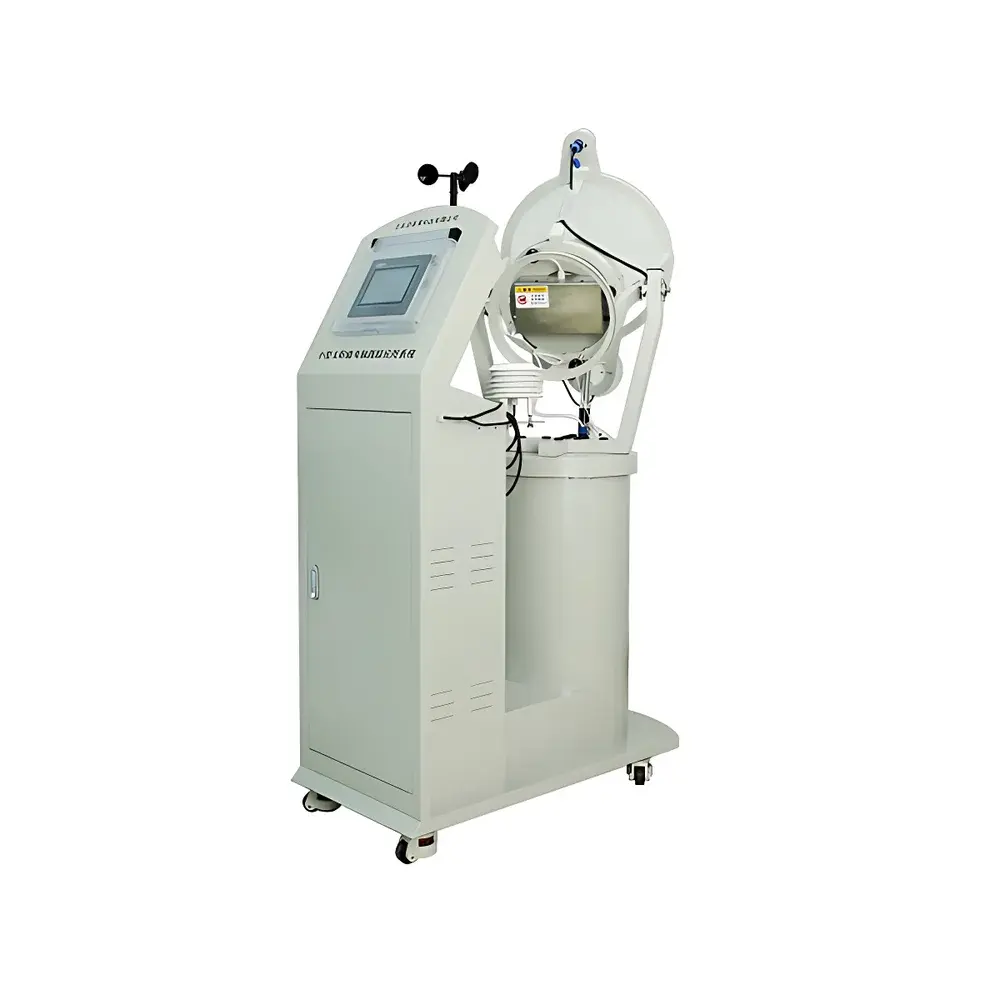
PLS-STAS-I Small-Scale Dual-Axis Solar Tracking Application System
| Brand | PerfectLight |
|---|---|
| Origin | Beijing, China |
| Model | PLS-STAS-I |
| Light Source Type | Direct Natural Sunlight (Outdoor Concentrated Illumination) |
| Illumination Mode | Internal Irradiation Configuration |
| Tracking Method | Hybrid Optical + Astronomical Time-Based Tracking |
| Elevation Range | 0–90° |
| Azimuth Range | −110° to +110° (0° = True South) |
| Tracking Accuracy | <0.3° (Optical), <1° (Time-Based) |
| Fresnel Lens Area | 0.2 m² |
| Minimum Focal Spot Area | 7 cm² |
| Concentration Ratio | 278× |
| Operating Temperature | 5–60°C |
| Ambient Temperature Range | −25°C to +55°C |
| Pressure Condition | Ambient Atmospheric |
| Gas Collection | 300 mL / 500 mL Gas Sampling Bags |
| Photosynthetic/Photochemical Irradiance Measurement | ≤10 W/cm² |
| Radiation Monitoring | Direct & Global Solar Irradiance |
| Environmental Sensors | Ambient Temperature, Relative Humidity, Barometric Pressure, Wind Speed |
| IP Rating | IP67 |
| Wind Resistance | Up to Beaufort Scale 6 |
| Control Architecture | Integrated PLC with GPS Geolocation and Real-Time Parameter Logging |
| Safety Features | End-Position Limit Switches, Wind-Activated Auto-Stow, Rain Detection & Shutdown |
Overview
The PLS-STAS-I Small-Scale Dual-Axis Solar Tracking Application System is a field-deployable, research-grade platform engineered for outdoor photoreactor operation under natural sunlight. Unlike conventional laboratory-scale photocatalytic systems relying on artificial xenon or mercury arc lamps to approximate solar spectra, the PLS-STAS-I enables direct utilization of unfiltered, time-varying extraterrestrial solar irradiance—capturing spectral fidelity, diurnal intensity gradients, and real-world angular incidence dynamics essential for translational solar energy research. Its core architecture integrates a hybrid tracking methodology: real-time optical feedback (photodiode array-based sun sensing) augmented by high-precision astronomical ephemeris computation (GPS-synchronized time-based trajectory prediction). This dual-mode strategy ensures robust performance under partial cloud cover, low-diffuse-ratio conditions, and transient irradiance fluctuations where pure photoelectric tracking may fail—thereby eliminating positional drift, mechanical overshoot, or hazardous misalignment during variable sky conditions.
Key Features
- Hybrid dual-axis solar tracking system combining closed-loop optical sensing and open-loop astronomical time-based control, delivering 30% cloud cover).
- Integrated 0.2 m² Fresnel lens concentrator achieving 278× geometric concentration, producing a minimum focal spot of 7 cm² with peak irradiance up to 10 W/cm²—sufficient for accelerated photocatalytic kinetics and concentrated photovoltaic (CPV) cell evaluation.
- Weather-hardened enclosure rated IP67 with active wind-stow protocol (Beaufort 6 threshold) and rain-activated shutdown logic, enabling unattended outdoor deployment across temperate, arid, and humid continental climates (−25°C to +55°C operating envelope).
- Onboard PLC controller with embedded GPS module for automatic latitude/longitude/UTC synchronization, enabling autonomous recalibration of solar ephemeris parameters without manual input.
- Comprehensive environmental telemetry suite: direct normal irradiance (DNI), global horizontal irradiance (GHI), ambient temperature, relative humidity, barometric pressure, and anemometric wind speed—all logged synchronously with tracker kinematics (elevation/azimuth angles) and reactor state variables.
- Modular gas-handling interface supporting quantitative collection via calibrated 300 mL and 500 mL Tedlar® gas sampling bags, compatible with offline GC-TCD/FID or online mass spectrometry for stoichiometric product analysis.
Sample Compatibility & Compliance
The PLS-STAS-I supports heterogeneous photocatalytic reactors (slurry-phase, immobilized thin-film, monolithic configurations), CPV mini-modules (up to 5 cm × 5 cm active area), and hybrid photoelectrochemical cells requiring stable, high-flux illumination under realistic solar incidence angles. All structural materials comply with ISO 9001-certified manufacturing protocols; optical components meet ISO 10110 surface quality standards (scratch-dig 60-40). The system’s data acquisition firmware supports audit-trail logging per GLP principles, with timestamped parameter records traceable to UTC via GPS pulse-per-second (PPS) signal. While not FDA 21 CFR Part 11–certified out-of-box, raw sensor logs (CSV/JSON export) are structured for integration into validated LIMS environments.
Software & Data Management
The integrated HMI displays real-time solar geometry (zenith/azimuth), irradiance metrics, environmental sensor outputs, and actuator status. Historical data—including angle trajectories, DNI/GHI time-series, thermal profiles, and gas collection timestamps—is stored locally on industrial-grade SD card (≥16 GB) with cyclic overwrite protection. Export formats include ISO 8601–compliant CSV and IEEE C37.118–aligned time-series JSON. Optional Ethernet/Wi-Fi gateway enables remote monitoring via Modbus TCP or MQTT, facilitating integration with campus-wide energy research databases or cloud-based analytics platforms (e.g., PVLIB-Python post-processing pipelines).
Applications
- Photocatalytic Reactor Validation: Quantitative assessment of CO₂ reduction, H₂ evolution, or NOₓ degradation under true solar spectra and dynamic irradiance—enabling kinetic modeling under non-stationary boundary conditions.
- CPV Cell Screening & Degradation Studies: Accelerated lifetime testing of multi-junction solar cells under concentrated natural sunlight (up to 278 suns), correlating thermal stress, spectral mismatch, and efficiency loss over seasonal cycles.
- Hybrid Photoelectrochemical Systems: Coupling of tracked solar input with electrolyzer stacks or redox flow batteries to evaluate round-trip solar-to-fuel efficiency in integrated renewable energy demonstration setups.
- Solar Spectral Responsivity Mapping: Empirical determination of action spectra for novel photocatalysts by correlating wavelength-resolved quantum yield with measured DNI spectral components (when paired with optional spectroradiometer add-on).
FAQ
What is the minimum usable solar irradiance for reliable optical tracking?
The optical sensor subsystem maintains lock-on capability down to ≈200 W/m² direct normal irradiance—equivalent to overcast morning/evening conditions with visible sun disk discernible through cloud gaps.
Can the system operate autonomously for extended unattended periods?
Yes. With full GPS synchronization and onboard battery backup (optional 12 V DC auxiliary supply), continuous operation exceeding 72 hours is achievable under standard configuration, including weather-triggered stow sequences and scheduled self-diagnostic routines.
Is calibration of the Fresnel lens focus required before each experiment?
No. The focal plane is factory-aligned and mechanically fixed; however, periodic verification using a thermopile-based irradiance map (recommended annually) ensures long-term flux uniformity compliance.
Does the system support third-party reactor integration?
Yes. Standardized 1/4″-20 threaded mounting points and 0–10 V analog I/O ports allow mechanical and electrical interfacing with external reaction vessels, temperature controllers, or gas chromatographs.
How is data integrity ensured during power interruption?
Non-volatile FRAM memory retains critical tracker state and last-known position; upon power restoration, the PLC reinitializes using GPS-derived ephemeris and resumes tracking within ±0.5° without manual intervention.






