
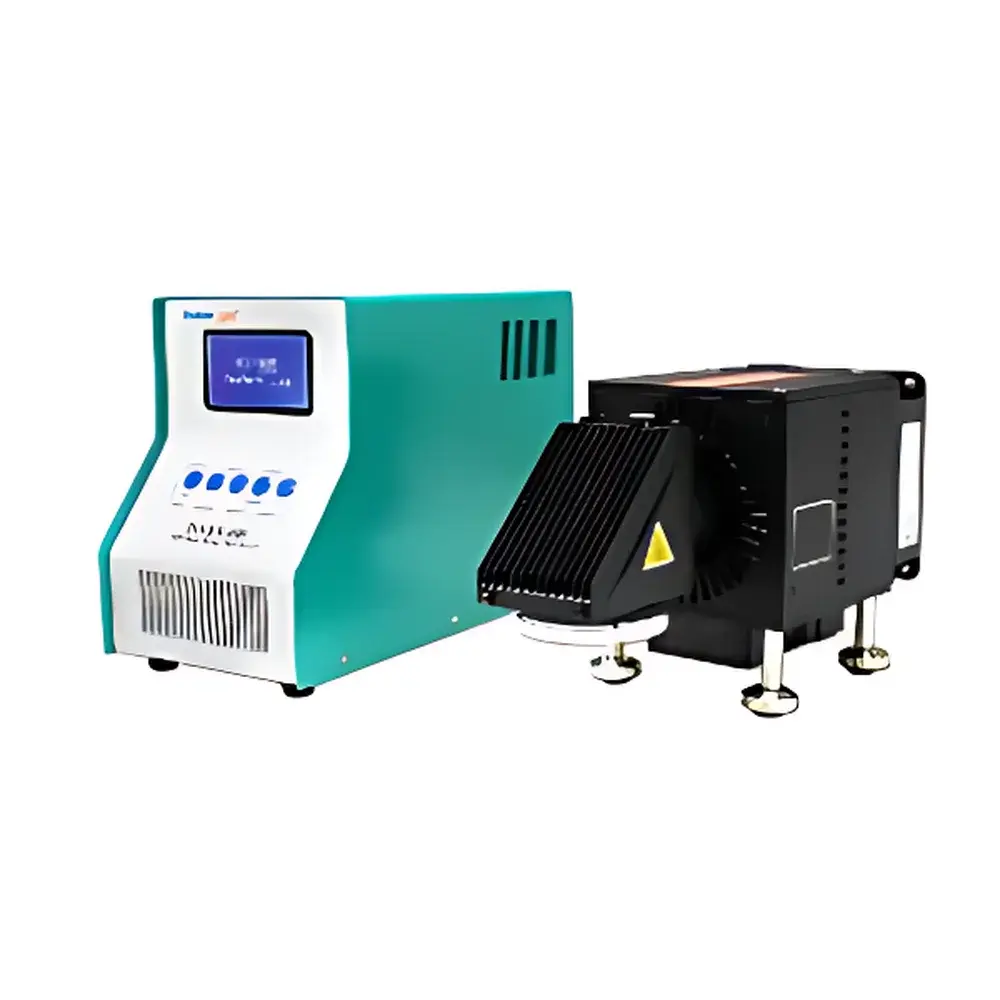
PLS-SXE300E/300EUV Xenon Light Source
| Brand | PerfectLight |
|---|---|
| Origin | Beijing, China |
| Model | PLS-SXE300E / PLS-SXE300EUV |
| Lamp Type | 300 W Short-Arc Xenon Lamp |
| Illumination Mode | External Irradiation |
| Power Adjustment Range | 150–300 W |
| Power Supply Ripple | 150 mVp-p |
| Load Regulation | ±0.5% |
| Current Limit Setting | 21 A |
| Lamp Lifetime | >1000 h (under standard photocatalytic operating conditions) |
| Total Optical Output Power | 50 W |
| Spectral Range | 320–780 nm (extendable to 320–2500 nm with optional optics) |
| Beam Divergence | ~6° (full angle, average) |
| Spot Diameter | 30–60 mm (distance-dependent) |
| Long-Term Intensity Stability | ≤±3% (over 8 h) |
| Triggering Method | Integrated High-Voltage Ignition (dual-stage, no high-voltage cabling between lamp and power supply) |
| Cooling Architecture | Axial Air-Cooling System (Patent No. CN201320740323.5) |
| Control Interface | RS232/USB for PC-based software control |
| Safety Features | Fan-failure shutdown, auto-startup, post-shutdown cooling delay, over-current & over-load protection |
| Housing Material | Non-metallic lamp housing |
Overview
The PLS-SXE300E and PLS-SXE300EUV are high-stability, externally irradiating xenon light sources engineered for precision photoreactivity studies in research laboratories. Based on a 300 W short-arc xenon lamp, these systems deliver broadband spectral output spanning 320–780 nm — covering the full UV-A, visible, and near-IR regions critical for photocatalysis, photoelectrochemistry, and quantum yield measurements. The optical architecture is optimized for collimated external illumination, enabling direct integration into custom reaction chambers, gas-phase flow reactors, or liquid-phase immersion setups without internal lamp placement constraints. Unlike conventional mercury-based or LED-only sources, the xenon arc provides continuous, solar-spectrum-like emission with high radiance and excellent temporal stability — essential for kinetic reproducibility in time-resolved photocatalytic experiments.
Key Features
- Engineered digital power supply with microprocessor-controlled regulation ensures ≤±3% long-term intensity stability over 8-hour operation — meeting ISO 17025 traceability requirements for quantitative irradiance-based assays.
- Integrated dual-stage ignition eliminates high-voltage transmission cables between lamp and power unit, significantly reducing electromagnetic interference and electrical safety hazards in shared lab environments.
- Patented axial air-cooling system (CN201320740323.5) maintains thermal equilibrium across the lamp envelope and quartz window, minimizing spectral drift and preventing premature quartz devitrification.
- Non-metallic lamp housing complies with IEC 61010-1 Class II insulation standards, mitigating ground-loop risks and enhancing compatibility with grounded electrochemical cells or Faraday cages.
- Full remote operation via RS232/USB interface enables synchronized triggering with data acquisition systems, shutter controllers, and environmental monitoring units — supporting GLP-compliant experimental protocols.
- Front-panel digital current display and programmable current limiting (up to 21 A) allow real-time power calibration and safe operation under variable load conditions.
Sample Compatibility & Compliance
The PLS-SXE300E/300EUV supports diverse sample configurations including gas-phase photoreactors (e.g., VOC oxidation), aqueous suspension systems (e.g., TiO₂-mediated dye degradation), thin-film photoelectrodes (PEC water splitting), and solid-state photocatalyst pellets. Its external irradiation geometry avoids thermal coupling between lamp and sample — preserving temperature-sensitive reaction kinetics. The system meets CE marking requirements for electromagnetic compatibility (EN 61326-1) and low-voltage safety (EN 61010-1). When paired with NIST-traceable reference detectors and calibrated filter sets, it supports ASTM E2938-22 (Standard Practice for Calibration of Broadband UV-Vis-NIR Radiometers) and ISO 11477 (Plastics — Determination of irradiance in weathering tests).
Software & Data Management
PerfectLight’s proprietary control software (Windows-compatible, x64) provides real-time monitoring of lamp current, voltage, runtime, and fault status logs. Users can define multi-step irradiation sequences — including ramped power profiles, timed on/off cycles, and conditional triggers based on external sensor inputs (e.g., temperature or O₂ evolution rate). All operational parameters and timestamps are recorded in CSV-formatted audit trails compliant with FDA 21 CFR Part 11 requirements when deployed on validated laboratory networks. Software updates include firmware-level calibration persistence and secure user-role management (admin/operator/guest tiers).
Applications
- Photocatalytic Water Splitting: Enables quantitative H₂/O₂ co-evolution studies under simulated AM1.5G illumination when combined with bandpass filters and reference solar cells.
- CO₂ Photoreduction: Supports product-selectivity mapping (CH₄, CO, C₂H₄) in gas-phase reactors using tunable UV–vis irradiation and in situ FTIR coupling.
- Air & Water Purification Research: Facilitates kinetic modeling of VOC and dye degradation pathways under controlled photon flux (measured via calibrated photodiode or thermopile sensors).
- Photoelectrochemical Characterization: Serves as a stable bias-light source for J–V curve acquisition and incident-photon-to-current-efficiency (IPCE) measurements per ASTM G173-03.
- Material Photostability Testing: Used in accelerated aging protocols for organic semiconductors and perovskite films under controlled spectral weighting (e.g., UV-B cut-off or NIR-enhanced output).
FAQ
What spectral range does the PLS-SXE300EUV cover, and how is UV extension achieved?
The base configuration emits from 320–780 nm. UV extension down to 250 nm and IR extension up to 2500 nm require optional fused silica or CaF₂ optical windows, quartz or sapphire collector lenses, and compatible bandpass filters — all available as factory-configured options.
Can this source be integrated into an automated reaction platform?
Yes — the RS232/USB interface supports Modbus RTU and SCPI command sets, enabling seamless integration with LabVIEW, Python-based control frameworks, or PLC-driven reactor automation systems.
Is the lamp lifetime specification verified under continuous or pulsed operation?
The >1000 h rating is validated under continuous DC operation at rated power (300 W) with proper cooling and stable line voltage; pulsed operation may extend lifetime but requires custom current-profile validation.
How is irradiance uniformity ensured across the illuminated area?
Uniformity (±5% over central 80% of beam) is achieved through collimating optics and optional homogenizers (e.g., fly’s-eye lens arrays or liquid light guides); flat-top profiles are attainable with the PLS-ULM series匀光器 (uniformity module).
Does the system support compliance with GLP or ISO 17025 documentation requirements?
Yes — firmware-embedded calibration certificates, electronic logbooks with digital signatures, and exportable metadata (including lamp serial number, ignition count, and cumulative operating hours) fulfill key documentation elements for accredited testing laboratories.




