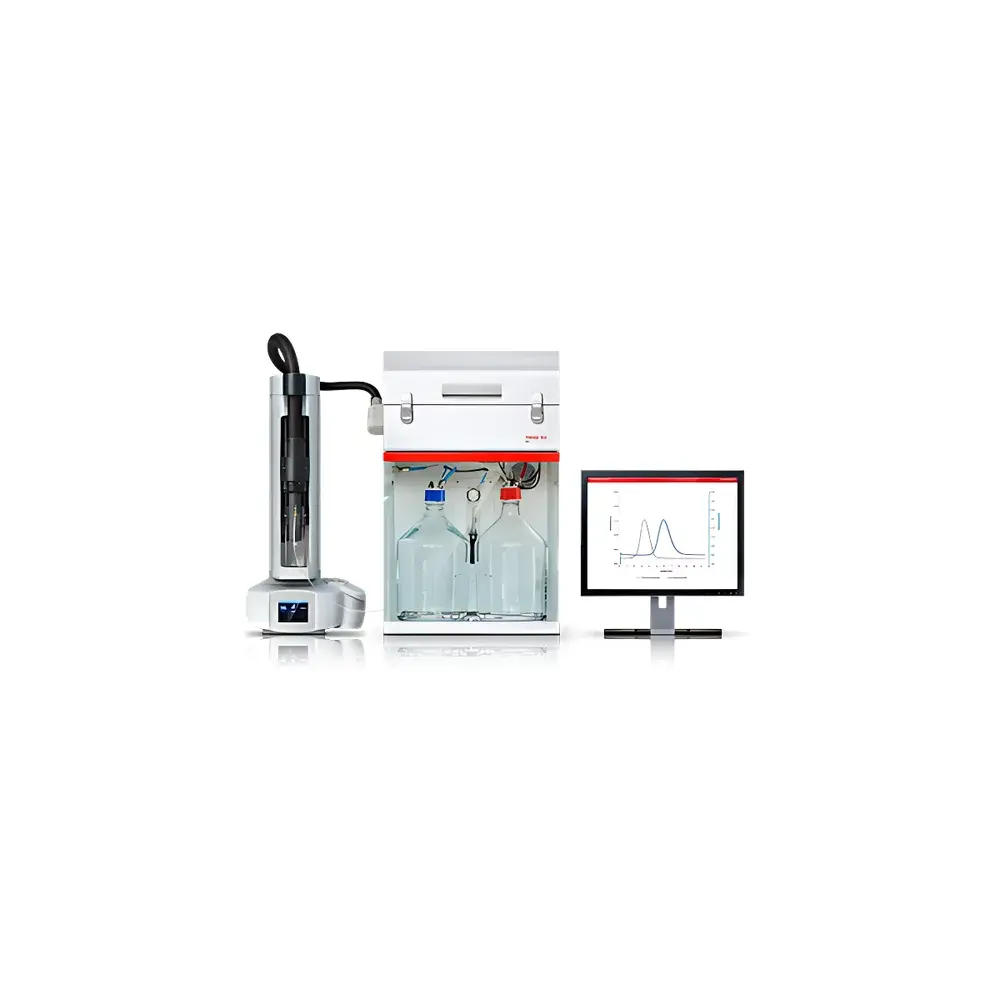
Polymer Char IVA Automated Intrinsic Viscosity Analyzer for Polymer Materials
| Brand | Polymer Char |
|---|---|
| Origin | Spain |
| Model | IVA |
| Dissolution Temperature Range | Up to 200 °C |
| Sample Capacity | 42 positions |
| Capillary System | Dual stainless-steel capillary viscometer |
| Optional Detector | IR4 infrared detector for C–H bond quantification |
| Solvent Handling | Fully automated solvent addition, dissolution, and system cleaning |
| Compliance Framework | Designed for GLP-compliant laboratories |
Overview
The Polymer Char IVA Automated Intrinsic Viscosity Analyzer is an engineered solution for precise, high-throughput intrinsic viscosity (IV) determination of synthetic polymers—particularly polyolefins such as polyethylene (PE) and polypropylene (PP). It operates on the principle of differential pressure measurement across dual parallel stainless-steel capillaries, enabling direct calculation of relative viscosity (ηrel) via simultaneous solvent and polymer solution pressure drop detection. Intrinsic viscosity is then derived using the Huggins or Kraemer equation, incorporating mass concentration determined either gravimetrically or—when equipped with the optional IR4 infrared detector—via real-time C–H bond absorbance calibration. Unlike classical Ubbelohde viscometers requiring manual timing, rinsing, and thermal equilibration, the IVA integrates a thermally stabilized dissolution module, programmable agitation kinetics, and closed-loop fluid handling to eliminate operator variability and ensure reproducibility across batches and laboratories.
Key Features
- Fully automated workflow: solvent dispensing, sample dissolution (up to 200 °C), viscosity measurement, and post-run system flushing—all executed without manual intervention.
- High-temperature dissolution module with programmable heating ramp, agitation speed (0–300 rpm), and dissolution duration (1–120 min), optimized to maximize solubilization of ultra-high-molecular-weight (UHMW) polyolefins while minimizing thermal degradation.
- Dual stainless-steel capillary viscometer: eliminates glass capillary fragility and solvent-induced etching; requires no post-measurement rinsing or recalibration between runs.
- 42-position autosampler with ambient external tray and heated internal transfer zone—enabling unattended overnight operation and seamless integration into routine QC pipelines.
- Optional IR4 infrared detector: provides non-destructive, solvent-independent quantification of polymer mass loading by measuring characteristic C–H stretch absorbance (2800–3000 cm−1); eliminates analytical uncertainty from manual weighing errors.
- Low solvent consumption design: typical usage < 15 mL per analysis, reducing hazardous waste generation and operational cost.
Sample Compatibility & Compliance
The IVA is validated for use with common polyolefin solvents including 1,2,4-trichlorobenzene (TCB), decalin, and xylene. It accommodates a broad molecular weight range—from conventional HDPE/LLDPE to UHMWPE (>1×10⁶ g/mol)—and handles both powder and pellet forms. The instrument’s architecture adheres to ISO 1628-1 (plastics—determination of viscosity number), ASTM D1243 (standard test method for intrinsic viscosity of polyolefins), and USP (viscosity measurements for pharmaceutical polymers). Its software supports full 21 CFR Part 11 compliance, including user authentication, electronic signatures, change control logs, and tamper-evident audit trails—making it suitable for regulated environments governed by GMP/GLP standards.
Software & Data Management
IVA Control Software provides intuitive method setup, real-time monitoring of dissolution temperature, pressure transients, and IR4 signal stability. All raw data—including differential pressure waveforms, temperature profiles, and IR absorbance integrals—are stored in vendor-neutral .csv and .xml formats. Batch reporting includes calculated IV values, Huggins/Kraemer coefficients, relative viscosity, and system diagnostic flags. Integration with LIMS via ASTM E1384-compliant interfaces enables automated result export and traceability across enterprise QA/QC systems.
Applications
- Quality control of polyolefin resin batches in petrochemical and compounding facilities.
- Correlation of intrinsic viscosity with melt flow index (MFI) and rheological behavior for process optimization.
- Stability assessment of polymer chains during extrusion, recycling, or aging studies.
- Supporting R&D of new catalyst systems by tracking molecular weight distribution shifts via IV trends.
- Regulatory submission support for medical-grade polyolefins requiring ISO 10993-compliant material characterization.
FAQ
What solvent types are compatible with the IVA system?
TCB is the primary solvent for high-temperature polyolefin analysis; decalin and xylene may be used for lower-MW grades or specialized applications.
Can the IVA measure intrinsic viscosity of copolymers?
Yes—provided the copolymer is fully soluble in the selected solvent and exhibits stable C–H absorption (for IR4-enabled mass determination).
Is calibration required before each analysis run?
No. The dual-capillary design ensures inherent zero-drift stability; only periodic verification with NIST-traceable viscosity standards is recommended per ISO/IEC 17025 guidelines.
How does the IR4 detector improve accuracy compared to gravimetric loading?
It removes cumulative error from balance precision, environmental humidity effects, and operator technique—delivering ±0.5% repeatability in mass determination versus ±2–3% typical for manual weighing.
Does the system support remote monitoring or unattended operation?
Yes—via Ethernet-connected IVA Control Software with email/SNMP alerting for completion, error, or maintenance events.