
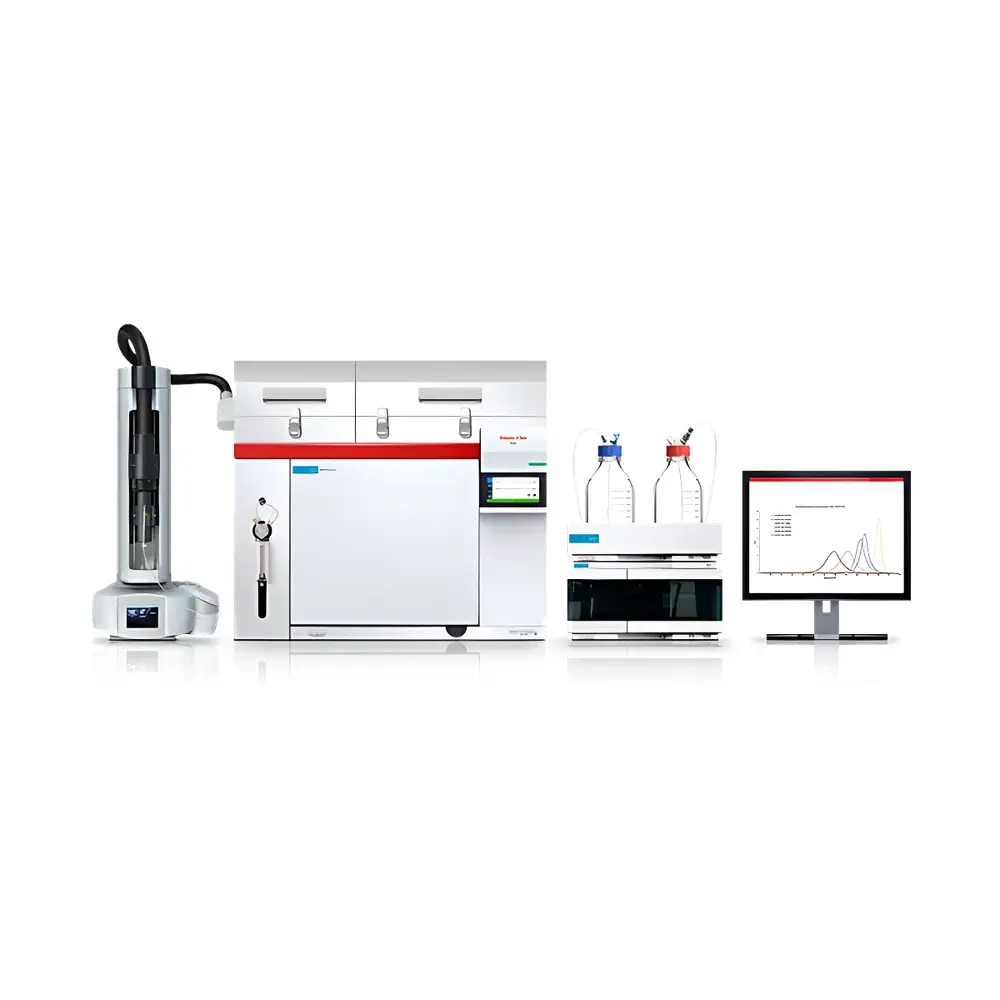
Polymer Char TGIC Temperature Gradient Interaction Chromatography Analyzer
| Brand | Polymer Char |
|---|---|
| Origin | Spain |
| Model | TGIC |
| Application Field | Polyolefin Characterization (Elastomers, Block Copolymers, Amorphous Fractions) |
| Operating Principle | Temperature-Programmed Adsorption/Desorption Chromatography in High-Temperature Solvent (e.g., 1,2,4-Trichlorobenzene) |
| Detection Options | IR4/IR5 FTIR Detectors, Viscometer, Multi-Angle Light Scattering (MALS), MCT-enhanced IR Sensitivity |
| Automation | Robotic Autosampler (42-position), Fully Integrated Solvent Delivery, Online Filtration, Remote Diagnostics |
| Software Platform | Cirrus GPC/SEC + TGIC Module (Compliant with 21 CFR Part 11 Audit Trail & User Access Control) |
| Regulatory Alignment | Designed for GLP/GMP environments |
| Sample Throughput | Up to 42 samples unattended with method-independent sequencing |
Overview
The Polymer Char TGIC Temperature Gradient Interaction Chromatography Analyzer is a high-temperature liquid chromatographic system engineered specifically for the multidimensional characterization of polyolefins—including ethylene-propylene elastomers (POE), block copolymers (e.g., iPP-b-PE), and low-crystallinity or amorphous fractions that remain unresolved by conventional crystallization-based techniques. Unlike TREF (Temperature Rising Elution Fractionation) or CEF (Crystallization Analysis Fractionation), TGIC operates on the principle of temperature-modulated adsorption–desorption interactions between polymer chains and a functionalized stationary phase in hot solvent (typically 1,2,4-trichlorobenzene at up to 160 °C). As the column temperature is linearly increased under controlled solvent flow, differences in chain polarity, branching density, comonomer distribution, and local crystallizability drive differential retention—enabling separation not by melting point alone, but by chemical heterogeneity across the molecular architecture. This makes TGIC uniquely suited for resolving chemically distinct domains within complex architectures where crystallinity gradients are insufficient for discrimination.
Key Features
- Fully automated 42-position robotic autosampler with independent method assignment per vial—enabling unattended batch analysis of heterogeneous sample sets.
- Integrated solvent delivery, high-temperature dissolution (up to 160 °C), and inline membrane filtration (0.2 µm PTFE) eliminate manual handling of hazardous solvents, ensuring full compliance with HSE and laboratory safety protocols.
- Modular detector configuration: Standard IR4 or high-sensitivity IR5 MCT FTIR detector for CH3/1000C quantification; optional triple-detection setup combining IR, differential viscometry, and multi-angle light scattering (MALS) for simultaneous chemical composition distribution (CCD) and molar mass–composition correlation.
- Unified software platform (Cirrus GPC/SEC + TGIC module) supports method sharing and data co-processing between TGIC and CEF modes on the same hardware—reducing capital cost and operational redundancy.
- Remote instrument monitoring, real-time diagnostic logging, and predictive maintenance alerts via secure HTTPS interface—compatible with enterprise LIMS integration and centralized lab management systems.
- Validated repeatability: Relative standard deviation (RSD) < 1.2% for peak retention time and < 2.0% for comonomer content across replicate injections under GLP-controlled conditions.
Sample Compatibility & Compliance
TGIC accepts standard polyolefin samples dissolved in 1,2,4-trichlorobenzene (TCB) at concentrations of 0.5–2.0 mg/mL. It accommodates homopolymers (e.g., PP, HDPE), random and block copolymers (e.g., ethylene–octene, propylene–ethylene), thermoplastic elastomers (TPEs), and reactor-grade blends containing both crystalline and amorphous phases. The system meets design requirements for ISO/IEC 17025-accredited laboratories and supports audit-ready documentation including electronic signatures, change control logs, and 21 CFR Part 11–compliant audit trails. All thermal, flow, and detection parameters are traceable to NIST-calibrated references and validated per ASTM D6474 Annex A4 (TGIC-specific verification procedures).
Software & Data Management
Data acquisition and processing are performed using Cirrus GPC/SEC software with dedicated TGIC extension modules. The interface provides intuitive workflow builders for temperature ramp definition, baseline correction, peak deconvolution, and CCD derivation. Quantitative outputs include compositional gradient curves (wt% comonomer vs. elution temperature), branching frequency profiles (CH3/1000C), and—when coupled with viscometry/MALS—branching density maps aligned to molar mass. Raw data files (.cir) are stored in vendor-neutral HDF5 format with embedded metadata (instrument ID, operator, timestamp, calibration certificate hash). Export options include CSV, PDF reports, and XML for LIMS ingestion. Software validation packages (IQ/OQ/PQ) and electronic record retention policies are available for regulated environments.
Applications
- Discrimination of ethylene–octene copolymer fractions by comonomer content—demonstrating inverse correlation between elution temperature and octene incorporation (e.g., 32 mol% octene retained at 40 °C).
- Quantification of blocky vs. random microstructure in iPP–PE multiblock systems, where higher PE block content increases adsorption strength and shifts elution to elevated temperatures.
- Resolution of amorphous POE phases coexisting with crystalline PP in industrial blends—providing CCD and branching metrics inaccessible to TREF due to lack of thermal fractionation contrast.
- Supporting catalyst development by correlating metallocene or post-metallocene catalyst architecture with in-reactor compositional heterogeneity.
- Quality control of reactor-grade polyolefins where batch-to-batch consistency of comonomer distribution directly impacts mechanical performance.
FAQ
What distinguishes TGIC from TREF and CEF?
TGIC separates based on temperature-dependent adsorption affinity—not crystallinity-driven elution. This enables resolution of non-crystalline or low-Tm fractions that elute cohesively in TREF/CEF.
Can TGIC quantify branching distribution independently of molar mass?
Yes—when used with IR detection alone, TGIC delivers chemical composition distribution (CCD); when combined with viscometry and MALS, it decouples compositional heterogeneity from conformational effects.
Is method transfer possible between different TGIC instruments?
Method portability is ensured through standardized column chemistries, thermal programming algorithms, and Cirrus software version control—validated per ASTM D6474 Section 8.
Does TGIC require specialized training for routine operation?
The intuitive graphical workflow editor and context-sensitive help system enable new users to perform validated analyses within one day of installation; advanced data interpretation training is recommended for R&D applications.
How is system suitability verified prior to sample analysis?
Each run includes an integrated reference standard (e.g., certified ethylene–propylene copolymer) to verify retention time stability, IR response linearity, and temperature ramp accuracy—logged automatically in the audit trail.





