
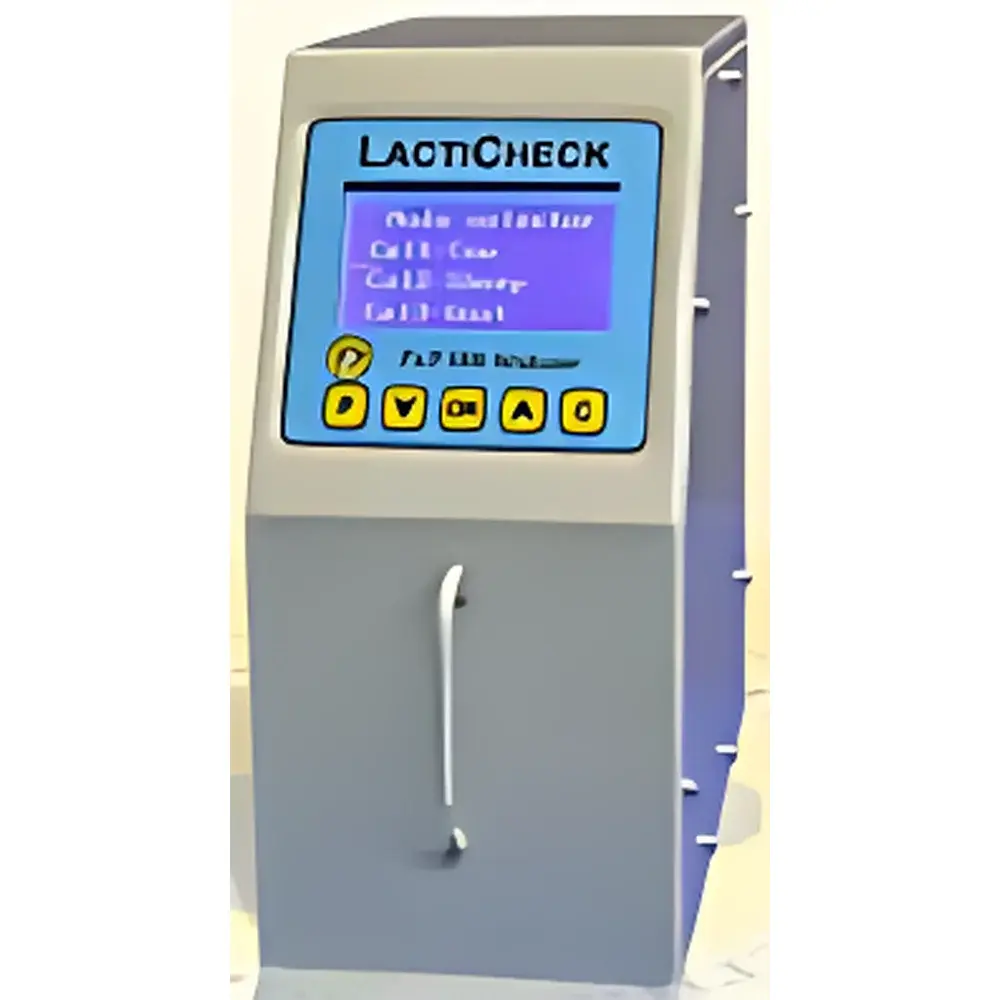
PP LactiCheck Mini Dairy Analyzer
| Brand | PP |
|---|---|
| Origin | USA |
| Manufacturer Type | Authorized Distributor |
| Origin Category | Imported |
| Model | LactiCheck Mini |
| Detection Parameters | Fat, SNF, Protein, Lactose, Density, Water Admixture, pH (optional) |
| Automation Level | Fully Automatic |
| Analysis Time | 60 s per sample |
| Channel Configuration | 3 independent flow-through channels (raw cow milk, goat milk, sheep milk) |
| Repeatability | ≤ ±0.1% for fat & protein |
| Accuracy | ±0.1% (fat), ±0.15% (protein, SNF), ±0.0005 g/cm³ (density), ±0.5% (lactose), ±3% (water admixture) |
| Sample Volume | <15 mL |
| Operating Temperature Range (sample) | 15–30 °C |
| Ambient Operating Conditions | 7–40 °C, 30–80% RH |
| Power Supply | 110/220 VAC (±10%/−15%), 50/60 Hz or 12 VDC (optional) |
| Max Power Consumption | 30 W |
| Dimensions (H×W×D) | 11 × 24 × 26 cm |
| Net Weight | 3.0 kg |
Overview
The PP LactiCheck Mini Dairy Analyzer is a compact, benchtop near-infrared (NIR) and ultrasonic-based instrument engineered for rapid, non-destructive compositional analysis of raw and specialty milks—including bovine, caprine, and ovine—within 60 seconds per sample. Designed for on-farm, dairy co-op, and quality control laboratory environments, the system employs dual-technology measurement principles: broadband NIR spectroscopy for organic component quantification (fat, protein, lactose, SNF), and high-frequency ultrasonic velocity/density correlation for precise density and water admixture determination. Its flow-through cell architecture ensures consistent optical pathlength and minimizes matrix interference, while built-in thermal stabilization maintains measurement integrity across ambient temperature fluctuations (7–40 °C) and sample temperature ranges (15–30 °C). The analyzer meets foundational metrological requirements for routine dairy testing and supports traceable calibration via certified reference standards aligned with ISO 9622:2013 (IDF 141:2013) for milk analysis instrumentation.
Key Features
- Fully automated, walk-away operation with three dedicated, self-flushing flow channels—individually optimized for raw cow milk, goat milk, and sheep milk—eliminating cross-contamination and manual reconfiguration.
- Integrated acoustic and visual alarm system triggers real-time alerts for maintenance events including channel cleaning, calibration drift, and temperature excursions outside operational limits.
- Robust, chemically resistant fluidic path constructed from food-grade stainless steel and PTFE-lined tubing, compliant with FDA 21 CFR §177.2600 for indirect food contact surfaces.
- Onboard thermal equilibration module ensures sample temperature stabilization to ±0.3 °C prior to measurement—critical for reproducible density and NIR spectral response.
- Low sample consumption (<15 mL per analysis) reduces waste and enables high-throughput screening without compromising analytical fidelity.
- Modular design supports optional pH probe integration (0–14 pH range, ±0.1 pH accuracy) for concurrent acidity assessment, enhancing compliance with Codex Alimentarius Standard CXS 206–1999 for raw milk quality.
Sample Compatibility & Compliance
The LactiCheck Mini accepts unfiltered, refrigerated, or ambient-temperature raw milk samples directly from bulk tanks or individual animal sources. It accommodates natural variations in viscosity, somatic cell content (<1,000,000 cells/mL), and microbial load typical of Grade A and artisanal dairy streams. All reported performance specifications—including repeatability (≤±0.1% RSD for fat/protein) and accuracy tolerances—are validated per ASTM D6584-22 (Standard Test Method for Determination of Milk Components by Mid-Infrared Spectroscopy) and referenced against NIST-traceable milk standard reference materials (SRMs 1549a, 1846). Instrument firmware and data handling protocols support audit-ready operation under GLP and GMP frameworks, with timestamped metadata capture for each analysis cycle.
Software & Data Management
The embedded LactiSoft™ v3.2 firmware provides intuitive touchscreen navigation, multilingual UI (English, Spanish, French, Arabic), and configurable reporting templates compliant with ISO/IEC 17025:2017 clause 7.8. Data export is supported via USB 2.0, Ethernet (TCP/IP), and optional Wi-Fi 802.11n—enabling seamless integration into LIMS platforms (e.g., LabWare, STARLIMS) through HL7 or ASTM E1384-compliant interfaces. All raw spectra, calibration logs, and QC checks are stored locally with SHA-256 hashing; optional cloud backup adheres to GDPR and HIPAA-compliant encryption standards. Audit trail functionality records user actions, parameter changes, and calibration events with immutable timestamps—satisfying FDA 21 CFR Part 11 electronic record/electronic signature requirements when paired with role-based access controls.
Applications
- Real-time payment grading at dairy collection centers based on fat, protein, and SNF content per contractual benchmarks (e.g., USDA FMMO Class III pricing).
- Pre-pasteurization quality verification to detect adulteration (e.g., water dilution, reconstituted powder addition) using multi-parameter deviation profiling.
- Genetic selection support in small-ruminant operations via longitudinal lactation profile tracking (goat/sheep milk composition trends across parity).
- Regulatory compliance testing for national milk safety programs requiring density, pH, and compositional conformity per national standards (e.g., China GB 19301-2010, EU Regulation (EC) No 853/2004).
- Research applications in dairy science laboratories studying thermal stability, enzymatic hydrolysis kinetics, or starter culture performance—leveraging rapid baseline characterization.
FAQ
What calibration standards are required for daily operation?
Certified liquid reference standards (fat, protein, lactose, density) traceable to NIST SRM 1549a must be run at startup and after every 25 samples—or whenever ambient temperature shifts >5 °C—to maintain ISO 9622-compliant accuracy.
Can the instrument differentiate between species-specific milk adulterants?
Yes—the tri-channel spectral library includes discriminant algorithms trained on >12,000 spectra from authenticated bovine, caprine, and ovine samples, enabling detection of species substitution at ≥5% w/w concentration.
Is remote diagnostics and software update capability available?
Yes—via secure HTTPS-based firmware update portal and integrated remote desktop (TeamViewer QuickSupport) accessible only with dual-factor authentication and administrator credentials.
Does the system meet regulatory requirements for export documentation?
The LactiCheck Mini carries CE marking (2014/30/EU EMC Directive, 2014/35/EU LVD), RoHS 2011/65/EU compliance certification, and FDA Establishment Registration (FEI #3015459233); full technical dossiers are provided upon order confirmation.
What is the recommended maintenance schedule?
Daily: Channel flush with deionized water and 0.1% sodium hypochlorite solution; weekly: O-ring inspection and ultrasonic cell cleaning; biannual: NIR source intensity verification and density transducer recalibration by authorized service technician.



