
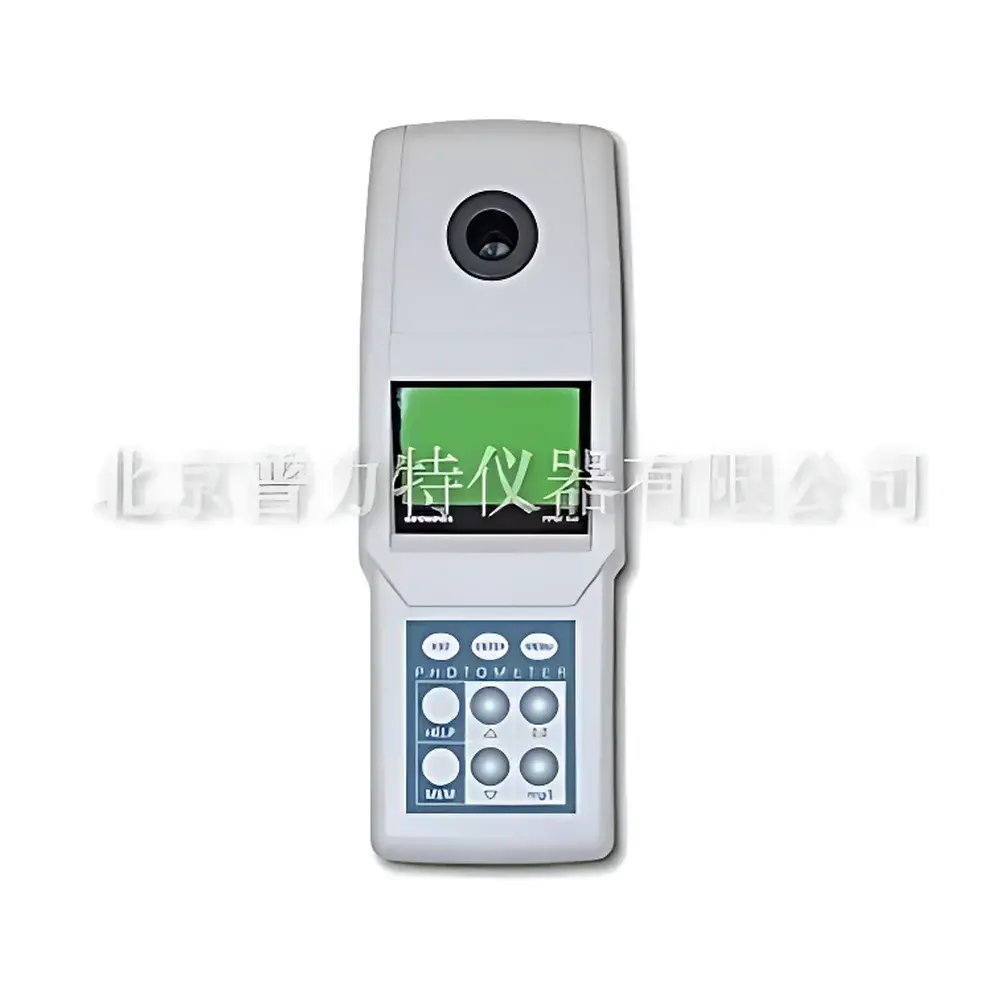
PPM150 Portable Multi-Parameter Spectrophotometer
| Origin | Germany |
|---|---|
| Manufacturer Type | Authorized Distributor |
| Origin Category | Imported |
| Model | PPM150 |
| Price Range | USD 2,700 – 6,800 |
| Light Sources | 9 high-stability LEDs |
| Wavelengths | 380, 430, 470, 500, 520, 560, 610, 700, 810 nm |
| Absorbance Range | −0.5 to 4.0 AU |
| Photometric Accuracy | ±1.5% of reading |
| Absorbance Precision | ±0.03 AU |
| Wavelength Accuracy | ±2 nm |
| Sample Cell | 16 mm round cuvette with light-blocking cap |
| Display | 128 × 64 pixel backlit monochrome LCD (60 × 40 mm) |
| Data Storage | 1,000 measurement records (date/time/wavelength/reagent/method/result/test ID) |
| Calibration Curves | Up to 150 preloaded or user-defined methods |
| Communication | IrDA infrared interface |
| Power Supply | 4 × AA rechargeable or alkaline batteries |
Overview
The PPM150 Portable Multi-Parameter Spectrophotometer is a field-deployable, LED-based absorption photometer engineered for quantitative colorimetric analysis of water quality parameters in compliance with standardized wet-chemistry protocols. Operating on the Beer–Lambert principle, it measures analyte-specific absorbance changes across nine discrete wavelengths (380–810 nm), enabling trace-level detection of inorganic ions, oxidants, nutrients, and organic contaminants without requiring optical gratings or moving parts. Designed for environmental monitoring, wastewater treatment, drinking water safety verification, and industrial process control, the instrument delivers laboratory-grade repeatability in ruggedized handheld form—fully compliant with ISO 7027 for turbidity-related measurements and aligned with ASTM D1253, EPA 365.3, and ISO 6777 methodologies where applicable. Its fixed-wavelength architecture eliminates spectral drift, while integrated temperature compensation ensures stability across ambient conditions ranging from 5 °C to 40 °C.
Key Features
- Fixed-wavelength photometry using nine calibrated, narrow-band LEDs (380, 430, 470, 500, 520, 560, 610, 700, 810 nm) with matched interference filters for minimal cross-talk and long-term spectral fidelity
- High-precision absorbance measurement range of −0.5 to 4.0 AU, supporting both low-concentration trace metal analysis (e.g., Cd: 0.01–2.0 mg/L) and high-range anion quantification (e.g., SO₄²⁻: 50–400 mg/L)
- Pre-programmed support for over 150 standardized test methods—including DIN, ISO, APHA, and EPA-compliant procedures—for reagents from multiple global manufacturers (Hach, Merck, Palintest, etc.)
- 16 mm round cuvette chamber with integrated light-blocking cap to eliminate ambient interference during kinetic or endpoint measurements
- On-device data management: 1,000 measurement records stored with full metadata (timestamp, wavelength, reagent lot, method ID, result, operator code)
- IrDA infrared communication enabling secure, line-of-sight data transfer to Windows-based PCs without Bluetooth pairing or driver installation
- Dual-language interface (English/German) with intuitive icon-driven navigation and context-sensitive help prompts accessible directly from measurement screens
Sample Compatibility & Compliance
The PPM150 accepts standard 16 mm round glass or plastic cuvettes conforming to ISO 10697 and DIN EN ISO 3696 Class 3 water specifications. It supports all common colorimetric reagent formats—including powder pillows, liquid concentrates, and tablet-based kits—provided they generate stable chromophores within the instrument’s defined wavelength bands. Method validation adheres to ISO/IEC 17025 principles: each preloaded calibration curve includes documented linearity (R² ≥ 0.995), limit of detection (LOD), limit of quantitation (LOQ), and inter-laboratory reproducibility data derived from certified reference materials (CRMs). The device meets IEC 61010-1 safety requirements for portable electrical equipment and carries CE marking under the EU Electromagnetic Compatibility Directive 2014/30/EU.
Software & Data Management
A dedicated PC application (Windows 10/11 compatible) enables full configuration, calibration curve import/export, batch report generation (PDF/CSV), and audit-trail-enabled data archiving. Software logs all user actions—including method edits, calibration updates, and data deletions—with timestamped entries meeting FDA 21 CFR Part 11 requirements when configured with electronic signature authentication. Exported datasets include embedded metadata fields required for GLP/GMP documentation: analyst ID, instrument serial number, calibration due date, and reagent expiration tracking. Raw absorbance values and processed concentrations are stored separately to support retrospective reprocessing if updated calibration models become available.
Applications
- Field verification of disinfectant residuals (free chlorine, total chlorine, chloramines, ozone, chlorine dioxide) per WHO Guidelines for Drinking-water Quality
- Monitoring nutrient loading in surface waters: NO₃⁻-N, NO₂⁻-N, NH₄⁺-N, PO₄³⁻, SiO₂, SO₄²⁻
- Heavy metal screening in industrial effluents and leachates (Cd, Cr⁶⁺, Cu, Ni, Pb, Zn, Ag, Mn) following ISO 11969 and EPA Method 200.7 protocols
- Process control in membrane filtration plants (e.g., Fe²⁺/Fe³⁺ ratio determination for coagulant dosing optimization)
- Emergency response testing for cyanide, phenol, and hydrazine in chemical spill scenarios per ASTM D4374
- Swimming pool and spa water management per EN 15288-1 and CDC Model Aquatic Health Code
FAQ
Does the PPM150 require annual recalibration by the manufacturer?
No—field recalibration is performed using NIST-traceable neutral density filters or certified liquid standards; factory recalibration is recommended only after physical impact or exposure to extreme thermal cycling (>50 °C).
Can custom calibration curves be uploaded via infrared?
Yes—user-defined curves (up to 150 total) may be imported via the PC software and transferred wirelessly using IrDA; all curves retain slope, intercept, wavelength assignment, and concentration unit definitions.
Is the instrument suitable for saline or high-turbidity samples?
It supports turbidity compensation up to 100 NTU using dual-wavelength correction (e.g., 700 nm reference channel); for salinities >10,000 µS/cm, use of matched blank matrices is required to minimize ionic strength effects on complexation kinetics.
What battery life can be expected during continuous operation?
With AA alkaline cells: ≥12 hours at 25 °C with backlight enabled; with NiMH rechargeables: ≥8 hours under identical conditions, with full charge achieved in <4 hours via optional desktop charger.
How are firmware updates delivered and installed?
Firmware releases are distributed as signed .bin files through the authorized distributor portal; installation requires connection to a Windows PC running the official configuration utility and takes <90 seconds with automatic rollback protection.





