
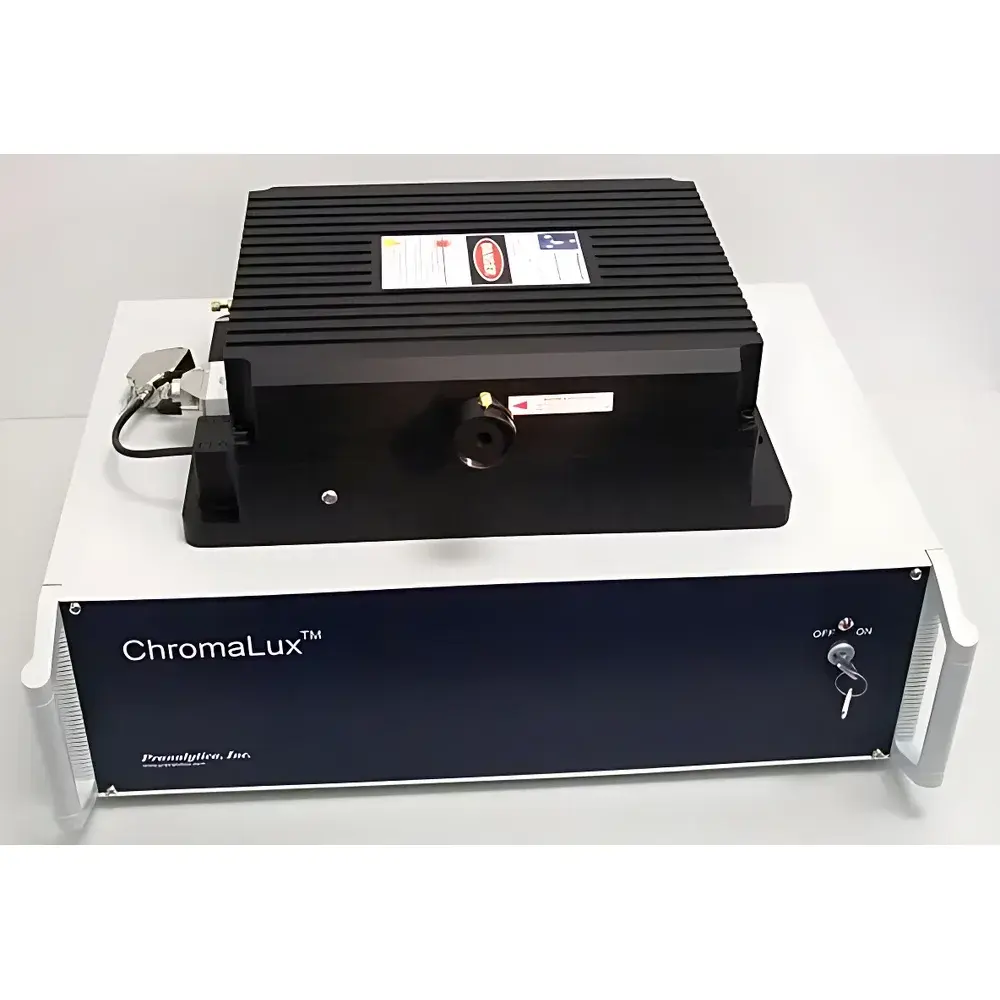
Pranalytica ChromaLux 1101-46-EGC High-Power Continuous-Wave External Grating Cavity Tunable Single-Frequency Quantum Cascade Laser System
| Brand | Pranalytica |
|---|---|
| Origin | USA |
| Model | ChromaLux 1101-46-EGC |
| Center Wavelength | ~4.6 µm |
| Coarse Tuning Range | ±150 nm around 4.6 µm |
| Fine Tuning Resolution | <40 MHz |
| Output Power | >200 mW across full tuning range |
| Linewidth (CW) | <40 MHz |
| Beam Quality | Near diffraction-limited |
| Operating Mode | True continuous-wave (CW) with +5 V DC bias |
| Laser Head Dimensions | 25 × 17 × 35 cm (W×H×D) |
| Weight | 10 kg |
| Controller Dimensions | 28 × 18 × 37 cm (W×H×D) |
| Weight | 10 kg |
| Input Power | 110/220 V AC, 4 A max |
Overview
The Pranalytica ChromaLux 1101-46-EGC is a high-performance, continuous-wave (CW), external grating cavity (EGC)-based tunable quantum cascade laser (QCL) system engineered for precision mid-infrared spectroscopy and trace gas sensing applications. Unlike conventional interband semiconductor lasers, QCLs operate on intersubband transitions within the conduction band of engineered semiconductor heterostructures—enabling wavelength emission in the 3.8–12+ µm spectral region, which overlaps with strong fundamental vibrational absorption bands of numerous molecules. The ChromaLux 1101-46-EGC employs a monolithic, thermoelectrically cooled laser chip integrated with collimating optics inside the laser head, delivering single-frequency, narrow-linewidth (<40 MHz) output under true CW operation. Its external Littrow-configured diffraction grating provides robust coarse wavelength selection (±150 nm around 4.6 µm), while active piezoelectric or thermal feedback enables sub-MHz fine frequency stabilization—critical for high-resolution absorption spectroscopy, photoacoustic detection, and cavity-enhanced measurement schemes.
Key Features
- True CW operation with stable single-frequency output and linewidth <40 MHz
- High optical power: >200 mW across entire tuning range; >300 mW at 4.6 µm center wavelength
- External grating cavity architecture enabling broad, reproducible coarse tuning (±150 nm)
- Integrated thermoelectric cooler (TEC) and collimation optics within compact laser head (25 × 17 × 35 cm)
- Front-panel and USB-controlled wavelength selection with TTL-compatible modulation input (1 kHz–100 kHz standard; up to 1 GHz with optional RF driver)
- Factory-calibrated current and temperature control ensuring optimal gain alignment and long-term wavelength stability
- Rugged mechanical design exceeding MIL-STD-810G environmental specifications for vibration, shock, and thermal cycling
- OEM-ready architecture supporting integration into turnkey gas analyzers, industrial process monitors, and defense-grade IRCM subsystems
Sample Compatibility & Compliance
The ChromaLux 1101-46-EGC is compatible with standard mid-IR optical components including ZnSe lenses, KRS-5 windows, multi-pass gas cells (e.g., White or Herriott configurations), and photoacoustic resonators. Its spectral coverage (centered at 4.6 µm, tunable across key CO, NO, N₂O, CH₄, and HF absorption lines) supports quantitative analysis per ASTM E2910–22 (Standard Practice for Calibration of Tunable Diode Laser Absorption Spectroscopy Systems) and ISO 14687–2 (Hydrogen fuel purity—Part 2: Analytical methods). The system’s embedded firmware supports audit-trail logging and user-accessible calibration parameters, facilitating compliance with GLP and GMP documentation requirements. While not inherently FDA 21 CFR Part 11–compliant, the USB interface and deterministic control protocol enable integration with validated software platforms meeting regulatory data integrity standards.
Software & Data Management
The ChromaLux controller includes proprietary embedded firmware for real-time wavelength lock, TEC setpoint optimization, and interlock monitoring. A Windows-compatible SDK (C/C++, Python, LabVIEW) provides low-level access to laser current, grating angle, TEC voltage, and photodiode feedback signals. All operational states—including startup sequence, fault logs, and modulation envelope settings—are timestamped and exportable as CSV. For automated deployment, the system supports SCPI-like command syntax over USB virtual COM port, enabling seamless integration into LabVIEW-based DAQ systems or Python-driven spectroscopic workflows. No cloud connectivity or proprietary runtime dependencies are required—ensuring deterministic timing for time-resolved measurements such as frequency-modulated spectroscopy (FMS) or wavelength-scanned direct absorption.
Applications
- Defense & Security: Infrared countermeasure (IRCM) source calibration, standoff explosive vapor detection (e.g., TNT, RDX), toxic industrial chemical (TIC) identification in battlefield environments, and container screening via backscattered mid-IR signatures
- Medical Diagnostics: Non-invasive breath analysis for ammonia (renal/liver function), nitric oxide (asthma inflammation), acetone (diabetic ketosis), and isoflurane/sevoflurane (anesthetic gas monitoring)
- Environmental Monitoring: Real-time stack emissions monitoring (NOx, SO2, CO), urban air quality networks, agricultural methane flux quantification, and marine vessel exhaust characterization
- Industrial Process Control: In-situ natural gas composition analysis (CH4/C2H6 ratio), semiconductor fab cleanroom impurity tracking (HF, HCl, NH3), and pharmaceutical lyophilization endpoint detection
- Research Instrumentation: Pump source for difference-frequency generation (DFG) in THz systems, local oscillator in heterodyne receivers, and excitation source for mid-IR pump-probe spectroscopy
FAQ
What is the maximum modulation bandwidth supported by the standard power supply?
The standard controller supports TTL-compatible analog modulation from 1 kHz to 100 kHz. For higher-speed applications (up to 1 GHz), a custom RF current driver and impedance-matched cabling must be specified at order.
Is the laser head hermetically sealed?
Yes—the laser chip and collimation assembly are housed in a nitrogen-purged, epoxy-sealed metal package rated IP54 for dust and moisture resistance.
Can the system operate unattended for extended periods?
Yes. The controller features automatic thermal recovery after power interruption, redundant overcurrent/overtemperature protection, and a 5-second soft-start sequence to prevent current overshoot during cold start.
Does the system include wavelength calibration traceability?
Each unit ships with a factory-measured wavelength vs. grating angle lookup table referenced to a NIST-traceable HCN absorption line near 4.6 µm. Users may perform in-field recalibration using a stabilized reference gas cell.
What cooling infrastructure is required?
No external chiller is needed. The integrated TEC achieves stable operation at ambient temperatures up to 35°C. For sustained maximum-power operation above 30°C ambient, forced-air convection (≥10 CFM) is recommended.






